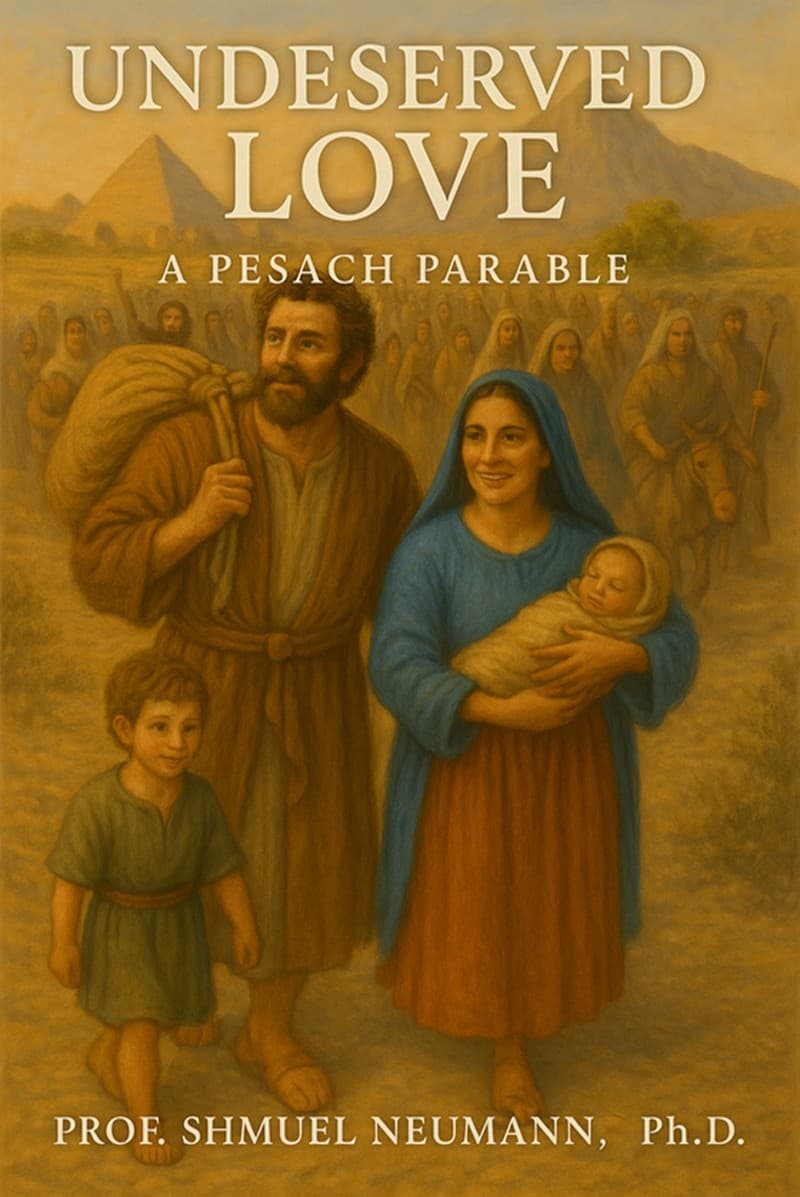
Undeserved Love
ביקורות
“This book strips love of its performance requirements. For anyone learning how to love again after disappointment, disillusionment—or childhood.”
סרטון הסבר
פודקאסט שמע
על הספר
Beyond perfection. Beyond expectations. This book strips love of its performance requirements. For anyone learning how to love again after disappointment, disillusionment—or childhood.
On the first night of Pesach, as Jewish families worldwide gather around their Seder tables, we tell a love story. Though we rarely frame it this way, the Pesach narrative recounts the most consequential courtship in human history—the moment when Hashem chose Israel as His bride. Like all profound love stories, it centers not on worthiness but on choice. Am Yisrael, mired in the 49th level of tumah, resembled not a radiant bride but an abandoned infant “wallowing in blood” (Yechezkel 16:6). Yet it was precisely in this state of utter unworthiness that Hashem declared “Through your blood, live!”—initiating a relationship that would transcend all human expectation.
My fascination with this divine paradigm of undeserved love began not in the beis midrash but in my own home. After fifteen years of marriage—years that included both profound connection and painful struggle—I found myself at a crossroads. The gap between my idealized expectations and the complex reality of married life had created a subtle but persistent disappointment. I loved my wife, but often with a love contingent on her meeting certain standards, fulfilling particular roles, satisfying specific needs. When, in my mind, she fell short—as all humans inevitably do—my love constricted accordingly.
During a particularly difficult season in our marriage, I sought guidance from my rebbe, hoping for practical advice to improve our relationship. Instead of techniques or strategies, he offered a single, transformative question: “What if you saw your wife through Hashem’s eyes rather than your own?” This question haunted me for weeks. How does Hashem see us? Not as we appear in our moments of failure or limitation, but as we exist in our essence—created in His image, containing infinite potential, worthy of love not because of what we do but because of who we are at our core.
This realization began a personal journey to understand the Torah’s vision for marriage—not as a contractual arrangement based on mutual performance but as a relationship mirroring Hashem’s relationship with Klal Yisrael. I immersed myself in sources that illuminated this parallel, from the explicit allegory of Shir HaShirim to the mystical teachings about zivug ha’elyon (the supernal union). What emerged was a radically different paradigm for marriage than the one dominating contemporary culture.
At the center of this paradigm stands undeserved love—ahavah she’einah teluyah badavar, love not dependent on any external factor. The Mishnah in Pirkei Avos contrasts this unconditional love with its more common counterpart: “Any love dependent on something—when that thing ceases, the love ceases. But love not dependent on anything will never cease” (5:16). While modern relationships often function as ongoing transactions—exchanges of affection, services, validation, and support—Torah-true marriage calls us to a love that transcends the balance sheet of deservedness.
The title “Undeserved Love” may initially sound strange to Jewish ears, perhaps even suggesting a love that lacks foundation or obligation. But as we shall see, the highest form of love in Torah thought is precisely that which transcends deservedness—flowing not because the beloved has earned it but because the lover has chosen to give it regardless of performance. This love forms the backbone of our relationship with Hashem and provides the template for the most elevated expression of marriage.
As we embark on this exploration together, I invite you to approach these ideas not just intellectually but experientially. The concepts presented here aren’t meant merely to inform but to transform—to reshape how you see your spouse and your shared life. Consider reading sections with your significant other, discussing how these principles might apply to your unique relationship. Or use these chapters as a springboard for personal reflection, examining where your own marriage might benefit from greater implementation of undeserved love.
May Hashem grant us all the wisdom to see our spouses through His loving eyes, the strength to love beyond deservedness, and the merit to create homes where the Shechinah dwells comfortably between husband and wife, transforming ordinary marriage into a reflection of the ultimate divine-human relationship.
What if the most powerful kind of love is the one we least understand?
In Unconditional Love, Prof. Shmuel Neumann explores the staggering idea that love need not be deserved. Through a blend of Torah insight, deep psychological truths, and the allegory of Pesach and Shir HaShirim, this book redefines how we think about marriage, self-worth, and Divine connection.
Hashem didn’t redeem us because we were righteous—we were wallowing in spiritual darkness. And still, He chose us. That is the model. This book walks readers through the emotional, halachic, and spiritual dimensions of ahavah she’eina teluyah b’davar—love not contingent on conditions. From the Exodus to your own kitchen table, the message is clear: true love doesn’t wait for perfection. It creates space for redemption.
This book explores how this divine model applies to human marriage. Each chapter examines an aspect of Hashem’s undeserved love for Am Yisrael despite our spiritual state to His ongoing faithfulness through our desert wanderings and beyond—and extracts practical wisdom for husbands and wives seeking to emulate this pattern. Drawing on sources from Tanach, Chazal, Rishonim, Acharonim, Chassidus, and Mussar, we’ll build a comprehensive vision of marriage founded not on mutual worthiness but on mutual commitment to seeing the divine image in each other.
The journey ahead may challenge conventional thinking about marriage. Our culture surrounds us with messages suggesting that love should flow in proportion to merit—that “partners” must continually earn each other’s affection through performance, appearance, or contribution. The Torah offers a radical alternative: love as an expression of the lover’s essence rather than the beloved’s deservedness. This shift from transactional to covenantal thinking transforms not just how we interact with our spouse but how we understand the very purpose of marriage.
My hope is that this exploration will benefit readers at every stage of the marital journey—from chatanim and kallos preparing to build their first bayis ne’eman b’Yisrael, to couples decades into their shared life seeking renewed vision for their relationship. While I draw primarily from my experience as a husband, the principles apply equally to both spouses, though they may manifest differently according to the distinct masculine and feminine approaches to relationship detailed in our tradition.