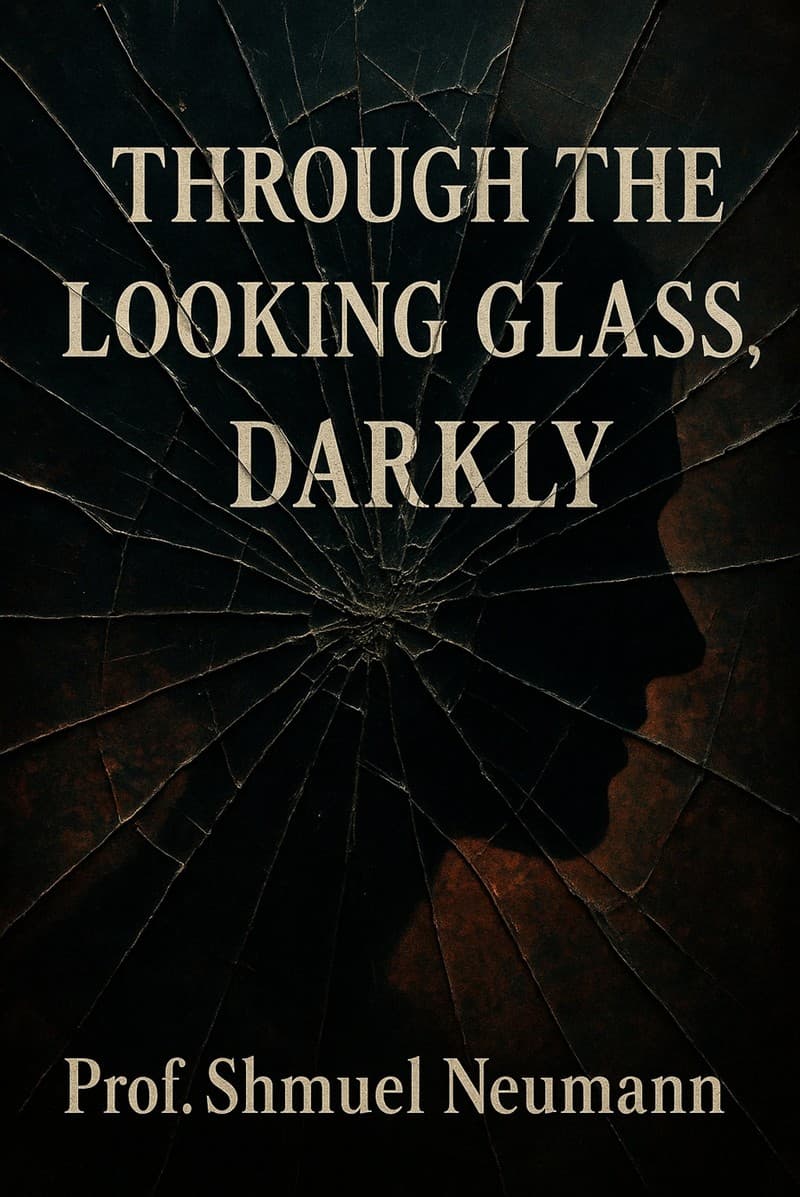
Through the Looking Glass, Darkly
ביקורות
“A powerful sequel to The Mirror's Lie, this book reveals how distorted self-perception doesn't just hurt you—it warps every relationship you touch. This is the emotional and spiritual work of learning to be seen. For those who hide behind performance and wonder why no one knows them.”
סרטון הסבר
פודקאסט שמע
על הספר
Until you see yourself clearly, you’ll keep loving like you’re invisible. A powerful sequel to The Mirror’s Lie, this book reveals how distorted self-perception doesn’t just hurt you—it warps every relationship you touch. This is the emotional and spiritual work of learning to be seen.
For those who hide behind performance and wonder why no one knows them.
We begin not with love, but with its ghost.
Before connection, before intimacy, even before longing—there is perception. And perception is not a neutral lens. It is a trick mirror, polished by memory, smudged by fear, warped by need. Most of us never meet each other. We meet the silhouettes we’ve cast in advance. We meet reflections of past pain disguised as present affection. We fall for a gaze, a gesture, a tone that echoes something familiar. But beneath that—what have we truly seen?
This book is not a manual. It is not a guide for better communication or longer-lasting romance. It is an exploration of the distortion that precedes every connection—and often outlasts it. It is a study of how we look at others and how they look back at us—and what happens when those gazes begin to fracture. If you are looking for comfort, turn back now. This is a book that shatters illusions carefully kept. It dissects the internal mirrors we call love, trust, self, and truth.
We want to be loved, but we do not want to be seen. We want to be understood, but only in the language we’ve written for others to read. What if our most intimate relationships are the most elaborate forms of self-deception? What if the love we seek is just a better version of our own reflection?
The stories in this book—clinical, philosophical, emotional, even autobiographical—are not stories of answers. They are stories of mirrors. Some are translucent, some opaque, and some so brutally clear they reveal what we had no intention of facing.
The mirror, in the end, does not lie. But it does not always show us what we want to see. It shows us where we are fragmented. Where we’ve substituted performance for presence. Where we’ve clung to someone not because we knew them, but because they temporarily concealed how little we knew ourselves.
So read this slowly. Read this if you’ve ever been in love and still felt alone. Read this if you’ve ever looked at someone and wondered whether they saw the real you—or just the version they hoped you would be. Read this if you’re tired of mirrors. But know this: you will not leave unmarked.
Because once you’ve seen the glass for what it is, you can never unsee it.
And that—though it may not feel like it at first—is the beginning of seeing clearly.
We don’t fall in love with people. We fall in love with reflections—of memory, desire, and hope.
Through the Looking Glass, Darkly is a searing psychological and spiritual exploration of perception, illusion, and relational projection. With piercing clarity and Torah-rooted insight, Prof. Shmuel Neumann exposes how even our most intimate relationships are shaped by distorted mirrors—what we think we see in the other, and what they perform under our gaze.
This is not a book about dating. It is about the space between seeing and being seen. A haunting, breathtaking meditation on why love so often feels confusing, why clarity can be painful, and why the mirror never truly lies—it only shows what we weren’t ready to face.
Beyond the glass is not certainty, but possibility. Not completion, but continuation. Not arrival, but the beautiful, ongoing journey of two people who keep choosing each other—not once, in some moment of perfect clarity, but again and again, through the fog and the confusion, through the misunderstandings and the revelations, through all the imperfect seeings that make up a shared life.
This is the path beyond illusion. Not into some perfect reality where all is transparent, all is known, all is resolved. But into the acceptance that transparency will always be partial, knowing will always be incomplete, resolution will always be temporary. And that within these limitations—not despite them, but because of them—we find the most genuine form of human connection possible: two people facing each other with open eyes and open hearts, saying not “I see all of you,” but “I see you today, as best I can, and I will look again tomorrow.”
This is not the love of fairy tales. It is not the love of perfect mirrors or unbroken glass. It is the love of real human beings with real limitations doing their best to truly meet each other in the space between their separate perceptions.
For when we step beyond the glass—when we stop chasing reflections and start embracing the messy, magnificent reality of human connection in all its imperfection—we discover that what we have been seeking was never perfect vision.
Not to be perfectly seen or completely known.
But to be witnessed in our becoming.
Not by an ideal lover who never misunderstands.
But by another flawed, beautiful human being who keeps choosing to look.
Who keeps learning our language.
Who keeps making space for our unfolding.
Who walks beside us on the journey beyond the glass, into the open air of authentic love.
And in that presence, we find not what we thought we wanted, but what we have always deeply needed: the courage to be seen, the freedom to become, and the faith that this unfinished, imperfect exchange—this constellation of partial knowings, this mosaic of glimpses and glances—is not a lesser version of love.