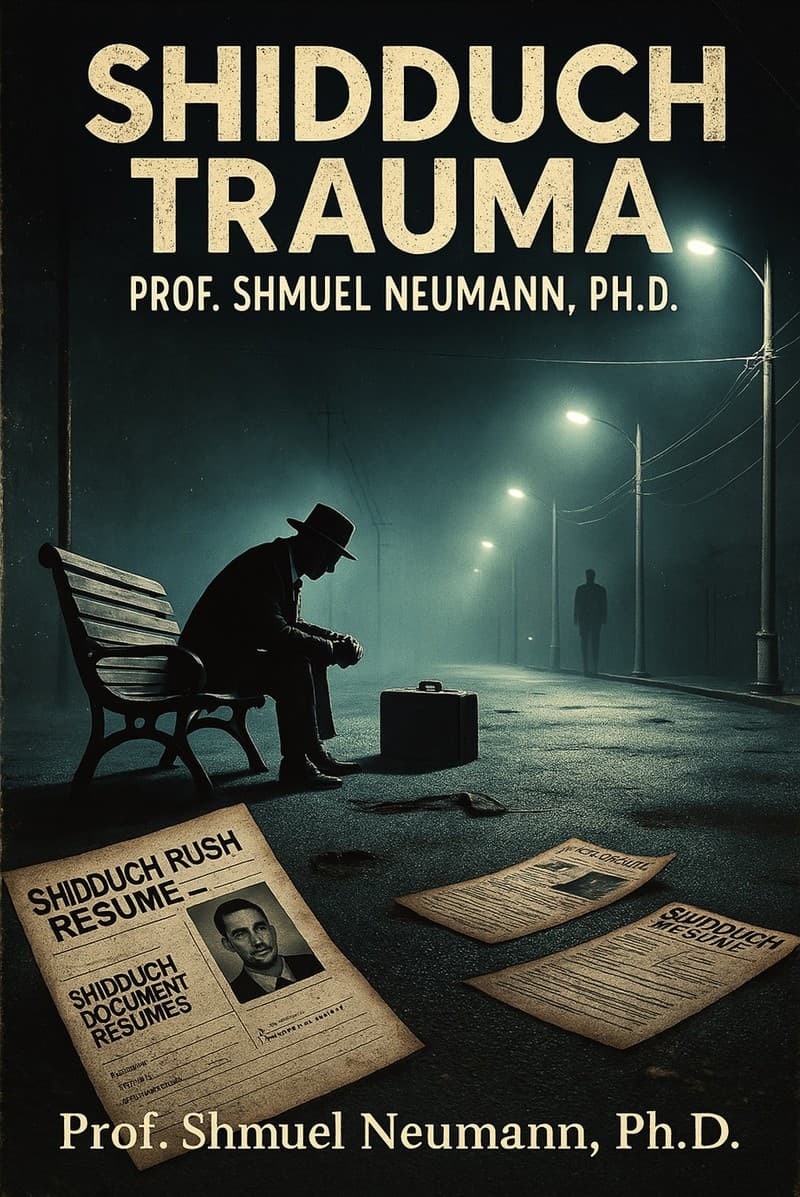
Shidduch Trauma
ביקורות
“The dating process doesn't just hurt—it dysregulates. This book names what others spiritualize or dismiss: that being constantly evaluated, ghosted, misread, or rejected wires the body for danger. It's the hidden toll of a system meant to bring love. For every single who thought they were the problem.”
סרטון הסבר
פודקאסט שמע
על הספר
It wasn’t a bad date. It was a nervous system collapse. The dating process doesn’t just hurt—it dysregulates. This book names what others spiritualize or dismiss: that being constantly evaluated, ghosted, misread, or rejected wires the body for danger. It’s the hidden toll of a system meant to bring love. For every single who thought they were the problem.
For many in the frum world, shidduch dating isn’t just stressful—it’s traumatizing.
No pain, no gain. It is a simple, almost cliché phrase, yet it captures a profound truth about the shidduch experience: the stresses and disappointments that often accompany Torah-observant dating are not without purpose or payoff. What might initially feel like an unrelenting uphill climb—weeks or months of searching for the right match, fielding unsolicited advice from neighbors or extended family, remaining vigilant about halachic boundaries—ultimately yields a deeper, more stable, and spiritually resonant marriage than anything proffered by Western secular values. In this chapter, we will explore precisely why the rigors of shidduch dating, though intense, pave the way for a far superior relationship. We will also shine a light on how this Torah-true union—rooted in mitzvot and time-honored communal norms—transcends what psychologists who champion purely secular outlooks typically present as the gold standard.
Many singles, especially in tight-knit religious communities, are all too familiar with the tangible stress of shidduchim: the constant phone calls from well-meaning relatives offering unsolicited suggestions, the wave of gossip following each date, the rollercoaster of anticipation and letdown when a prospective match fails to materialize. Add to this the halachic limitations—negiah, yichud, a careful code of modest speech and dress—and it can feel at times like dating is a full-time job. Emotions run high. A single might wonder whether all of it is worth the toll on their emotional and mental well-being, especially when the secular world seems to offer a more “freewheeling” approach: date whomever you please, move in together if you want, explore physical intimacy whenever it feels right. Psychologists operating in that secular arena may claim that less restriction and more self-expression lead to a healthier relationship. They define “healthy” by measures such as “personal fulfillment” and “emotional safety,” rarely acknowledging that a life shaped by mitzvot or communal ties can produce a type of relationship that surpasses what secular metrics can capture.
Ironically, those halachic constraints and communal norms often guide singles into marriages more robust and enduring than their secular counterparts. The “no pain” option—eschewing tradition, going with the flow, ignoring communal structure—may appear alluringly easy, but it does not necessarily yield real depth. Torah sets forth an entirely different path: it demands careful, methodical steps that do indeed cause friction, especially in a contemporary environment that worships instant gratification. But once a couple does reach the chuppah with these values intact, they enter a marriage bathed in a sense of sanctity and shared purpose. That sense of holiness is precisely what lifts their marriage above the typical secular union championed by therapists or relationship experts who do not factor in mitzvah observance at all.
In the secular model, a person might bounce from one relationship to another, guided largely by attraction, “vibes,” or ephemeral psychological compatibility. Professional counselors who subscribe to that system may urge individuals to “live together first” to test drive cohabitation, or to maintain open relationships if they feel they “aren’t quite sure yet.” Western society often treats marriage as a fluid arrangement that can be dissolved the moment it no longer serves one’s evolving personal needs. If conflicts arise, a psychologist might encourage exploring personal autonomy—sometimes fueling dissatisfaction with the partnership if it cramps one’s growth. By contrast, the Torah-true approach to marriage begins with the fundamental premise that God orchestrates matches, with each man and woman ultimately seeking to fulfill a divine plan in uniting together. Courtship is not a casual pastime but a search for the individual who will join you in building a Jewish home. Physical contact is deferred until after marriage, not because the Torah denies the importance of intimacy, but precisely because it cherishes intimacy enough to situate it within a sacred, committed bond.
Some might wonder: how does stress in the dating phase translate into a superior relationship later on? Does the heartbreak from rejections or the aggravation caused by communal expectations magically transform into marital bliss? The truth is that these struggles are akin to spiritual and emotional “training grounds,” forging the traits—patience, resilience, empathy—that become invaluable once the couple stands under the chuppah. A single who endures repeated disappointment and still chooses to retain hope, to engage in self-reflection rather than resentment, develops an inner fortitude that a purely secular approach rarely demands. The community, for all its meddlesome tendencies, can still provide a support structure anchored in shared values. The single learns to navigate constructive boundaries with parents, neighbors, and prospective matches while remaining faithful to mitzvot like kibbud av va’em, tzniut, and guarding one’s speech from lashon hara. These qualities—respect, self-control, commitment to higher principles—become the bedrock of a marriage that is not easily shattered by the inevitable challenges life will bring after the wedding.
In Shidduch Trauma, Prof. Shmuel Neumann gives voice to the emotional toll so many suffer in silence. With piercing psychological insight and Torah-aligned compassion, this book explores what happens when a sacred process becomes a source of shame, fear, anxiety, and identity loss.
Drawing from dozens of stories, clinical patterns, and communal realities, Neumann maps the emotional terrain of the dating system: the pressure to perform, the fear of rejection, the erosion of self-worth, and the burnout that steals hope. Most importantly, this book helps you reclaim agency, sanity, and self-compassion while navigating one of the most emotionally charged experiences in Jewish life.
This is not a critique of shidduchim. It is a healing guide for those still inside it.