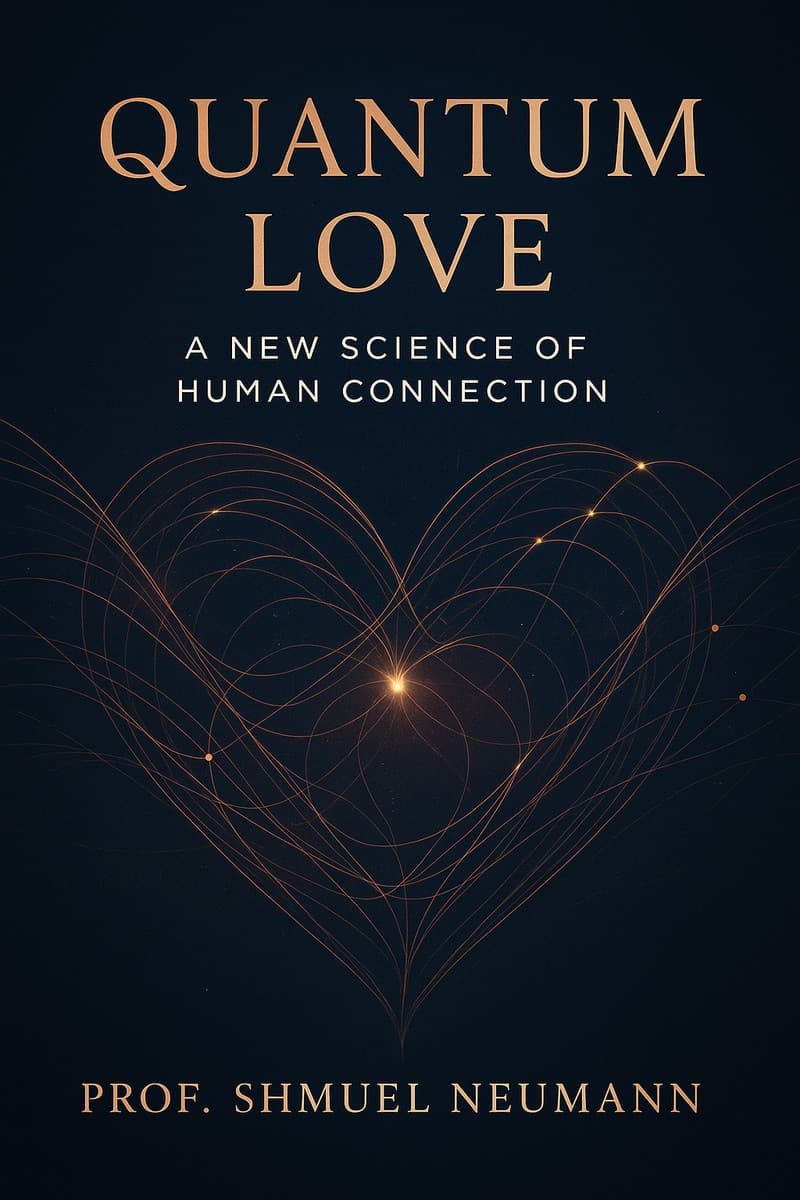
Quantum Love
ביקורות
“Ambitious, rigorous, and unexpectedly tender, Quantum Love earns its subtitle. It offers couples a calmer way to navigate turbulence, gives practitioners a fresh toolkit grounded in measurable signals, and invites researchers to test claims that are finally precise enough to fail.”
סרטון הסבר
פודקאסט שמע
על הספר
Perhaps the book’s most valuable contribution is its stance. Quantum Love does not promise prediction so much as discipline: a way to notice more, intervene earlier, and argue less with the basic uncertainty that makes intimacy both fragile and astonishing. Models, here, are not cages; they are lenses—sharpening compassion by showing where it can do the most good.
Ambitious, rigorous, and unexpectedly tender, Quantum Love earns its subtitle. It offers couples a calmer way to navigate turbulence, gives practitioners a fresh toolkit grounded in measurable signals, and invites researchers to test claims that are finally precise enough to fail. It’s a rare thing: a science-forward book that leaves you both smarter and kinder.
Prof. Shmuel Neumann sets himself an audacious challenge in Quantum Love: to give love a grammar rigorous enough to measure, model, and—most importantly—care for. He largely succeeds. Rather than reducing relationships to tidy equations, Neumann uses mathematics as a disciplined way to see what our habits of mind usually miss: that connection is a living system with thresholds, feedback loops, and context effects we can actually work with.
Two frameworks anchor the book. The first is quantum formalism—not as a claim that couples behave like particles, but as a precise language for ambiguity, complementarity, and the way observation changes outcomes. Neumann’s discussion of “measurement effects” feels instantly practical: ask a brittle question at the wrong time and you collapse possibilities; shift the context and different truths emerge. The second framework is nonlinear dynamics and chaos. Here the book shines. Phase transitions, bifurcations, and strange attractors become more than metaphors; they map onto familiar relationship weather—those sudden ruptures after long plateaus, the repeated-but-not-identical arguments that circle an invisible drain, the delicate windows where small nudges do outsized work.
What saves the project from cleverness-for-its-own-sake is Neumann’s insistence on evidence and restraint. He draws on everyday, accessible measures—heart rate variability, respiration, electrodermal activity, recovery time after a perturbation—and shows how to read them without turning a relationship into a lab. His chapter on early-warning signals is especially useful, translating “critical slowing down” into something couples and clinicians can spot: longer recovery after tiny frictions, rising variance across ordinary days, subtle “flickers” between closeness and distance that signal an approaching threshold. The guidance that follows is concrete and humane—time your questions, downshift arousal before meaning-making, aim interventions at leverage points rather than forcing global change.
The book’s ethics are as notable as its models. Neumann is clear-eyed about the line between attunement and surveillance, insisting that consent and reciprocity govern any measurement worth the name. He also keeps the equations on a short leash. They appear as commitments—claims precise enough to be tested—and are immediately translated back into plain language and practice. When the data are early or mixed, he says so. When a metaphor risks overshoot, he reins it in.
If there is a friction point, it’s the occasional density of the mathematical prose. Readers with no tolerance for symbols may need to lean on the accompanying explanations. Yet even here Neumann anticipates the gap: he pairs each formalism with a narrative example and a brief intervention recipe, so that the takeaway is rarely in doubt. And the payoffs are real. By the time he reframes apologies as “micro phase shifts,” repair rituals as “parameter tuning,” and trust as a dynamic resource to be budgeted rather than a static trait to be judged, it is hard to imagine going back to the flatland of tips-and-tricks relationship books.