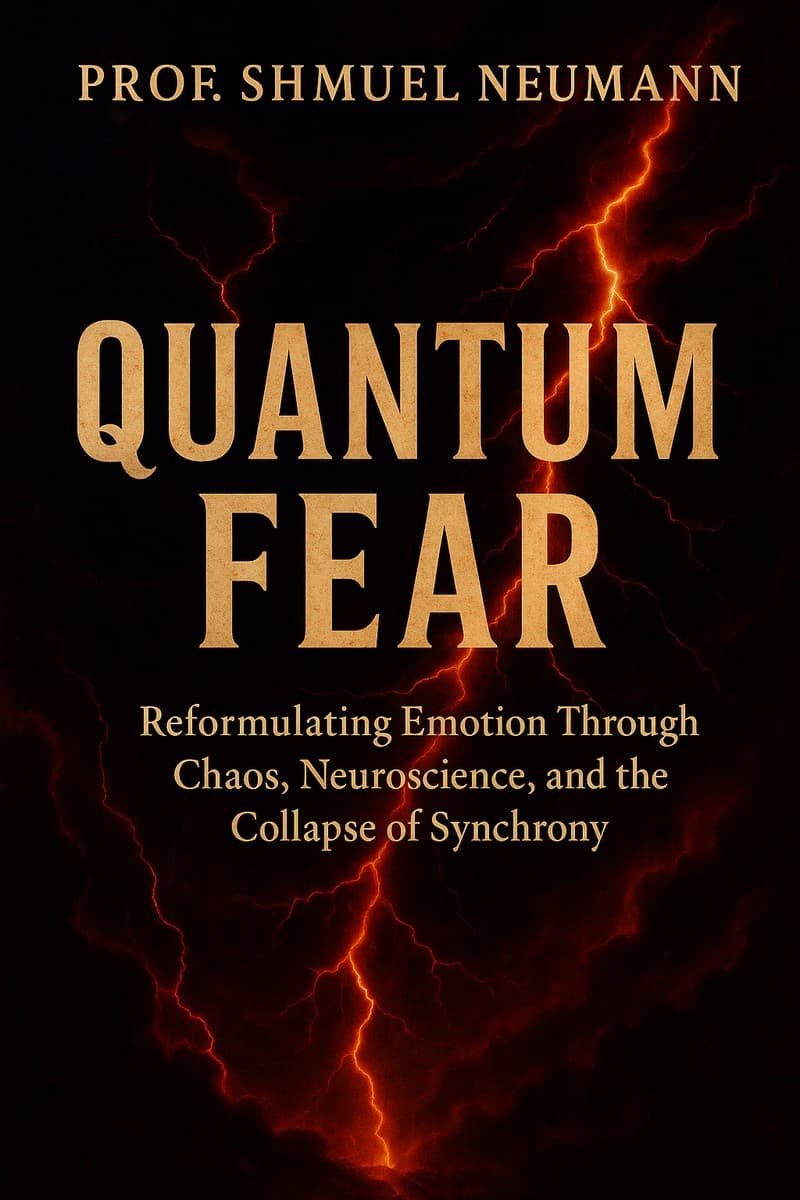
Quantum Fear
ביקורות
“Fear isn't just a survival mechanism—it's a quantum state. Blending neuroscience, quantum theory, and Torah insight, this book explores the mechanics of fear as a metaphysical and psychological force. For readers who crave both intellectual depth and spiritual relevance, Quantum Fear offers a radical new framework to understand—and transcend—the unknown.”
סרטון הסבר
פודקאסט שמע
על הספר
From uncertainty to awe: the physics of our deepest anxieties. Fear isn’t just a survival mechanism—it’s a quantum state. Blending neuroscience, quantum theory, and Torah insight, this book explores the mechanics of fear as a metaphysical and psychological force. For readers who crave both intellectual depth and spiritual relevance, Quantum Fear offers a radical new framework to understand—and transcend—the unknown.
Prof. Shmuel Neumann’s latest volume upends a century of “fight-or-flight” orthodoxy by showing that the three classic fear channels—phenomenology, physiology, and behavior—rarely move in lock-step. Drawing on long-buried datasets that were shelved in the 1970s for contradicting prevailing theories, Neumann re-analyses them with 21st-century tools and proves that desynchrony is the norm, not the anomaly. The opening chapters retrace how Peter Lang’s tripartite model replaced the unitary reflex view of fear, then marshal fresh meta-analyses to demonstrate just how weak the correlations among self-report, heart-rate, and overt actions can be—even in laboratory phobias and combat PTSD .
Where the book truly breaks new ground is in its mathematical turn. Neumann argues that only chaos theory can capture the butterfly-effect volatility of fear spikes, and he illustrates this with lucid walk-throughs of Lyapunov exponents, fractal dimensions, and entropy metrics extracted from EEG and HRV recordings. Case studies—from “frozen” dissociative veterans to high-arousal, low-awareness repressive copers—are mapped onto strange attractors that shift with minute perturbations, making a persuasive case that conventional linear statistics miss the story.
Just when the reader thinks the argument cannot tilt further from tradition, Neumann pivots to quantum cognition. Borrowing formalisms first deployed to explain survey order effects and conjunction fallacies, he treats emotional states as qubit-like superpositions and shows how fear probabilities exhibit quantum interference in sequential appraisal tasks. Critics may balk at extrapolating from metaphor to mechanism, yet the author is careful to distinguish physical quantum claims from “merely” quantum-probabilistic modeling—while still dangling the provocative possibility that future brain research could reveal genuine micro-quantum substrates.
Prof. Neumann delivers an audacious, interdisciplinary manifesto that reframes fear as a dynamical, probabilistic phenomenon—one best understood through the twin lenses of chaos mathematics and quantum cognition. For researchers, clinicians, and scientifically minded readers, Desynchronized will feel less like an incremental advance and more like a paradigm shift.
The therapeutic payoff arrives in the final section: a session-by-session protocol that uses chaos diagnostics to tailor exposure, CPT, EMDR, and NET for survivors of mass atrocities, including the 2023 Hamas attacks . By monitoring a patient’s real-time entropy and fractal HRV, Neumann shows clinicians when to push, when to pause, and how to recognize relapse as a nonlinear “turbulent trajectory” rather than failure .