The Problem
"Trust me" is not an answer.
A shadchan calls with a name. You ask the obvious question: why this person? What makes you think we'd be good together? The answer comes back vague. "I have a feeling." "You're both great people." "Just try it." You're being asked to invest hours of preparation, emotional energy, and hope—on faith. On someone else's instinct. On a process you can't see and can't verify.
So you say yes out of obligation, or because you've run out of reasons to say no. You show up to the date already guarded, already skeptical, already half-expecting disappointment. The other person feels the same way. Two people sit across from each other, both wondering why they're there, neither fully present because neither understands the premise. The conversation is fine. The chemistry is absent. Not because the match was wrong—maybe it was, maybe it wasn't—but because no one gave either of you a reason to show up open.
This is how promising matches die before they begin. Not from incompatibility. From opacity.
The Solution
Show the reasoning.
Imagine reading something like this before you ever met: "You both described your ideal Shabbos table in almost identical terms—full, loud, everyone talking over each other, warmth and chaos and belonging. You both listed humor first when asked what you're looking for, and your styles are complementary: she's dry and observational, you're quick and self-deprecating. You both come from homes where the father learned in the morning and worked in the afternoon, and you've both said—separately, in different conversations—that this is the model you want to build."
That's not a feeling. That's a foundation. That's walking into a date knowing what to explore, what questions to ask, what to look for. That's two people meeting not as strangers thrown together by someone else's hunch, but as people who understand—at least in outline—why this meeting might matter.
When you see the reasoning, you can engage with it. You can bring your own judgment to bear. You can say yes with understanding, or say no with clarity about why. Skepticism becomes curiosity. Guardedness becomes presence.
How It Works
The AI sees what no human can hold.
A shadchan meets hundreds of people. They carry impressions, fragments, intuitions—but the details fade. The specific phrase someone used to describe their family three months ago, the emotion underneath it, the hesitation before they spoke—gone. Human memory cannot preserve it. The AI preserves everything. Every conversation, every preference stated and every preference revealed through behavior, every pattern that emerges across dozens of interactions.
When the AI suggests a match, it draws on all of this. And then it explains itself. Not generic compatibility language—specific connections. The echoes between what you said and what they said. The values that align. The vision of life that overlaps in ways that would take months of dating to discover—surfaced before you ever meet.
For shadchanim, the AI offers something equally powerful: a detailed comparison before making a suggestion. You have an instinct about two people. You sense they might work. But you want to check—to see if the data supports what you feel. The comparison surfaces shared values you sensed but couldn't name, friction points you hadn't considered, depths of alignment that confirm your instinct—or reveal that the feeling was misleading. Your intuition doesn't disappear. It becomes visible, checkable, explainable.
The AI also learns from behavior. Every time you accept a suggestion, it notices. Every time you reject one, it notices that too. You say height doesn't matter, but you've rejected four people under 5'8". You claim you want ambitious, but you keep saying yes to the laid-back ones. The AI sees the gap between what you declare and what you do—and calibrates accordingly. Over time, the suggestions align less with the person you think you should want and more with the person you actually respond to.
The Ask
"Why this person?" deserves an answer. A real one. One you can think about, respond to, engage with.
Now there is one.
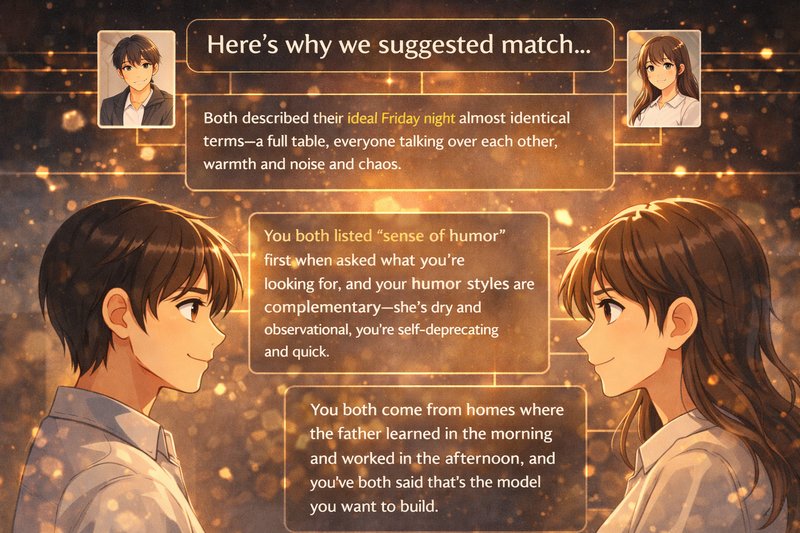
When you get a suggestion from Yismach, you'll see the reasoning. You'll understand why this person, why now. And when both sides understand why they're meeting, something shifts. Two people sit across from each other knowing—at least in outline—why this meeting might matter.