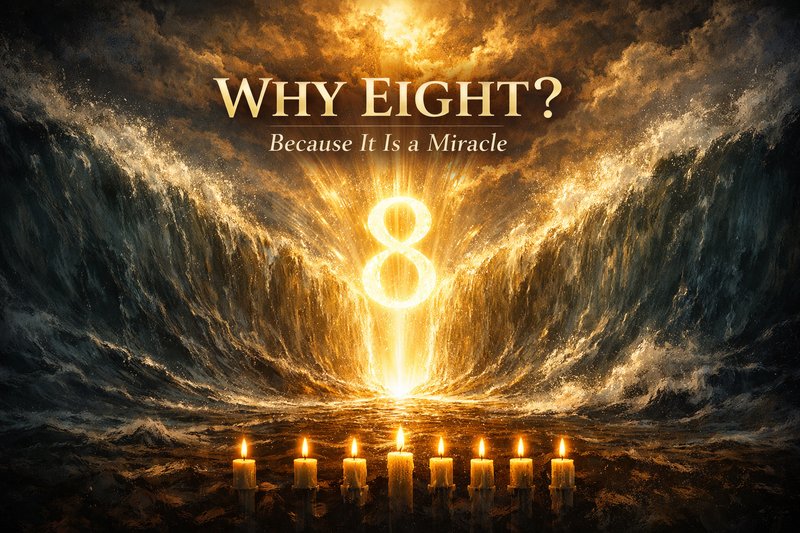
Kohelet says it once and never elaborates: ein kol chadash tachat hashemesh. There is nothing new under the sun. Everything that is, has been. Everything under the sun belongs to the natural order—the world of seven, the world that was completed in seven days of creation and turns on seven-day weeks and seven-note scales and seven directions of space. Under the sun: the domain of nature. The number of nature is seven.
Eight is what exists above the sun.
The Maharal of Prague taught this with precision. Seven is the complete cycle of the natural world. Eight is the dimension that transcends it—not the next step within the natural order but a step out of the natural order entirely. The Ramban said it plainly in his commentary: everything that is seven is whole and complete according to the laws of nature. Eight is what breaks through those laws. The Kli Yakar went further: eight always represents a supernatural level of existence that the world of seven cannot contain.
This is not numerology. It is the organizing principle of the most sacred moments in Jewish life. Brit milah is on the eighth day—after the child has passed through one full natural cycle of seven, the covenant is cut on the eighth, above that cycle, beyond what nature alone can do. The Mishkan was inaugurated on the eighth day. Shemini Atzeret follows seven days of Sukkot: during those seven days, seventy bulls were offered for the seventy nations of the world—all of nature, all of creation, everything under the sun. Then on the eighth day Hashem turns to Israel alone and says assei li seudah ketanah k'dei she'ehehaneh mimecha—make me a small feast, just you and Me. Seven was the world. Eight is the intimate one, the one that cannot happen without the seven but belongs to a different order entirely.
Chanukah is eight days for the same reason. The Beit Yosef asked the famous question: the oil burned naturally for one day and miraculously for seven more—so why do we celebrate eight days instead of seven? The answer the Maharal gives is not about the arithmetic. Chanukah is eight days because eight is the number of transcendence. The miracle did not happen to last eight days. It lasted eight days so that Chanukah would be an eight-day holiday. Because what the Chashmonaim accomplished—the few against the many, the pure against the contaminated—was not a natural victory. They drew on something above the sun.
Now: the Gemara in Sotah says that making a shidduch is kasheh k'kriyat Yam Suf—as difficult as the splitting of the sea. Most people hear this as a complaint about logistics. The Maharal hears something entirely different. The sea, he explains, naturally flows together—water cleaves to water, that is its nature. To separate it and hold it apart is to override the natural order. That is what made the miracle miraculous: not the drama of it, but the category of it. It was supernatural. And so, says the Maharal, is a zivug. People are naturally apart, each pursuing their own existence. For two separate people to merge their lives, to become one flesh, to build something that belongs to neither of them individually—this is not a natural act. It is above the sun. It requires the same category of divine intervention as the splitting of the sea.
This is why eight. A shidduch is not a natural event. It is a miracle. And miracles belong to the number eight.
◆
A bochur from Chevron Yeshiva reports to his Rosh Yeshiva after the first date: I don't know.
Do you have hakpados? Chas v'shalom. So continue. Same after four. Same after six. After eight he walks in still not sure. The Rosh Yeshiva looks at him: Eight dates and no engagement? What kind of person are you? He gets engaged.
The Rosh Yeshiva was not manufacturing a feeling. He was protecting a process that belongs to the order of eight—the supernatural order, the one that cannot be rushed or evaluated from outside. He never asked do I feel it yet. He asked is there a reason not to. One question tries to evaluate the output before the process has run. The other clears the obstacles and stays in the room. The distinction is everything. And we've lost it.
◆
Something forms between two people that belongs to neither of them. Not his qualities. Not hers. What grows in the space between them develops underneath awareness, without announcement, at its own pace.
You cannot evaluate it before it exists. You cannot feel it before it forms.
But nobody waits for it to form. They next.
Something is working very hard to make sure they do.
The Fear Underneath
Nexting is not pickiness. It is not high standards. It is fear—dressed up as discernment, so well-disguised that the person experiencing it genuinely believes they are being honest with themselves.
Here is the mechanism. A suggestion arrives. With it comes a spike of anxiety—the possibility of a date, the possibility of disappointment, the possibility of sitting across from a stranger and feeling nothing, or worse, feeling something and then having it not work out. That anxiety is real. And the fastest way to make it disappear is to say no. The moment you reject the suggestion, the anxiety dissolves. Relief floods in. The nervous system learns: no equals calm. Yes equals danger. The brain learns through repetition that no is the safe move. Every time. Regardless of who's being suggested.
What looks like fear of the wrong person is actually fear of the moment when possibility collapses into reality. Multiple outcomes exist in the imagination simultaneously—it could be wonderful, it could go nowhere—and as long as you never sit down, the wonderful outcome remains intact. The safer move, every single time, is to never let it collapse. To keep saying no. To stay in the realm of the possible without ever entering the realm of the actual. This is what Quantum Fear maps with precision: fear not as a survival mechanism but as a quantum state, holding multiple possible futures open by refusing the observation that would collapse them into one. The first date is not frightening because of who is sitting across the table. It is frightening because of what sitting down forces to become real.
Years of this produce something measurable in the nervous system. The dysregulation that accumulates from treating every first date as an audition, every meeting as a threat to be survived, is not metaphorical—it is physiological. Shidduch Trauma documents what years of failed auditions do to a person: a nervous system permanently calibrated to threat, in which every encounter triggers the same cascade of anxiety before, performance during, evaluation after, relief when it's over. The person on the other side of the table is never actually encountered. They are processed. And a processed person cannot become someone you fall in love with.
There is also a subtler variant. For some, what registers as the absence of chemistry is actually the absence of chaos. Years of threat-calibrated experience produce a nervous system that reads safety as flatness. A stable, unhurried, genuinely kind encounter—exactly the architecture of a good marriage—lands as boring, as missing whatever it is, because the nervous system learned to feel most alive on the brink. Living on the Edge names this pattern directly, and The Pleasure of Danger traces its deeper roots: the neurotheological pull toward intensity, the person for whom the ordinary feels like deprivation because extraordinary was the only frequency their nervous system was ever tuned to.
The Certainty Reflex
Fear has a cognitive companion. The mind under anxiety does not deliberate—it seizes. A detail arrives: wrong neighborhood, wrong school, unclear hashkafa. The judgment locks. The shadchan calls to say just meet him and the response is already sealed, because reopening it would mean reintroducing the anxiety the no was built to eliminate.
Each no creates a rule. The rules accumulate. They feel like standards. They are scar tissue. The brain retroactively justifies every rejection—so the rejected person gets worse in memory and the decision gets wiser—while quietly erasing everything about him that might have worked. Maximizers, people who insist on identifying the best possible option before committing, search longer, compare more, and end up less happy, more depressed, more regretful than people who decide with less information. The act of optimizing does not produce the feeling of having optimized. It produces the feeling of having possibly missed something better.
When this certainty-seeking hardens past a personal preference into a governing ideology—when the person has already decided before the profile is opened, has loaded the missiles before the evidence arrives—Prophets of Annihilation is the diagnosis. The person is no longer looking for a spouse. They are maintaining a closed system that protects them from ever having to find out.
The Map You Brought
Everyone who walks into a first meeting is already carrying a map. Not a wish list. A map. How love should feel. How a husband should act. What safety means. What intimacy costs. Drawn in childhood, revised by every significant relationship since, invisible to the person carrying it.
The map was shaped by the people who held you or didn't—who responded to your needs or missed them, who modeled what marriage looked like by how they treated each other when they thought you weren't watching. It was shaped by early wounds and by every relationship that taught you something about what closeness feels like and what it costs. It determines who you're drawn to, how you interpret what they do, what you need from them when you're hurting, what quietly accumulates when they get it wrong. Love Maps: The Scripts That Bind traces this architecture with granular care—because the Love Map is not a conscious preference. It is the emotional template through which another person is experienced. Every person you've ever been attracted to, and every person you've ever rejected, was filtered through this map. And you didn't know it was there.
The critical finding—the one that changes everything—is that the map can only become accurate through repeated, unhurried encounter. The first meeting gives you almost nothing real. Both people are performing. The strong pull you felt on the first date, or the notable absence of it, is almost entirely projection layered onto a stranger. The map you're reading is not theirs. It's the one you brought. If you next after one or two meetings, you are nexting a person you haven't actually met yet.
And Quantum Love extends this: even if you stay, the relationship itself is not a fixed object being evaluated. It is a dynamic system—chaotic, nonlinear, irreducible to initial conditions. Two people interacting change each other in ways that cannot be predicted from their profiles, their photos, or their first impression. The signals that matter most are not the loudest signals early. They are faint, emerging slowly as novelty fades and the actual patterns of two people in each other's presence become visible. A slow warmth that builds meeting by meeting. An ease that accumulates without being announced. The shidduch world treats initial chemistry as signal and its absence as disqualification. The research shows that initial chemistry is noise. The signal is underneath, and it takes time and proximity and the willingness to sit with uncertainty before it becomes audible.
The Fig Leaf
The fig leaf was the first resume. Both were fashioned for the same reason: to cover what was real before someone else could see it. Shame—not shame as pathology but shame as sacred compass, calling you back to who you truly are—is what surfaces when you are actually seen by another person. Putting Shame to Shame makes the distinction: shame is not the enemy. It is the signal that the performance is about to give way to something real. The person who runs from that signal will never be genuinely known.
Through the Looking Glass, Darkly documents how hiding becomes habitual. The resume doesn't just misrepresent—it teaches people to hide. The performance begins before the first meeting, in the crafting of the profile itself. By the time two people sit across from each other, both are already wearing the version of themselves they believe will pass the audit. Neither is present. Both are performing. And underneath the performance, as The Mirror's Lie traces, is a fractured inner mirror—an inability to see oneself accurately that bleeds into how every potential match is perceived. The distortion is projected outward. You cannot connect with someone through a mask. And you cannot see someone else clearly through distortion.
Then there is the person who cannot receive what they did not earn. Someone is kind and they flinch. Someone sees them clearly and they hide. Warmth arrives and they dismantle it, because somewhere in the architecture of how they understand love is a conviction that they had not earned this—that love comes with conditions they haven't yet met. Undeserved Love is the antidote to that conviction: not a strategy, but an encounter with the possibility that love can arrive without prerequisites. The only way to revise a Love Map that says I don't deserve this is to stay in the room while someone treats you as though you do.
For men specifically, The Binary Man names what the system never actually prepared them for. Not performance. Not provision. Presence. What the Torah demands from a man in a relationship is harder and more specific than anything the resume culture built them to deliver. And The Naked Truth of Eden goes back to the beginning—from Gan Eden to today, from the first fig leaf to the last resume, tracing how the impulse to hide what is real has been with us from the moment we were ashamed of being seen.
The Tool That Made It Worse
The shidduch resume was supposed to help. Too many singles. Too many names. Shadchanim needed a way to keep track. So we created a simple tool: name, age, background, schools. Just the basics.
But something happened. The tool became the gatekeeper. "Just meet them" turned into "Send me a resume first." We started screening instead of meeting. We started analyzing photos like detectives and passing on people because of font choices. Shidduch Resume: The Solution That Became the Problem traces the full arc of how a practical tool became a cultural pathology—and what it cost.
What the resume enables is a fantasy: that sufficient research will eventually produce a candidate who requires no risk. That if you screen hard enough, investigate thoroughly enough, analyze the photo carefully enough, you can eliminate the possibility of disappointment before you ever sit down across from another person. That fantasy has not produced more marriages. It has produced more nexting, more exhaustion, and the peculiar loneliness of looking endlessly for something you've never actually reached for.
The century of research that Who Marries Whom and Why synthesizes makes the cost explicit: the variables that actually predict who ends up together and stays together are not the ones on a resume. Not height. Not seminary. Not neighborhood. Not family background. The variables with the strongest empirical relationship to lasting marriage—the ones where couples reliably resemble each other regardless of what they told the shadchan they were looking for—are emotional regulation style, communication patterns, implicit relationship scripts, and values as lived rather than stated. You cannot see any of these on a piece of paper. You cannot research them through references. You can only discover them by sitting across from someone, repeatedly, long enough for the performance to drop and the real person to emerge.
What Nobody Taught
A dating system that frames every meeting as a marriage audition has produced a generation of adults who have never developed the interpersonal competencies that genuine connection requires. They have never practiced authentic self-disclosure, reading another person's emotional state, being present without agenda. So when they sit down on a date, their minds do the only thing they've been trained to do: run an audit. Is this the one? Do I feel it? Is this person marriage material?
The audit is not neutral. The assessment mode actively crowds out the only thing that could answer its own question. When the mind is tasked with evaluating marriageability, it evaluates marriageability—categorizing, comparing against a checklist, looking for disqualifying information. And in doing so it prevents the attachment mode—the mode in which warmth, curiosity, and genuine interest emerge—from ever engaging. The two cannot occupy the same moment. The Play Date shows how the skills themselves can be taught and developed: authentic self-disclosure, attunement, responsiveness, the capacity to be present without agenda. These are not personality traits. They are competencies. They can be built. But only if the system stops treating every meeting as a verdict and starts treating it as a practice.
And then there is the one competency that holds every marriage together that nobody talks about in shidduchim at all. Not chemistry. Not hashkafa alignment. Not shared goals. The right silence—the willingness to be in a room with someone without filling it, to listen without preparing your next sentence, to let the space between words carry something real. Two people can share every stated value and exhaust each other within months if their communication patterns create chronic, low-grade friction. He needs to process aloud; she needs silence before she can think. She asks questions to connect; he hears interrogation. He withdraws when hurt; she pursues. None of this appears on a resume. All of it is discoverable across eight meetings. Reclaiming the Lost Art of Listening is the map for that discovery.
Eight Meetings
Familiarity is not just revealing. It is generative. Repeated exposure doesn't only uncover compatibility that was already there—it creates compatibility that did not exist before the meetings happened. Comfort accumulates. Ease accumulates. The nervous system recalibrates. The performance drops. And in the space that opens up, something begins to form that belongs to neither person individually. The thing we started this article talking about. The thing that develops underneath awareness, at its own pace, that you cannot evaluate before it exists and cannot feel before it forms.
Nexting at one, two, or four meetings means the process never ran. You evaluated an absence and called it a conclusion.
More than eight meetings is its own problem. If something real has begun to grow, the rational mind re-engages. Accumulates concerns. Finds reasons to hesitate. Talks itself out of what the heart already knows. You fall in love somewhere in the middle. Then you keep meeting until you don't.
Eight is the number. Not because we invented it. Because the research points there—and because eight is the number of the supernatural, the number that sits above the domain where nothing new can happen, the number of the miracle. And a shidduch is a miracle. The Maharal said so.
The Process
A shadchan who makes a suggestion has exercised judgment—thought seriously about a life, reviewed a profile, weighed intuition against analysis, and brought a name. That name represents their best thinking. When someone declines without cause—based on a resume, a photo, a neighborhood—they have told the shadchan that their considered assessment of another person's life is not worth one hour. The Wisdom of the Heart names what is actually required of a shadchan: not a transactional service provider but someone with chachmas halev, who do not think this could be a good match but intuitively know. This is the capacity to see people clearly. This is the humility to suggest a shidduch that does not fit on paper, trusting that it akin to prophesy, that when the name is put into their head and despite expecting the "What were you thinking, has faith that this shidduch is from heave. Reflexively declining, nexting tells the shadchan that you don't trust their judgment and that you expect someone better than the best that they have to offer. On the other hand, the offer may be off base.
Due diligence comes before the first meeting—references checked, facts verified. The Shidduch Handbook draws the line precisely: the research is for facts. The meetings are for truth. Do not use one as a substitute for the other. The decision at the end of due diligence is not whether to marry. It is whether to begin. Ideally, the commitment should be to eight meetings, made before the first one starts. Stopping requires a decision. Continuing does not. Showing up is the default. The feelings accumulated across eight genuine meetings are the most reliable data that will ever exist about this specific relationship.
After the eighth meeting, seven prompts—drawn from the framework in Eight Steps to the Chuppah—all oriented toward the yes: something about this person that surprised you, in a good way. A moment you keep returning to. How you feel about yourself in their presence. The quality you most want your children to inherit from them. Why you believe they would be a faithful spouse. The prompts do not ask for concerns. It's Not Who You Marry says it plainly: marriage does not work because you found the right person. It works because you stayed when it was hard. The prompts ask whether, after eight genuine meetings, something alive is present. Something that wants to say yes.
What they are then being asked to consider is what Rooted in Heaven frames as its central argument: not marriage as partnership—a business arrangement with emotional benefits—but marriage as spiritual merger, the sacred scaffolding that most couples never learn exists because nobody taught them, because the system was too busy screening resumes to build the thing that actually makes a marriage last.
What Eight Meetings Surface
Eight meetings with the same person, without the escape hatch of nexting, will surface things. Not just about the other person. About yourself.
By meeting three or four, the idealized version of the other person begins to crack. What replaces it is either more real or less tolerable—both outcomes valuable, both requiring the meetings to have happened. In His Own Image examines what this cracking actually is: we sculpt the people we love through every act of attention, every moment of judgment or grace, every time we choose to stay or look away. Nexting at meeting two means you nexted the ideal. You never met the person.
Eight meetings, not eighty. Enough to discover. Not enough to lose yourself. How Close Is Too Close maps where intimacy ends and entanglement begins—the point at which closeness stops being nourishing and starts being consuming. The process is designed to protect that boundary.
For those who have been through all of it—the nexting, the shame, the fear, the years of searching—Bravehearts is not a pep talk. It is a theology of persistence. Bravery redefined as the refusal to vanish. The willingness to show up one more time. And Unshackling Fear for those who know exactly what fear took from them and want it back—not coping, not management, reclamation.
If after eight genuine meetings you still cannot say yes—the Rosh Yeshiva's question applies to you too. What kind of person are you? The system creates the conditions, removes the obstacles, engineers the repeated exposure, disables the assessment mode. And if it isn't there after eight genuine meetings, a ninth will not produce it.
What kind of person are you? Is this impregnable wall you hit, not about them or the relationship, but your fear of commitment? Almost Forever is a piercing, honest account of what it means when a relationships end before it became permanent—and provides tools to get past it.
Nest, Not Next
One letter.
The difference between leaving and staying. Between evaluating and inhabiting. Between asking who's next and asking what's here. Nexting is the demand for the natural world's answer—the seven-world's answer, the world of nothing new under the sun, the world where the outcome is already knowable from the inputs and a conclusion can be reached before the process has run. Nesting is something else. Nesting is the decision to stay in the room long enough for something to form that did not exist before you stayed.
The Maharal said that making a zivug requires the same force as splitting the sea—not because it is logistically hard, but because it is categorically supernatural. Two people becoming one is not a natural event. It belongs to the order of eight, the order above the sun, the order of things that cannot happen within the domain of what nature already contains. You cannot evaluate your way there. You cannot screen your way there. You cannot optimize your way there. You can only stay in the room and let the miracle do what miracles do.
Seven is what you get when you stay within the bounds of what you already know. Eight is what becomes possible when you remain one day longer than nature required.
For those who have been waiting long enough to have nearly stopped hoping—What It Will Feel Like was written directly to that ache. What is coming, when it comes, will be worth what it cost.
Nest, not next. It takes a miracle. That's why eight.
◆
BOOKS REFERENCED IN THIS ARTICLE
Love Maps: The Scripts That Bind — The hidden childhood architecture of who we love, how we trust, and what we run from.
Who Marries Whom and Why — A 300-page synthesis of a century of research on human pair formation.
Quantum Love — Relationships as dynamic systems—chaotic, nonlinear, irreducible to initial conditions. Why initial chemistry is noise and the real signal takes time to emerge.
The Play Date — The evidence-based curriculum in relational competencies—and the skills problem at the heart of the Orthodox dating crisis.
Shidduch Resume: The Solution That Became the Problem — How a practical tool became a cultural pathology, and what it costs.
The Shidduch Handbook — A direct guide to dating with dignity, depth, and freedom from the mythology of the perfect match.
It's Not Who You Marry — A Torah-based, psychologically grounded model of what makes love endure—covenant over chemistry.
Rooted in Heaven — Marriage not as partnership but as spiritual merger—the sacred scaffolding most couples never learn.
The Wisdom of the Heart — Torah-anchored emotional intelligence for shadchanim and mentors who need to see people clearly.
Eight Steps to the Chuppah — The practical framework for serious preparation for marriage.
Reclaiming the Lost Art of Listening — The one skill that holds every marriage together: not the right words, but the right silence.
In His Own Image — How we sculpt those we love—and how they sculpt us.
Undeserved Love — Love stripped of its performance requirements. For anyone learning to receive what they did not earn.
The Binary Man — What breaks men, what builds them, and what the Torah actually demands from them.
How Close Is Too Close — Where intimacy ends and entanglement begins.
The Naked Truth of Eden — From Gan Eden to today: shame, intimacy, and the human condition.
Putting Shame to Shame — Shame not as pathology but as sacred compass, calling us back to who we truly are.
Bravehearts — Bravery redefined: the refusal to vanish, for those who have been through the fire.
Quantum Fear — Fear not as survival mechanism but as a quantum state—the physics of our deepest anxieties.
Unshackling Fear — Breaking the chains. Not coping—reclamation.
Living on the Edge — Why calm feels threatening to trauma survivors, and how chaos becomes addictive.
The Pleasure of Danger — The neurotheology of thrill-seeking and the sacred pursuit of intensity.
Prophets of Annihilation — What happens when certainty-seeking hardens into ideology—and why the missiles are already loaded.
The Mirror's Lie — The fractured inner mirror and how distorted self-perception quietly sabotages connection.
Through the Looking Glass, Darkly — How hiding behind performance keeps you from being genuinely known.
Shidduch Trauma — The dysregulation produced by a system designed for love that has learned to operate on threat.
Almost Forever — A piercing postmortem on relationships that ended before they became something permanent.
What It Will Feel Like — Prophetic hope for hearts that have only known waiting.