Everyone's claiming AI now. Open any shidduch platform's website and the buzzwords are everywhere—"AI-powered matching," "intelligent algorithms," "machine learning compatibility." It sounds impressive. It sounds modern. It sounds like someone finally cracked the code.
They haven't.
What most organizations call "AI matching" is machine learning from twenty years ago—collaborative filtering, content-based filtering, matrix factorization. The same techniques that power Amazon and Netflix, refined by billions of dollars and decades of research. And they work brilliantly for retail, where Netflix can afford to be wrong a thousand times on the way to getting it right. You scroll past something irrelevant, you don't click, the system learns a tiny bit, and everyone moves on. The cost of failure is measured in seconds of mild annoyance.
Shidduchim operate by entirely different rules. A bad suggestion doesn't get scrolled past. It affects someone's dignity, their emotional energy, their trust in the entire process. A shadchan cannot send profiles to a hundred people just to "collect data." You cannot run experiments on people's lives. The very practices that make shidduchim sacred are precisely what starve these algorithms of the data they need to function. We tried all these techniques six years ago. They performed adequately. Nothing more.
Here's the problem nobody wants to admit. Traditional machine learning requires massive scale—Netflix runs hundreds of experiments per year on hundreds of thousands of users, Amazon processes billions of interactions. These systems need tens of thousands of meaningful outcomes spread across countless variables just to stabilize, just to begin detecting patterns that might be predictive. Shidduchim cannot generate that volume, and they never will. Most people have only a handful of introductions over years of dating. The yes rate is inherently low. The pool fragments by hashkafa, by community, by geography, each segmentation reducing the overlap that algorithms need to find patterns. And when 80 to 90 percent of suggestions get declined, there simply aren't enough positive outcomes distributed across all the possible combinations of features for any algorithm to learn what actually works.
Everyone else is stuck. They're applying tools designed for retail to a problem that operates by entirely different rules, hoping that marketing language will paper over the gap.
But all of this is almost beside the point. Because there's a problem so fundamental it makes everything else irrelevant.
Look at what these systems are actually processing. Look at what they're feeding into their fancy algorithms. Look at the input.
The shidduch resume.
The same reductionist disaster we've been warning about for years. The document that reduces a human soul to a checklist. The paper that has done more damage to Jewish dating than any technology ever could.
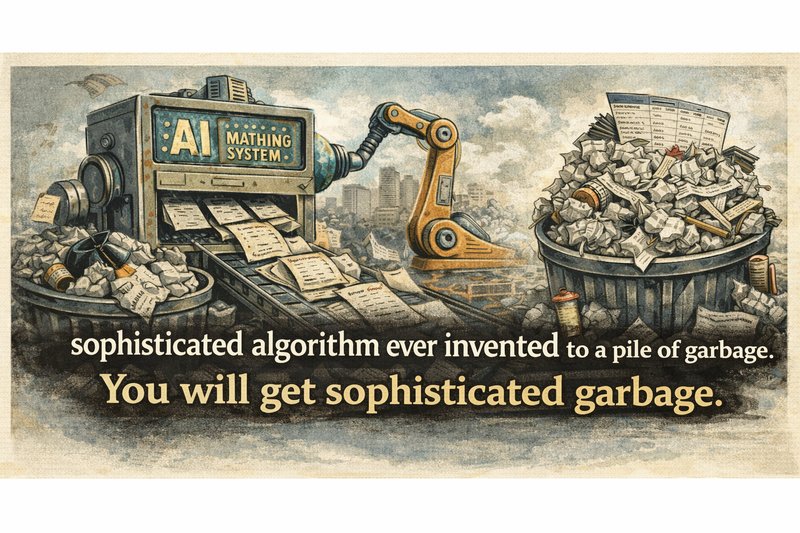
Garbage in, garbage out. And the resume is garbage.
Name. Age. Height. Schools attended. Father's occupation. References to call. A generic template—the same format, the same categories, the same sanitized presentation that every single person uses, revealing almost nothing about who anyone actually is. What are they really looking for? How do they handle conflict? What lights them up? What are they running from? What do they need but have never been able to say out loud?
The resume answers none of this. The resume was never designed to answer any of this. It was a filing system, a way for overwhelmed shadchanim to keep track of too many names. It became a gatekeeper by accident. It became the deciding factor by dysfunction. And now organizations are building "AI" on top of this wreckage as if the foundation weren't already rotten.
You can apply the most sophisticated algorithm ever invented to a pile of garbage. You will get sophisticated garbage. You can run cutting-edge machine learning on a spreadsheet of surface demographics and community affiliations, and all you'll discover is which demographics cluster together—which everyone already knew, and which tells you exactly nothing about whether two people will recognize each other across a coffee table.
This is like predicting the weather by studying calendar dates. Yes, December tends to be cold. Congratulations. You still have no idea if it will rain tomorrow. The resume doesn't contain the information that predicts compatibility. It can't. That information doesn't fit on a resume. It never did. The variables that determine whether two people will build a life together—emotional availability, attachment patterns, communication styles, what they learned about marriage from watching their parents, what they're secretly afraid of, what they actually need versus what they think they want—none of this shows up on a piece of paper listing height and hashkafa.
So when these organizations trumpet their "AI-powered matching," understand what they're actually selling. They're running twenty-year-old algorithms on a document that was already failing the community before anyone thought to digitize it. They're automating dysfunction. They're putting a technological veneer on a broken system and calling it innovation.
It's not innovation. It's a cover-up.
The failure runs deeper still. Even if you had better data, even if you could magically generate tens of thousands of outcomes to train on, traditional systems would still miss what actually matters in shidduchim. Because they read profiles like spreadsheets, not like people. A feature-based system extracts keywords and computes overlap. A collaborative system finds patterns in who clicked on whom. Neither understands what someone is actually communicating. And shidduchim are decided by meaning—by tone, flexibility, emotional posture, by what's said between the lines and what's carefully left unsaid.
Consider a concrete example. His profile says he's serious about learning but practical about the future, looking for someone who values ruchniyus but is down to earth, wanting a real person rather than someone who needs everything perfect. One woman describes seminary as the best year of her life, seeking a ben Torah who will make learning his priority, with high standards because she believes we should strive for the best in everything. Another writes that she loves learning and growing but knows life isn't always smooth, wanting someone who takes Yiddishkeit seriously but doesn't stress about every little thing—someone real, not a perfect image.
A traditional system sees both women mention learning, Torah, growth, values. The keyword overlap looks similar in both cases. But look at what's actually being communicated beneath the shared vocabulary. He's signaling flexibility, practicality, a rejection of perfectionism. The first woman is signaling the opposite—idealism, high standards, a specific image of what a Torah home should look like. The second woman's language mirrors his exactly in what it reveals about orientation and temperament. The keywords match in both cases. The people don't.
This is where traditional "AI matching" fails quietly—confident outputs from shallow understanding.
And then there's the dimension that everyone in this industry acknowledges matters but nobody has managed to solve: physical attraction. It's not that people ignore it—it's that no one has figured out how to address it. Attraction is deeply personal, highly subjective, resistant to the kind of patterns that map neatly onto database fields. What one person finds attractive, another doesn't. It doesn't reduce to features you can quantify. Yet it plays an enormous role in whether someone says yes or no, often before they've read a single word of the profile. Traditional machine learning operates in the world of text and structured data and has no meaningful way to incorporate visual information into its predictions. Some have tried basic approaches—rating systems, photo scoring—but these are crude instruments that miss the point entirely. We researched every existing method that attempts to address attraction computationally.
They don't work.
So we developed our own—a novel model to understand images in the context of attraction. To our knowledge, this capability does not exist anywhere else in the world.
What we've built at Yismach is fundamentally different, and the difference isn't incremental. Real AI isn't machine learning rebranded with fresh marketing language. It's an entirely different category of capability—one that understands language the way people do, reasons through ambiguity and nuance, grasps meaning rather than matching keywords. Think about what a great shadchan actually does. They don't compare resumes looking for overlapping bullet points. They listen. They pick up on what someone is really looking for, even when the person struggles to articulate it themselves. They read between the lines of a conversation, notice the hesitation behind a stated preference, sense what's negotiable and what isn't. They hold dozens of people in their mind simultaneously and somehow recognize when two of them might connect in ways that wouldn't be obvious from their profiles alone.
Our AI operates in that same space. It sees through your lens, understanding preferences that are deeply personal and often unspoken, filtering out noise, weighing what actually matters—not what a checkbox says should matter, but what fourteen years of experience in this work have taught us genuinely predicts compatibility. It sees beyond the written word, detecting family dynamics, hashkafic nuances, psychological patterns that prove far more predictive than anything on a resume. Where conventional systems need tens of thousands of interactions to detect patterns, ours achieves precision within a handful of attempts.
This isn't an improvement on existing approaches. It's a departure from them entirely.
But here's what fourteen years of this work has taught us: AI matching, however powerful, is only a small part of what's needed. A match suggestion is merely a beginning. What happens after—the communication, the follow-ups, the back-and-forth, the coordination, the navigation through uncertainty and vulnerability—this is where relationships are actually built or lost. This is where shadchanim burn out under the weight of endless administrative chaos. This is where singles lose faith after months of silence or confusion. Technology that focuses only on the initial match misses the vast majority of where help is actually needed.
So we built something far more ambitious: an end-to-end system with over 25 AI features working together, each one designed to address a specific point where the traditional process breaks down. Discovery that understands meaning rather than keywords. Explanations for every suggestion that articulate not just who but why—what these two people share, where their values align, what patterns suggest they might recognize something in each other. AI that initiates outreach on your behalf, follows up appropriately, collects responses, processes feedback when the answer is no and notifies the shadchan to step in when the answer is yes.
The system coordinates logistics, captures feedback after each date, and surfaces patterns over time that foster self-awareness—tendencies you've developed, dynamics that keep recurring, insights that might be uncomfortable but ultimately help you understand your own dating history more clearly.
And that feedback isn't a form to fill out. After each date, you leave a voice note. Just talk. Say what you actually felt, what worked, what didn't, what you're not sure how to put into words. Our AI processes that voice note—not just transcribing it, but understanding it. The hesitation in your voice when you say "it was fine." The energy when you describe a moment that surprised you. The things you mention three times without realizing it. This is real machine learning: every voice note refines the system's understanding of what you're actually looking for, not what your resume says you want. The more you date, the smarter your suggestions become—not because we're running more experiments on you, but because you're teaching the system who you are in your own voice.
And there's the Mirror, which reveals what others actually see: who you attract, who is attracted to you, why people are saying yes, why they're saying no. Information so rarely available and so critically important—now visible in ways that can genuinely change how someone approaches the process.
But perhaps nothing demonstrates the difference between what we've built and what everyone else is selling more clearly than this: we tested our model retrospectively on a relationship that has lasted 38 years. We fed the system only information available at the beginning—before the couple knew what their life together would become. Our AI predicted the arc of that relationship. The challenges they would face. The dynamics that would define them. The trajectory of a shared life.
And then we compared it to what actually happened across nearly four decades of marriage.
It matched.
This isn't pattern-matching on resumes. This isn't collaborative filtering hoping for signal in noise. This is understanding what makes relationships work at a depth that can see forward—or in this case, backward—across a lifetime.
No one else has built anything like this. No one is even close.
The shidduch crisis is real, and it will not be solved by running twenty-year-old algorithms on the same garbage data that helped create the crisis in the first place. You cannot fix a broken system by processing its failures faster. After fourteen years of this work, we know what doesn't work because we've tried it. We've tested the conventional approaches, measured their limitations, and moved beyond them to develop techniques that didn't exist before. What we've built at Yismach is something genuinely new—technology designed from the ground up for the actual constraints of shidduchim, processing information that actually matters, built on a foundation that isn't rotten to begin with.
This is what real AI innovation looks like.
And we're just getting started.