
Sefer Derech Eretz is a 490-page compilation of Torah law, philosophy, and ethical teaching on shidduchim and marriage. Running through it, embedded within the halachic structure, are stories — Talmudic aggadot, Midrashic parables, ethical tales. Each story is followed in the book by explanations drawn from the original sources: the Maharal, the Zohar, the Arizal, the Ben Ish Chai, the Chafetz Chaim, and many others.
What follows is every narrative story as it appears in the book, told at full length, followed by the explanation the book itself gives — drawn only from the sources the book cites, stated only as those sources state it.
I. What Heaven Does

1. The Tower in the Sea
Sefer HaAgadah, Part Five — Opening of the book
Solomon had a daughter, and there was none like her in all of Israel for beauty. He gazed at the stars to see who her destined match would be, to see who would marry her and who was her bashert. He looked — and he saw: a poor young man from Acco. There was no one poorer in all of Israel.
What did he do? He built a high tower in the sea, surrounded by water on all sides. He took his daughter — Solomon — and placed her in that high tower, together with seventy eunuchs from the elders of Israel as her guards. He made no door in the tower, no entrance. He gave them ample provisions. He said: I will see what the Name does, and what His work brings.
After some time, that poor young man was traveling at night, barefoot and naked and hungry and thirsty. He came upon the carcass of an ox lying in a field and entered between its ribs to shelter from the cold, and he slept there.
A large bird came and carried the carcass in its mouth and set it down on the roof of the tower, above the chamber of the young woman.
When dawn broke, the young woman came out from her chamber to walk on the roof as was her daily custom, and she saw this young man.
"Who are you, and who brought you here?" she said.
"I am a Jew," he said, "from the city of Acco. A bird brought me here."
What did she do? She took him and brought him into her chamber and washed him and clothed him and fed him, until there was none like him in all of Israel for sharpness and learning and wit and fine speech. And the young woman loved him, in her heart and in her soul.
One day she said to him: "Do you want to betroth me?"
"If only," he answered.
What did he do? He pricked his finger and let blood flow, and he wrote her a marriage document with his blood. He betrothed her, and he said: "Today, to this day, God is my witness" — and the angels Michael and Gabriel.
She became pregnant. When the seventy guardians saw that she was with child, they confronted her: "You look as if you are pregnant." "Yes," she said. "From whom?" "That is not your concern," she told them. The faces of the elders fell with fear of Solomon. They sent for him.
Solomon came by ship and entered the vessel and came to them. He said: "Tell me the matter, and let not blame rest on my servants."
When Solomon heard, he called to his daughter and asked her about the matter.
She said: "A young man — handsome, a good Torah student, sharp — God brought him to me. He betrothed me." And she showed him the ketubah her husband had written.
He called for the young man and the young man came before the king. The king asked about his father and his mother and his family and his city. And from within the young man's words, Solomon understood: this was the one he had seen in the stars.
He rejoiced with great joy and said: Blessed is the One who gives each woman to her man.
What the Maharal says — Beer HaGolah, Be'er Revii
The Maharal of Prague asks: the Midrash teaches that what God has been doing since the six days of creation is arranging matches — "this man's daughter for that man's son." But this seems strange. The Midrash elsewhere says there is nothing new under the sun — everything was established at creation. So how can matching couples be called a new divine act?
The Maharal's answer: the creation of the human species — in general — was complete at creation. But the joining of THIS specific man with THIS specific woman is a new thing every day. Every particular match is a new creation. When God joins two particular souls together, He is doing something that was not in the general order of creation, something that requires His direct intervention in the particulars.
This is why the Name is embedded within the union itself. The word for man in Hebrew is Ish — yud, shin. The word for woman is Isha — aleph, shin, heh. When the letters of the divine Name, Y-H, rest between a husband and wife, they are sheltered from every trouble. And when those letters are removed — when the marriage is not walked in God's ways — what remains is Esh and Esh: fire and fire, two fires that consume each other.
The Maharal then explains the comparison to the splitting of the Red Sea. The sea was one unified entity. God split it — took what was one and separated it into two walls. The husband and wife are the reverse: they were one entity (Adam was created as one, and the woman was separated from him), and God must rejoin what was separated. This is why the sages said matching couples is "as hard as the splitting of the Red Sea." The sea was unified and had to be split; the couple was split and must be reunified. Both require overcoming the natural state of things — in one case, separation; in the other, reunion.
For the first match — two souls descending to the world for the first time, fresh from their divine source — the joining is natural and flows easily. But for a second match — where souls have been separated, where one has already been given to another — the reunification requires divine force of the same order as splitting the sea itself.
What the Zohar says — Lech Lecha
The Zohar teaches: all the souls that are destined to come into this world are arranged before God in pairs, male and female together, before they descend. When the time comes for them to descend, the Holy One separates them. The male goes one way, the female goes another. They are separated when they enter the bodies of human beings.
When their time for union arrives, the Holy One, who knows all the males and all the females — all the souls and spirits — brings them back together. As it was before they came into the world, so He pairs them again. He announces: "This man's daughter for this one," and they are rejoined. When they are joined, they become one body and one soul.
This is why the Zohar says there is "nothing new under the sun" and yet God announces "this man's daughter for this one" — the announcement is not a new creation. It is a return to what already was before they descended. They were always paired. The announcement is the recognition and the restoration.

2. The Roman Matron and Rabbi Yosi bar Chalafta
Bereshit Rabbah 68 — Chapter 1 of Sefer Derech Eretz
A Roman matron once came to Rabbi Yosi bar Chalafta and asked him: "In how many days did the Holy One, blessed be He, create the world?"
"In six days," he told her.
"And what has He been doing from then until now?"
"He sits and arranges marriages," Rabbi Yosi told her, "saying: this man's daughter for this man's son, this one's property for that one."
"Is that His craft?" she said. "I could do that. I have as many male slaves and female slaves as I want. In a short time I can match them all together."
"If it seems easy to you," he said, "it is as hard before the Holy One as the splitting of the Red Sea." And he left her and went on his way.
What did she do? She took a thousand male slaves and a thousand female slaves. She stood them in rows and announced: this one will marry this one, this one will marry that one. In a single night she matched them all.
In the morning they came before her: this one with a cracked head, this one with a fractured arm, this one with an injured leg, this one with a crushed eye.
"What happened to you?" she asked them.
"I want nothing to do with her," this one said.
"I want nothing to do with him," that one said.
She sent immediately for Rabbi Yosi bar Chalafta and brought him before her.
She said: "Rabbi, your Torah is true, and beautiful — everything you said is praised and accurate."
Rabbi Berekhyah said that this is how Rabbi Yosi answered her: "The Holy One sits and makes ladders — He raises this one up and lowers that one down, He elevates this one and brings this other one low."

What Sefer Derech Eretz explains from the Maharal
The Maharal explains: the matron thought she had demonstrated an impossibility by matching couples in a single night, only to find chaos. But her experiment proved precisely the opposite of what she intended. She showed that pairing two particular human beings — this specific man with this specific woman — cannot be accomplished by force or by arrangement from the outside. The chaos in the morning was not a failure of the methodology. It was a revelation: that genuine union cannot be imposed.
Rabbi Yosi's answer about God raising one and lowering another is the key. Matching couples is not simply administrative — it is the work of Providence arranging the full circumstances of each human life so that the right people are brought to the same place at the same time, in the right conditions, with the right needs and capacities to meet each other. This is why the Psalmist says "God places the solitary in households" (Psalm 68) — He arranges the particulars. He raises one person's fortune and lowers another's; He shapes the conditions that make meetings possible.

3. Eliezer at the Well
Genesis 24 — Chapter 3 on the Greatness of Marriage; with commentary from Tractate Ta'anit and the Rashba
Abraham sent his servant Eliezer to find a wife for Isaac. He arrived at the city of Nahor toward evening and stopped at the well at the time when the women came out to draw water. He prayed and devised a test.
He said: "I will say to a young woman: please tilt your pitcher and let me drink. And if she says, Drink, and I will also water your camels — she is the one whom You have designated for Your servant Isaac. By this I will know that You have done kindness with my master."
He said nothing about the camels. He would ask only for himself. He would wait to see whether she would notice the animals without being prompted, without being asked.
Rebecca came to the well and filled her pitcher. Eliezer ran to meet her and said: "Please let me sip a little water from your pitcher."
She said: "Drink, my lord" — and she quickly lowered her pitcher onto her hand and gave him water.
And when he finished drinking she said: "I will also draw water for your camels, until they have drunk their fill."
She ran to the well again and drew water for all his camels.
The man stood gazing at her in silence, waiting to learn whether God had made his journey successful or not.
He gave her the gold nose-ring and the two gold bracelets. He asked whose daughter she was. She told him. He bowed and gave thanks to God: "Blessed is the Lord, God of my master Abraham, who has not withheld His kindness and His truth from my master."
What the Talmud says — Tractate Ta'anit 24a
The sages taught: any bride whose eyes are beautiful does not require further examination. "Eyes are beautiful" — this refers not to physical appearance but to the quality of a person's eye toward others: whether she sees what is needed by those around her, whether she moves to provide without being asked.
Eliezer tested only this one quality. From the answer to one request — "let me drink" — and her response of drawing for all ten camels unprompted, he learned everything he needed to know about her character. The Rashba explains: because the quality of a generous eye toward others is the root quality from which all good character traits grow. One who has this quality has the foundation; one who lacks it lacks the foundation.
What Sefer Derech Eretz says about the test's design
The test was carefully constructed. Eliezer mentioned only himself, not the camels. He placed the burden of noticing on her. If she responded only to what was asked — water for a thirsty man — that would tell him one thing. If her eye moved past the explicit request and saw the thirsty animals who could not ask for themselves, that told him everything. Ten camels after a long journey need enormous quantities of water. Drawing for them was not a small matter. She ran back to the well. She drew and drew. And Eliezer stood silently watching, not speaking, waiting for God to confirm what he was seeing.
The silence of Eliezer at that moment is itself a teaching in the text. He had designed the test. He had seen her response. He knew. And yet he stood in silence, still waiting for confirmation from Heaven. He understood that what was unfolding before him was not his doing. His job was to witness it, to recognize it, and to respond with gratitude.
II. What the Talmud Preserved
4. Kimchit and Her Seven Sons
Tractate Yoma 47a — Chapter on Tzniut
Kimchit had seven sons, and all seven of them served as Kohen Gadol — High Priest of Israel. When the sages heard this they came to her and asked: "What have you done to merit this?"
She said to them: "In all my days, the beams of my house have never seen the hairs of my head."
They said to her: "Many women have done the same and did not achieve what you achieved."
What the Talmud and the commentaries say
The Talmud records the sages' response immediately: many women have been careful about covering their hair. But not all of them merited what Kimchit merited. The implication is that Kimchit's modesty came from a different place.
The Jerusalem Talmud adds what the Rashi explains: "King's daughter is all honor within" — a woman of noble character wears gold embroidery (Psalm 45). The greatness of Kimchit was not merely the external practice of tzniut but that her modesty was so complete and so internal that even the beams of her own home — alone, unseen, in the privacy of her own domestic life — never saw her hair. Her tzniut was not performed for an audience. It went all the way down to her private self.
The book explains: the sanctuary of Israel, the innermost sanctum of the Temple — the place where the Kohen Gadol entered on the holiest day of the year — requires an extraordinary inner sanctity. The children who enter that most hidden and most holy place must themselves come from a place of inner concealment and holiness. A modesty that is consistent in private, that requires no audience, that is the person's natural state even alone — that is the kind of modesty whose children inherit the capacity for such service.
5. The Man Who Never Knew His Wife
Tractate Shabbat 53b — Chapter on Tzniut
There was once a man who lived with his wife throughout their entire married life, until the day she died, and he never had marital relations with her.
When Rav heard this account, he said: "Come and see how modest this woman was."
Rabbi Chiya said to him: "Do not say only that. Say also: how modest this man was."
What the Talmud says
The exchange between Rav and Rabbi Chiya preserves both sides of a single truth. She maintained, within her own marriage, a level of personal reserve that went beyond what the Torah requires — and her husband recognized this and honored it, throughout the entire span of their life together, without coercion, without grievance, without ever pressing past the boundary she had set.
Rabbi Chiya's correction is precise: Rav's instinct was to praise only the woman, whose modesty was visible. Rabbi Chiya insists that the man's restraint be equally recognized and named. Both of them, together, maintained a private sanctity that the world never saw. The teaching was preserved in the Talmud not as a model to imitate but because it represents a level of tzniut — on both sides of a marriage — that the sages considered worth recording for all generations.
6. Abba Chilkiyah's Wife
Tractate Ta'anit 23b — Chapter 3
Abba Chilkiyah was the grandson of Choni HaMe'agel, and he was a man whose prayers for rain were known to be answered. Once a drought had come upon the land and the sages sent two Torah scholars to ask him to pray for rain.
They found him working in a field. He did not greet them. He took his cloak and wore it with one side, and he walked home, with his wife walking ahead of him. When they reached the city his wife came out to greet him dressed in fine clothing.
When they entered the house, he invited them in and gave them bread. He sat his sons — the older one beside him and the younger one on the other side. He ate with them. To his wife he gave a portion but he himself did not eat.
They went to the roof to pray. He stood in one corner and his wife stood in another. The clouds came up first from the direction of his wife's corner.
When he came down, the scholars asked him about what they had observed — why he had not greeted them in the field, why his wife had come dressed in fine clothing to meet him, and why the clouds had gathered first from her corner.
He explained: as for his wife — "my wife's prayers were answered first because she was there to help the poor directly, while I give them money. Also, it sometimes happens that a poor person comes to me when I have no money and I tell him to wait, which causes him suffering. But my wife feeds them directly, without delay — so her prayers are answered first."
What Sefer Derech Eretz draws from this story
The book cites this story in the chapter on the greatness of a good wife. The key principle is stated by the Zohar and echoed in the Maharal: "A man's blessing comes to him only for the sake of his wife." The sages derived from the verse that Laban's house was blessed for Jacob's sake that blessing in a household flows through the woman of the house. Abba Chilkiyah acknowledges this openly: his wife's prayer was answered first.
7. Rabbi Yochanan at the Mikveh Gate
Tractate Bava Metzia 84a — Chapter on Beauty
Rabbi Yochanan possessed beauty of an extraordinary kind — a beauty that the Talmud traces back through a chain of ancestors: his beauty was like a reflection of the beauty of the ancestors, like a silver goblet filled from a garden and ringed with a garland of red roses, set between the sun and shadow. People were warned not to gaze directly at Rabbi Yochanan's face because of the power of the impression it would leave.
Rabbi Yochanan used to sit at the entrance of the women's mikveh, the ritual bath.
He said: "When the daughters of Israel come up from their purification, they will encounter my face, and they will have sons as beautiful and as sharp as I am."
His students asked him: were you not afraid of the evil eye? He answered: I am descended from the sons of Joseph, upon whom the evil eye has no power.
What Sefer Derech Eretz explains from the Talmud and commentaries
The book explains that Rabbi Yochanan's sitting at the mikveh gate was understood by the Talmud as an act of preparation on behalf of children yet unborn. When a woman emerges from the mikveh after her monthly immersion — in a state of purity and sanctity — the first thing her eyes encounter has an effect on the child who may be conceived that night. Rabbi Yochanan understood this. He sat there so that the image her eyes took in would carry the quality of Torah scholarship and physical beauty that he embodied.
The book cites the same principle in a different context: the Maharal's letter on intention during marital relations states that a husband and wife should direct their thoughts upward and toward holiness during the time of union, because the thought and intention at that moment shapes the nature of the soul that may be drawn down. Rabbi Yochanan's practice at the mikveh gate was an expression of the same principle — that the impressions received at the moment of preparation for that sacred encounter matter.
8. Rabbi Yochanan and Reish Lakish in the Jordan
Tractate Bava Metzia 84a — immediately following the above
Rabbi Yochanan was bathing in the Jordan River one day. Reish Lakish — who had been a gladiator and a man of great physical strength — saw him and leaped into the water beside him.
"Your strength belongs in Torah," Rabbi Yochanan said to him.
"Your beauty belongs in women," Reish Lakish said.
"If you return to Torah," Rabbi Yochanan said, "I will give you my sister in marriage — and she is more beautiful than I am."
He accepted. He returned to Torah. Rabbi Yochanan taught him Mishnah and Gemara and made him into a great man. He married Rabbi Yochanan's sister.
When Reish Lakish tried to return to take his garments — to reclaim the life he had been living — he found he could no longer. He had already changed. He was already someone else.
What the Talmud says elsewhere about Reish Lakish
The Talmud records that when Reish Lakish died, Rabbi Yochanan could find no one to replace him in learning. Every other student agreed with Rabbi Yochanan in his reasoning. Reish Lakish had always challenged him. He would raise thirty-two objections and through the thirty-two responses the matter would clarify.
"What do I need someone who tells me I am right for?" Rabbi Yochanan said. He mourned Reish Lakish for the rest of his life. The depth of a study partnership — the kind of intellectual bond that Reish Lakish and Rabbi Yochanan had — is, the Talmud suggests, a form of the bond that the Torah calls "one flesh." When it is lost, a part of the person is gone.
9. What Happened to Rabbi Yosi HaGalili's Wife
Jerusalem Talmud, Ketubot — Chapter 9
Rabbi Yosi HaGalili had a wife who would shame him in public. When his students came to him one day and saw this happening — saw her degrading him before everyone — they said to him: "Rabbi, divorce this woman. She does not treat you in accordance with your honor."
He said to them: "Her ketubah is large, and I cannot afford to pay it."
His students said: "We will collect the money and pay it for you. Divorce her."
They collected the money and paid the ketubah, and he divorced her.
She went and married the officer of the town. After some time the officer became blind, and she led him around the city streets as he begged for alms. She led him everywhere. One day she brought him to the street where Rabbi Yosi HaGalili lived.
When Rabbi Yosi heard her voice calling out from the street — and he recognized her, and he saw the misery of what had become of her life — he had compassion on her. He prayed. Through his prayer the officer's sight was restored.
The officer stopped being blind. She stopped having to lead him through the streets.
Rabbi Yosi took them both and provided for them for the rest of their days. As it says in Isaiah: "Do not hide from your own flesh."
What Sefer Derech Eretz draws from this story
The book cites this story in the context of the obligation of the husband to seek peace and harmony within the home. The story is brought as an illustration of the principle that even in cases where separation becomes necessary — where the damage done to domestic peace is severe and irreversible — the Torah does not release a person from his basic obligation of compassion and care toward someone who was once his wife. Rabbi Yosi HaGalili, despite everything, responded to her suffering with prayer and with ongoing material support. "Do not hide from your own flesh" — even after the formal bond of marriage has ended, the connection remains.
10. The Woman Who Boasted About Her Fast
Jerusalem Talmud, Chagigah — Chapter on Intent
There was a woman who was known to fast. When she had completed a fast, she would say to her friend: "I fasted today." She spoke of it to many people. It was her way.
Our sages taught that this woman was punished in Gehenna.
What the book explains from the Jerusalem Talmud
The principle the book draws from this story is stated in Tractate Sota (22b) and in Avot deRabbi Natan: a person who performs an act of piety and publicizes it — whose performance of the act is connected to the desire for others to know about it — has shown that his actions are not entirely for Heaven's sake. The act may be genuine. The fast may have been a real fast. But the announcement reveals that the motivation was mixed: part of it was for an audience.
The book cites the teaching of the sages in Avot deRabbi Natan: "Always be hidden." A person of genuine piety performs acts of service to God in private, without seeking recognition. The woman in this story had fasted genuinely — but the habit of telling others corrupted the intention at its root. The punishment is not for the fasting. It is for the telling.
11. Yosef and the Wife of Potiphar
Zohar, Volume 1, Chapter 9 — Chapter on Wisdom of the Heart
The wife of Potiphar pursued Yosef day after day. She said to him: "Lie with me." He refused day after day. He gave her the full moral argument: how could he do this evil against his master, who had trusted him with everything in the house? How could he sin before God?
One day she cleared the house of all the servants. No one was in the house. She seized him by his garment. He fled. He left his garment in her hand and ran out.
What the Zohar says
The Zohar teaches: at the moment she seized his garment — at that precise moment, with the door closed and the house empty — Yosef saw the image of his father Jacob's face. The image appeared before him. This is what gave him the strength to flee.
The Zohar connects this to the verse: "How can I do this great wickedness and sin before God?" The Zohar explains that Yosef saw in his father's face everything that was at stake — the covenant, the lineage, the divine purpose for which he had been separated from his family and brought to this house in this country. The face of the righteous father was the face of all of that.
The Zohar then states the consequence: because Yosef guarded himself at that moment — at the hardest possible moment, in the emptiest possible room — he was raised to dominion over Egypt. And through that dominion, he was the instrument of Israel's sustenance through the years of famine, and through those years the entire people of Israel came to Egypt, where the long centuries of slavery and eventual redemption would take place.
The Zohar's teaching is explicit: one act of self-restraint, for the sake of Heaven, in the moment when it costs the most — brings its fruits across generations.
12. Rabban Shimon ben Gamliel on the Temple Mount
Tractate Avodah Zarah 20a — Chapter on Beauty
Rabban Shimon ben Gamliel was standing on the steps of the Temple Mount when he saw a gentile woman of extraordinary beauty. He said: "How great are Your works, O Lord — You filled the earth with Your wisdom" (Psalm 104).
Rabbi Akiva was there as well and saw the wife of Turnus Rufus, the Roman governor. He laughed. Then he wept.
He laughed because this woman — from a drop of impurity, from the side of the nations — was destined to eventually convert and become Rabbi Akiva's wife. He wept because this beauty — incomparable, luminous — would one day return to dust.
The Talmud then asks: is it not forbidden to gaze upon such a woman? It answers: Rabbi Akiva encountered her without seeking her out, and turned his gaze — what the verse describes as "raising the eyes" — was in fact a single involuntary encounter, after which he acknowledged the Creator.
What Sefer Derech Eretz explains about the blessing
The law derived from this passage is stated in the Shulchan Aruch (Orach Chaim 225): one who sees exceptionally beautiful people or exceptionally beautiful trees says the blessing, "Blessed is He who created such things in His world." The book explains that this blessing is said only the first time one sees such a thing — not repeatedly for the same person or the same tree — and only when the beauty is genuinely exceptional.
The deeper teaching is this: beauty in the physical world is an overflow from a higher source. When a person encounters something of extraordinary beauty — whether in nature or in a human face — the correct response is not to possess it or dwell on it, but to recognize it as pointing to its Creator, to say the blessing and move on. Rabbi Akiva's laughter and his tears both expressed the same recognition: this beauty is real, it comes from somewhere real, and it is temporary. All three of those things are true simultaneously.
III. The Ben Ish Chai's Stories for Women
Chapter Six of Sefer Derech Eretz is an extended ethical address for women in the tradition of Rabbi Yosef Chaim of Baghdad — the Ben Ish Chai. It is direct, warm, practical, and precise. The following stories appear within it, each followed by the teaching the chapter draws from it.
13. The Sage Who Knew About the Illness
Chapter 6, Section 11
A woman's son became gravely ill. She heard of a great sage, a man whose prayers were known to reach Heaven, and she came to him weeping, asking him to pray on her son's behalf.
He received her. He listened to everything she said. Then he said to her: the suffering you are watching, in this son you love — you yourself brought it about. Not with intention, not with malice. Two words you spoke two years ago — do you remember them? At the time, the damage was held back; it was deferred. Now the appointed time has arrived.
She tore at her hair. She pressed her face in her hands and wept. Through the sage's prayer, and through her tears and her grief, the Holy One looked down with compassion. The boy recovered.
What the chapter says
King Solomon said: "He who guards his mouth guards his life" (Proverbs 21:23). The tongue has power — not merely social or emotional power, but spiritual power. A word spoken carelessly does not dissipate. It is written and held in account, and its time comes.
The chapter teaches this story to illustrate the principle that idle, careless, or negative speech — even if spoken without malicious intent — carries consequences. A woman who guards her tongue guards not only her own soul but the wellbeing of those she loves. The verse: "He who guards his mouth and his tongue, guards his soul from trouble."
14. The Two Fools and the King
Chapter 6, Section 37
Two fools entered the court of a king and began speaking foolish and offensive things, embarrassing themselves and everyone present. The king lost patience and commanded that they both be hanged.
When the fools heard that they were to be executed, they cried out: "Woe to us! There were two of us, and now we are three — because whoever becomes angry at the words of a fool makes himself one of them."
The king laughed. He forgave them and let them go.
What the chapter says
The chapter draws this principle from the story: a person of wisdom who hears ten insulting words directed at him is forbidden from returning even a single word of degradation in response. He should let the sounds pass in silence. The chapter cites the principle from the sages: "Silence brings rest to the soul and rest to the body." A person who responds to insult with insult has accepted the terms of the fool and stepped onto his ground. The one who stays silent has remained on higher ground.
The fool in the story was correct in his observation: whoever the king executed in his anger at the fools' words would have joined them in foolishness. The king, being wise, recognized this — and that recognition was itself the proof that he was not a fool.
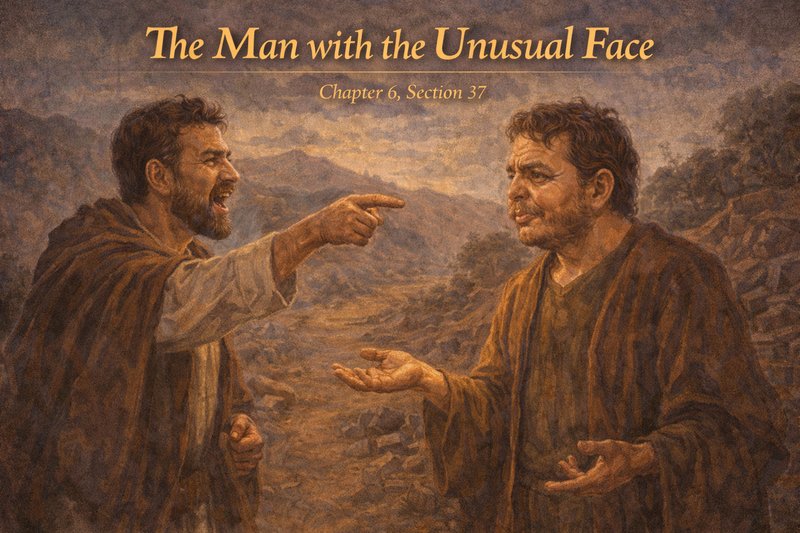
15. The Man with the Unusual Face
Chapter 6, Section 37
A man who had an unusual, misshapen face was walking down the road. Another man met him and began to mock him: "How strange your face is. How distorted your features. Perhaps everyone in your city looks like you."
The man with the unusual face turned to the mocker and said calmly: "Go and say that to the craftsman who made it."
The mocker stopped. He understood what had been said. He had not been mocking a man's face. He had been mocking the work of the Creator of every face. He turned and apologized. He asked for forgiveness from the man — and then from the Holy One who had made him.
What the chapter says
The chapter teaches this story in the context of the prohibition against mocking the physical appearance of another person. The verse says: "The body is the creation of the Holy One, blessed be He." A person who mocks the appearance of another has expressed contempt for divine workmanship. The chapter notes: many people who were born with beautiful appearances have lost them over time. The one who mocked may one day find himself in need of the same tolerance he denied to another.
The correct response when encountering someone who mocks your appearance is the one in the story: not anger, not a return insult, but a calm redirection to the source. This response requires nothing — no argument, no defense — and it achieves everything. It reveals the nature of the criticism and the nature of the critic without a single word of attack.
16. The Iron Chains
Chapter 6, Section 9
An old man was walking through the street, bent deeply with age, moving with the heavy slowness of very old feet. A young man saw him and began to mock the way he walked, laughing at him.
The old man stopped. He turned and looked at the young man. He was not angry. He said:
"Blessed is the One who wills it so. The One who placed iron chains on my legs will place the same chains on yours."
He turned and walked on.
What the chapter says
The chapter teaches: a person who mocks old age mocks what he himself will become — if God grants him the years. The physical difficulties of old age are not a subject for ridicule. They are part of the order of creation, part of what a human life is. The old man's response — calm, without anger, without self-defense — said everything that needed to be said.
The chapter also notes: a woman who takes pride in her appearance and her strength, and uses that pride to look down at those who have less, or who are different, has forgotten that what she has was given to her and will not remain with her forever. When the day comes — as it comes for everyone — that the beauty and the strength are reclaimed, what remains is only how the person treated others with what she had been given.
17. The Cats and the Mice
Chapter 6, Section 14
A man came to visit a friend's house and found an unexpected sight: cats and mice moving through the same spaces in what appeared to be something close to peace. The cats were not chasing the mice. The mice were not fleeing. They shared the house without apparent conflict.
"How is this possible?" the visitor asked. "These are natural enemies."
The hosts explained: two reasons. First — the cats are fed generously every night from our cooking. They are fed to satisfaction before the mice are active, so they have no hunger to act on. A cat that is genuinely full has no need to hunt. Second — the mice eat what the cats overlook or leave behind. There is no competition between them because the house is managed so that everyone's need is met.
"Because of this," they said, "we have peace in this house."
What the chapter says
The chapter teaches this parable as an illustration of the wise management of a household. A woman who provides abundantly enough that there is no scarcity, no unmet need, no competition between the members of the household — creates conditions for peace that look, from the outside, impossible to explain. The chapter says: "Wise women build their houses" (Proverbs 14). The building is not only physical. It is the creation and maintenance of the conditions in which people can live together without conflict.
18. Seventy-Seven Cats
Chapter 6, Section 14
A man encountered a large gathering of cats — their number was seventy-seven — all moving purposefully in the same direction. He asked where they were going.
They answered: to the homes of the lazy and careless women — where food is left out uncovered, where what was bought is forgotten, where the kitchen provides for anyone who is patient enough to wait.
What the chapter says
The chapter teaches: the negligent woman loses her household bit by bit without knowing it. She does not see what walks away in the night. The chapter quotes Solomon: "Wise women build their houses, and foolish ones tear them down with their own hands." Laziness in household management does not simply cost money. It invites in what should be kept out, creates chaos where order is needed, and accumulates damages that compound quietly over time.

19. The King and the Poor Couple in the Garbage
Chapter 6, Section 19
A king and his minister were walking through the city at night. They passed the garbage dump at the edge of the city and saw a light coming from within the refuse.
They went closer. There, in the middle of the garbage, a man and a woman were living. They were in terrible poverty — worn clothing, gaunt faces, nothing around them but what the city had discarded.
The king and his minister worked. From the garbage itself they fashioned what they could: rags into covering, flat stones for a table, broken dishes for plates, cracked bottles for cups. They gathered whatever food was there and arranged it before the couple.
The husband sat down and began to sing. His wife answered him, note for note, verse for verse. He poured water from a broken bottle into a chipped bowl and they toasted each other. They ate from broken dishes and drank from cracked vessels, and they were in a joy — a complete, radiant, extraordinary joy — unlike anything the king had ever witnessed in his palace.
The king stood watching for a long time. Then he blessed them: "May God bless your joy and your delight. May He watch over you always." And he and his minister walked away into the dark.
What the chapter says
The chapter places this story in the context of the teaching: a woman who is content with her portion is a blessing to herself and to her household. The chapter cites the verse from Proverbs: "Better is a dry crust and peace with it than a house full of feasting with strife." The couple in the garbage dump had nothing — and yet they had the one thing that no wealth can purchase and no poverty can take away: genuine contentment with what they had and genuine joy in each other.
A wife who is not content — who always wants what her neighbor has, who creates pressure and dissatisfaction as a household atmosphere — brings a form of poverty that money cannot cure. A wife who can sing at a broken table, with cracked cups and nothing around her but refuse, has brought a palace into the marriage that her husband cannot build for himself.
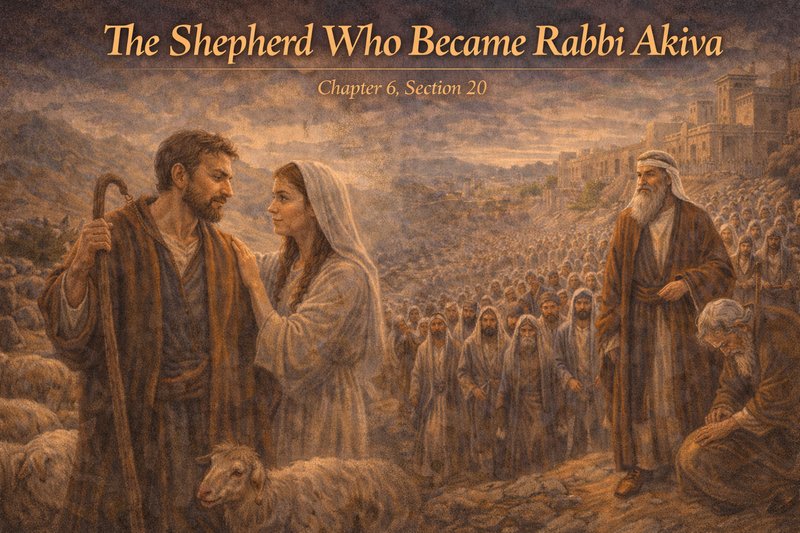
20. The Shepherd Who Became Rabbi Akiva
Chapter 6, Section 20
Akiva ben Yosef was forty years old, a shepherd, unlettered. He had not learned even the aleph-beis. He worked for a wealthy man named Kalba Savua. Kalba Savua's daughter saw him. She saw something in him that had no name — an inner quality, a depth of character — and she said to him:
"If I agree to marry you, will you go and learn Torah at a yeshiva?"
"Yes," he said.
They betrothed themselves secretly, because her father never would have permitted it. Her father disowned her for it when he discovered what she had done — he cut her off from his household and his name and his inheritance.
She sent her husband to study. He went. He was forty years old.
He studied for twelve years. He did not come home.
When twelve years had passed, he returned to his city. He came at the head of twelve thousand disciples. He stopped outside the door of his own house before going in — he wanted to hear what was being said inside.
A neighbor was speaking to his wife. He was pressing her: "Your father was right. Your husband has abandoned you. He has not come back. You have waited twelve years. He has never returned. Go to the courts. Demand a divorce. Rebuild your life."
She answered the neighbor: "If it were up to me — if he asked — I would be happy for him to stay another twelve years."
Rabbi Akiva heard this from behind the door. He understood what she had given him. He turned around. He went back. He stayed for another twelve years.
He returned the second time at the head of twenty-four thousand disciples. His father-in-law, who had never met the great Torah scholar Rabbi Akiva and did not recognize him, came to greet this famous teacher and ask him to release him from a vow he had once made against his daughter — the vow of disownership, made when she had married that shepherd.
"Had the man been a Torah scholar," the father-in-law said, "I would never have made such a vow. For even one chapter, for even one law — I would not have made it."
"I am that shepherd," Rabbi Akiva said.
The old man fell at his feet. He gave his son-in-law half of everything he owned.
What the chapter says
The chapter brings this story as the central illustration of a single principle: a wife who enables her husband's Torah learning shares in the reward of that learning. The chapter quotes the teaching of the sages: Rabbi Akiva said to his disciples, "Whatever is mine and whatever is yours — belongs to her." Everything that he had become and everything that his students had learned flowed back, in his accounting, to the woman who had seen something in him before there was anything to see, and had given him the years to become it.
The chapter also notes the specific moment of her words to the neighbor: "I would be happy for him to stay another twelve years." She said this without knowing he could hear. She said it to the neighbor who was pressing her to abandon him. This was not a performance. This was who she was. And it was precisely because she did not know he was listening that the words carried the weight they carried.
21. The Mother Who Sent Her Daughter to Her Husband's House
Chapter 6 — From Bereshit Rabbah / from the Midrash on a wise mother's instruction
A wise mother, on the day she was sending her daughter to her husband's house to begin their life together, took the girl aside at the threshold and spoke to her.
She said: "My daughter. Listen to my words. Do not be too soft and do not be too harsh. Do not be too sweet and do not be bitter.
"Stand like this: when your husband comes home, go to meet him at the door. When he comes in, let him find warmth and readiness, not distraction or complaint. When he speaks, listen fully. When he is tired, do not press him with questions. When he is in difficulty, do not add to it with your own needs.
"My daughter, you are not going to a friend's house or to your mother's house. You are going to the house of a man. Treat him as a king treats his lord, and he will treat you as a king treats his queen. The way you approach him in these first years sets the shape of the house for a lifetime. And whatever he does to you, forgive him."
She gave her daughter a blessing and sent her on her way.
What the chapter says
The chapter cites the principle from Sefer Chasidim and from the Maharal: a woman's conduct toward her husband determines, in large part, the quality of the peace within the house. The sages said: "A man's house is his wife." The chapter notes that this saying cuts both ways — it describes her centrality in the household, and it also places on her a responsibility that cannot be transferred. What she builds, she builds. What she tears, she tears.
The chapter quotes the verse from Proverbs: "Wise women build their houses, and foolish ones tear them down with their own hands." The wise mother in this story knew this from experience and was transmitting it to the next generation. The instruction she gave her daughter was not a list of rules but a framework of orientation: how to be present in the house, how to meet a husband, how to create the conditions for peace.
22. Abraham Visits Ishmael — The Threshold
Chapter 6, Section 25 — From the Midrash
When Abraham parted from his son Ishmael and Ishmael had gone far away, Abraham went one day to visit him. Ishmael was away. His wife was at the entrance to the tent.
Abraham came to the tent entrance as a stranger — an old man, tired from the road, not revealing who he was. He was only visiting to see the household his son had built.
The wife looked at this old, tired man at her door and received him with indifference. No water, no food, no welcome of any warmth. She gave him the absolute minimum and no more.
As Abraham was preparing to leave, he said to her: "When your husband comes home, give him this message from me: the threshold of his house needs to be replaced."
Ishmael came home. His wife gave him the message. He understood. He knew his father had visited. He knew what had been seen. He divorced her.
Abraham came again, later, after Ishmael had taken a second wife. He came the same way — as a stranger, old, tired from the road, not revealing himself.
The second wife looked at this old man at her door and gave him everything: water, food, warmth, genuine welcome. She cared for him with grace and attention, as if he were the most important guest who had ever arrived. She gave not because she knew who he was, but because this was her nature.
As Abraham was leaving, he said to her: "When your husband comes home, give him this message: the threshold of his house is good. Let him keep it and honor it."
Ishmael came home. His wife gave him the message. He understood. He knew his father had visited. He knew what had been seen. From that day he loved his second wife deeply — he honored her and showered her with gifts.
What the chapter says
The chapter draws from this story the teaching about how a wife should receive her husband's guests and family. The test Abraham performed was not about etiquette. It was about what a person is when no audience is expected — how she treats a stranger, how she behaves toward the person in front of her when there is no self-interest in the equation.
The chapter quotes the principle: who you are to the stranger at the door is who you are. A threshold is not a piece of wood. It is the opening through which the people in a family's life pass. The wife who makes that opening warm — who gives generously to everyone who arrives, without calculating the return — has built something that no amount of money or status can substitute.
The chapter also draws the negative lesson from the first wife: a woman who is cold to her husband's people, who gives the minimum and no more, who fails to honor what he values — creates a household that his father could not enter. The message "replace the threshold" was not about the door. It was about the woman standing in the doorway.
23. The Woman Who Borrowed Millstones
Chapter 6, Section 25
A woman needed to borrow millstones and some kitchen items from her neighbor. She walked to the house. The door was closed. She knocked and pushed on the door firmly while she waited.
From inside: "Who is knocking at our threshold?"
She gave her name.
"Honor yourself, my Lady So-and-so," came the reply from inside — meaning: please wait, I am coming.
The door opened. The woman of the house greeted her visitor with genuine warmth. She asked first about the family: "How is your husband? How are the children? Is everyone well?" Only after asking about the people did she ask: "What do you need, my sister?"
"I need some millstones and a few dishes."
"Here we are," the hostess said. "We are entirely at your service. Take whatever you need. I am happy to give it."
What the chapter says
The chapter notes two contrasts in this small story. The woman who needed something pushed open the door while she waited — she was already pressing, already announcing her priority, before she had even been invited in. When she is inside, the woman of the house models the opposite: she asks about people before she asks about purposes.
The chapter teaches: a woman who asks about people before asking about things, who speaks with grace even when she is the one who came to request something, finds that every door opens for her. This is not strategy. This is character, and character is felt. People recognize the quality of another person and respond to it. A woman who carries warmth and genuine interest in the people she encounters brings that quality into every interaction — and that quality is itself a form of household building, because it creates the web of goodwill and mutual support on which a family depends.
24. The Husband Who Miscounted His Years
Chapter 6, Section 28
A husband and wife were sitting together, speaking easily about ordinary things, when the conversation turned to the question of how many years they had been alive.
"How many years have you lived?" the husband asked her.
"Twenty-five," she answered.
"You are wrong," he said. "We have been married for twenty years. You are older than twenty-five."
"I am not wrong," she said. "The years of my youth — the years I spent carelessly, before I took hold of our Torah and our faith and began to live with intention — those years I do not count. They were years of existing, not years of life. The day I woke up and began truly living — that is twenty-five years ago."
Her husband was quiet. Something moved in him. Then he said: "You have woken me from my own mistake. I have been counting myself as a man of seventy years. But I realize now that I am only forty."
He had been counting from birth. She had been counting something else — the years that built something, the years that accumulated into a life in service of something real.
They turned it into a prayer: may God in His mercy give us years of life for His service. Years that count.
What the chapter says
The chapter cites this story in the context of its teaching about the proper way to understand the passage of time and the value of each day. The principle comes from the verse in Ecclesiastes (9:11): "Time and chance overtake them all." The chapter teaches that a person who spends years in idle or wayward living and then returns to Torah and to service of God has genuinely begun his life anew. Those earlier years are not, in the fullest sense, his years — they do not belong to him in the way that years lived in service of God belong to him.
The wife in this story was the one who held this understanding. She offered it to her husband not as a rebuke but as a gift: the realization that they had more time — in the only sense that matters — than he had thought. This is described in the chapter as a form of wisdom that a wife can give her husband: a correction of perspective that opens the future rather than mourning the past.

25. The Scholar's Son and the Candle
Chapter 6 — from the Talmudic narrative about Rabbi Akiva's son
When Rabbi Akiva's son married, he brought his bride home. On the first night, he sat and studied Torah through the night — reading aloud, working through the text — as a Torah scholar does. The candle burned low as the hours passed. His wife took it in her hand and held it steady for him through the entire night, so that his learning would not be interrupted.
Rabbi Akiva came in the morning. He looked at his son, and he looked at the candle — still in her hands, the evidence of the night still present. He understood immediately what had happened.
He asked his son: "Did you find her, or did she find you?"
"She found me," the son said.
"Then blessed is the One who guided her steps to yours," Rabbi Akiva said.
What the chapter says
The chapter teaches: a wife who supports her husband's Torah learning — who holds the candle, who removes obstacles from his path, who creates the conditions in which his study can happen without interruption — shares in every word he learns and every insight he reaches. The sages stated this principle explicitly: Rabbi Akiva told his students that whatever they had achieved, the credit belonged to his wife Rachel. The Talmud derives this principle from the verse in Ecclesiastes: "Enjoy life with the wife you love."
The small gesture of holding a candle through the night says, without words: I know what matters to you. I want to protect it. The greatness of this act is that it requires no heroism — only attention and love. A marriage that begins with that quality of attention has built something real before the first day is over.
IV. What the Kabbalists Recorded
26. The Arizal on His Wife
Sha'ar HaGilgulim, Introduction 8 — Chapter 2 on First and Second Matches
The Arizal — Rabbi Yitzchak Luria of Tzfat — wrote in his own words, in the Sha'ar HaGilgulim (Introduction 8):
"Know that there is no soul among all the sparks of my root that is as close to me as the spark of Rabbi Akiva. Everything that happened to him happened to me. My wife Chana is a reincarnation of the daughter of Kalba Savua — who was Rabbi Akiva's wife."
He explained: his wife Chana's soul was originally a male soul that had been reincarnated in a female body. This was why she had not been able to bear him sons through the ordinary means — because a second female soul had to join with hers to make conception possible. That second soul was the soul of the wife of Turnus Rufus, the Roman governor, who had later converted and married Rabbi Akiva in his old age.
He concluded with the words of his teacher, the Ramak: "My wife is truly my destined one — from my mother's side of my soul's root."
What the Sha'ar HaGilgulim teaches about first and second matches
The Arizal teaches in Sha'ar HaGilgulim: all souls descend to this world in pairs — male and female together — before they are born. When their time comes to enter this world, the Holy One separates them. They come down separately, each into different bodies, and they search for each other in life.
A first match — for souls that have not been through a gilgul, a reincarnation, and are meeting in this world for the first time — happens naturally and without great difficulty. The souls recognize each other. They flow together as water returns to its own level.
A second match is different. Here, the souls have been through previous lives. A soul may have already been paired with another in a previous lifetime. Through sin or through other circumstances, the original pair was separated. The soul enters a new life, and its original mate may be with someone else, or waiting, or not yet ready. For such souls, the reunification requires the force that the sages compared to the splitting of the Red Sea. It does not come easily. It requires merit, prayer, and divine intervention of a higher order.
This, the Arizal says, is the story of his own marriage: the echo of Rabbi Akiva's marriage across many centuries and many gilgulim, the two souls from the root of his own neshamah finding each other again across lifetimes.
27. The Holy Fire in the Letters
Yalkut Shimoni on Genesis, Chapter 8 on Husband and Wife
Rabbi Yehoshua ben Korcha asked: why is the woman called Isha — from the word for man, Ish?
He answered: because the Holy One placed the letters of His name between them. The yud of Ish and the heh of Isha — together, Y-H — two letters of the divine Name.
When a husband and wife walk in God's ways, His Name rests between them and they are protected from every trouble.
When they do not walk in God's ways, His Name departs. What remains of Ish without the yud is Aleph-shin: Esh — fire. What remains of Isha without the heh is the same: Esh — fire. Two fires, burning each other.
What the Maharal says
The Maharal explains this teaching in the Be'er HaGolah: the divine Name between husband and wife is not metaphorical. It is a description of the spiritual structure of a marriage that is lived in accordance with the Torah. When a husband and wife are what the Torah calls them to be — when they fulfill their obligations to each other with faithfulness and with holiness — the divine Presence actually rests in their home. The Talmud states this explicitly: "When the Shekhinah rests between husband and wife."
The reversal — fire — is equally real. When a marriage is not lived in Torah's ways, when the divine Name is absent from the space between them, the intensity that makes two people into something larger than either can become destroys rather than builds. The same fire that, in a holy marriage, illuminates — consumes when there is nothing to contain it.
28. The Chasid Who Sighed and Lost His World to Come
Attributed to a student of Reb Ber of Mezritch — Chapter 12
This story was told of a great rav — a man of deep piety and Torah learning who was still in the years before his greatness became widely known, when poverty was his constant companion.
One day his wife came to him, unable to hold back the full weight of their situation. She began to describe it: the children were hungry. There was no covering. The gap between what they needed and what they had was growing and showed no sign of narrowing.
He listened to her. He heard everything she said. And then he sighed.
A voice came from Heaven: you have lost your portion in the World to Come.
He stood very still. He thought about what this meant. He had nothing in this world — his children were cold and hungry. And now he had lost his portion in the World to Come as well. Both worlds, empty.
Something clarified completely in him in that stillness. He thought: if there is nothing left in either world — then there is only one way to serve God. Not for reward. Not for the World to Come. Not for this world. Simply because He is God. Simply because this is what God wants.
He returned to his learning with a fire that had not been there before.
That same day, a voice came again from Heaven: his portion in the World to Come was restored.
He was told: from now on, do not sigh over the children's suffering. Not because their suffering is unreal. But because God's mercy — which sees everything and arranges everything — is already more than you can conceive. The sigh had been, without his awareness, a small accusation placed at the door of Heaven.
What Sefer Derech Eretz draws from this story
The book draws two teachings from this story — stated explicitly in the text. The first is the teaching from another story about the student of Reb Ber of Mezritch about another posek: the proper response to difficulty is to receive it with love, as a divine decree, not to present it upward to Heaven as an accusation or a grievance. The sages taught: "Fortunate is the person whose rebuke comes from God with love." A decree accepted with love generates merit. A decree met with resentment or accusation — even a quiet sigh — expresses a lack of trust in divine mercy.
The second teaching is about the wife. The chapter notes: the wife came to her husband with her grief out of the power of a mother's love for her children. Her intention was not to harm him. She spoke the truth of what she saw. But the effect of her words on him — leading to the sigh, leading to the loss of his World to Come — is itself a teaching about the responsibility a wife carries in how she brings difficult things to her husband. The chapter is not blaming her. It is noting that the wife of a Torah scholar must be attentive to the impact of how and when she speaks of hardship, because the spiritual stakes are higher than she may realize.
V. The Laws of Shidduchim — Stories from Chapter 24
29. The Orphan and the "Relative" of the Chafetz Chaim
Chapter 24 on Shidduchim — responsum of the Chafetz Chaim
A matchmaker was working a shidduch. An orphan girl with modest circumstances and no powerful family name was being suggested to a Torah scholar. In describing her to the scholar, the matchmaker mentioned, in passing, that she had a connection to the household of the Chafetz Chaim. This was not precisely true — but it was not precisely false either. All of Israel are, in some sense, related.
The scholar became interested, in part because of this description. He pursued the match. Later, when the girl's family heard what had been said, they came to the Chafetz Chaim himself with the question: was this permitted?
What the Chafetz Chaim ruled
The Chafetz Chaim ruled carefully. He cited the Talmud in Ketubot (17a): "How does one dance before a bride? One praises her." The sages noted that Beit Shammai said one should only state what is actually true of the bride, while Beit Hillel said one always praises the bride as beautiful and gracious, regardless of her appearance. The halacha follows Beit Hillel. This permission has a reason: in matters of shidduchim, the Torah creates a special latitude for framing and warmth that does not exist in ordinary commerce or speech.
The Chafetz Chaim then applied this principle to the matchmaker's description. If the match was genuinely good — if those two people truly belonged together — and if the matchmaker's description was the bridge that allowed them to find each other, then the description served the truth even if it went beyond the exact fact. The spirit of the halacha permits this.
But the Chafetz Chaim also stated the limit clearly: the latitude exists for framing, for bridging distance, for creating the conditions that allow two suitable people to give each other a chance. It does not exist for deceiving someone about the substance of who they are marrying — not about character, not about health, not about circumstances that would materially affect the other person's decision. The latitude covers approach; it does not cover substance.
30. The Matchmaker and the Old Man's Proposal
Chapter 24 — Laws of Shidduchim, on appropriate matches
An old man came to a matchmaker — genuinely old, past the ordinary age for marriage — and asked the matchmaker to arrange a match for him with a particular young woman who was being sought by many young men.
The matchmaker refused. He said: "I will not arrange this. She has no desire for you. If I force this connection, I bring immorality into the world. The Torah says: 'Do not profane your daughter into harlotry' — and this means arranging a match that a young woman did not choose freely."
The old man pressed the matchmaker: "She told me herself that she prefers me. She knows me and she values me because I am a good Jew."
A decisor was asked to rule. His ruling was clear: if she is choosing him freely — if she has been told everything, if nothing has been concealed, if her preference is genuine and uncoerced — the matchmaker may proceed. The prohibition applies to force and to coercion. Where the desire is real and the choice is genuinely free, the matchmaker's job is to serve the souls involved, not to impose his own picture of what a match should look like.
What Sefer Derech Eretz says from the Rambam
The Rambam states in Hilchot Ishut: "A man may only take a wife who is appropriate for him." The book cites the Rambam's subsequent statement that a wife taken for beauty alone or for money alone — where the intention is not for the sake of Heaven — creates damaged offspring. The spirit of the law on appropriate matches is not about age or conventional pairing — it is about the intentions and the genuine suitability of two people for each other.
The Sefer Chasidim adds: pray every day for your destined match. Ask for a wife who is appropriate for you in character and in values. And the sages said: one who marries a woman for her money will have unsuitable children from her, and one who marries her for her character will be blessed.
31. The Pious Man Who Hosted the Guest and Saw His Fortune Decline
Sefer Chasidim — Chapter 14
There was a man who was prospering in everything — children, property, health, good standing. He was content and grateful for what he had.
One day a pious wanderer came to his door. He welcomed him in, hosted him generously, fed him and gave him lodging and care.
From that day, things changed. Business became harder. Property declined. The good fortune that had been consistent began to slip away.
He might have concluded: this holy man brought misfortune. Instead he reflected and said:
"Before this man came to my door, I can see now that everything I had was beyond what I had earned. What I thought was mine was actually a deposit — held in my hands until a more worthy custodian arrived. When this pious man came, Heaven reassigned the deposit. It had always been destined for whoever could carry it with the appropriate spiritual weight."
He remembered the verse: Laban said to Jacob, "God has blessed me for your sake." When the righteous person is present, blessing follows. When he leaves, the borrowed blessing departs with him.
He accepted this. He began rebuilding his character and his service from the ground up — not from the inherited surplus, but from what he could honestly earn.
Several years later his fortune returned — this time built on a foundation that was genuinely his.
What Sefer Chasidim says
The Sefer Chasidim states: when a righteous person comes to stay in a man's house, the blessing of his presence fills the house. This is the meaning of the verse about Potiphar's house being blessed for Joseph's sake, and Laban's house being blessed for Jacob's sake. But this blessing is lent, not given. It belongs to the righteous person, and when he departs it departs with him. A man should not mistake borrowed blessing for his own earning. His own earning must be built through his own character, his own service, and his own merit.
32. The Scholar and the Wife Who Drove Him to Torah
Chapter 6, Section 44 — from Talmud and Midrash
A mother came to a sage seeking to arrange a match for her daughter. The sage asked: "From what will your son-in-law support himself? From his books? From the candles of his study?" She refused him. "He will not be able to support my daughter," she said, and she took her daughter and gave her to a wealthy young man who was not a scholar.
Time passed. Fortunes reversed. The wealthy family lost everything. The couple learned the trade of bookbinding. The scholar's wife's former husband — the one the mother had chosen over the sage — came to buy books. And the woman who had been matched to the wealthy man was the one who sold them, earning the household's living from the very books she had dismissed.
The book says: look at this, women. Look at the treasury of the compassionate Creator.
What the chapter says
The chapter then tells the contrasting story: a young man from the city married a local girl and when his wife brought him the Gemara he said "give me that" — and she gave him the cigarette box instead. When he asked for the Zohar she brought him the bag of pearls. When he said "what is this game?" she replied: "Because I see that you never actually learn, and your father was among the notables of the city, and you spend your time only on letters and pamphlets — you have left us to waste our time in business. Be quiet, foolish woman: Torah will shelter us and protect us. We will live and be sustained and profit in this world and in the World to Come."
When the wife heard these words of praise from her husband, she changed her mind. She began to repent. She said: "I sinned in my words, my husband. I was wrong and you were right to call me foolish and stupid. From now on, whatever you wish to learn, ask me, and I will bring it. I will also kiss it. And please, my husband, read Torah to me so I can hear it, and God in His glory will forgive me."
The chapter says: this is the treasury of the compassionate Creator.
33. The Woman Who Prayed Every Day
Tractate Ta'anit — from Chapter 44 on Prayer
A woman was known in the city for going to the synagogue every day without exception, to pray with the congregation. One day as she was on her way to pray, a man standing nearby mocked her. He pointed at her prayer book and said: "Your prayer is not in that book. You left it at home."
She stopped. She told him a parable.
"A guide was traveling through the wilderness. Suddenly a lion blocked his path. He could not go forward and he could not retreat. He said to the lion: 'Wait — all my wisdom is stored in a cave not far from here. Let me go and retrieve it, and I will give you the best counsel of my life.' The lion agreed. The man fled. The lion waited a long time. A wise man came by and asked the lion why it was waiting. The lion told him. The wise man said: that man has no wisdom in any cave. What he called wisdom was exactly the thing that let him run. He has no wisdom at all."
She then said to him: "My prayer lives here" — she pointed to her chest — "in my heart. It does not live in a book. You, however, have left your heart somewhere else. You will need to go back and find it before you can enter this house of God."
He stood there with no answer.
What the chapter says
The Talmud in Tractate Berachot (31a) derives the laws of concentration in prayer from the verse: "And Hannah spoke in her heart." The mouth moves but the heart is the essential organ. A prayer that is externally correct but internally absent is not the prayer the Torah describes. The woman in this story prayed from her heart. The man who had forgotten his heart could not recognize hers because he had no access to his own.
The chapter draws from this story a teaching about the priority of internal consistency: a woman who prays with her heart, whose external behavior flows from internal conviction rather than external pressure — such a woman's prayers are answered. The woman who prays only because it is expected, only because an audience is present, has not yet begun to pray in the sense that Hannah meant when she "spoke in her heart."
VI. The Splitting of the Sea
34. First Match and Second Match
Tractate Sotah 2a; Maharal, Be'er HaGolah; Zohar, Mishpatim — Chapter 1
Rabbi Yochanan said: "It is as hard before the Holy One to arrange a match as it was to split the Red Sea."
The Talmud then says: "And this is said only of the second match."
What the Maharal says — Be'er Revii
The Maharal explains: there are two kinds of matches, and they operate differently.
A first match is the pairing of two souls who are each other's true destined partners, who have not yet been through a gilgul, and who are descending to this world together for the first time. For such a match, the Zohar says: forty days before the formation of the child, a divine voice announces "this person's daughter for this person's son." The announcement is not a new creation — it is a restoration of what was already true before they descended. The souls were already paired. The announcement restores what was always the case.
For such a match, the joining is natural. It flows like water returning to its source. It may require effort and prayer to arrange, but the underlying force moves in the right direction. The Maharal says: as the sea was one before it was split, so the first pair was one before they were separated into male and female. Bringing them back together is like allowing what was one to become one again.
The second match is different. Here the souls have been through previous lives. A soul may have been given to a wrong match in a previous gilgul, or the original pairing may have been disrupted by sin. The soul enters a new life, and its true destined partner may be with someone else. For Heaven to arrange this reunion — to take back what was given to one and give it to another, to work against the grain of what was already arranged — requires the same kind of divine force that stood at the sea's edge and split the waters. The sea did not want to be split. The waters pushed back. God split them anyway.
The Maharal's point is not that the second match is better or worse than the first. It is that it requires a different order of divine intervention — and that this intervention is possible, as the sea split, when the time is right and the merit is sufficient.
What the Zohar says — Mishpatim, Abas
The Zohar teaches: all souls descend to this world paired. When their time comes for union, the Holy One brings them together. He announces "this man's daughter for this one" — and when they are joined, they become one body and one soul.
But for souls who have already been through lifetimes — who carry the accumulated weight of previous gilgulim — the pairing is more complex. The Zohar describes a righteous soul that is waiting for its match, but its match is still occupied with completing a previous gilgul. Such a soul waits in a state of suspension, as it were, until the conditions are right. The Zohar says of such a righteous person: "He who deserves will earn his destined partner at the right time."
35. What the Altar Weeps For
Tractate Gittin 90b — Chapter 23
The Talmud states: "Anyone who divorces his first wife — even the altar weeps for him."
The verse cited is from Malachi: "And this second thing you have done: you cover the altar of the Lord with tears, with weeping and sighing, because He no longer turns to the offering or accepts it with favor from your hand."
What the Talmud and the Rishonim say
Rabbi Elazar derived from this verse that the altar itself registers the dissolution of a first marriage. The Talmud asks: why specifically the first wife? The Rishonim explain: a first wife carries a bond with her husband that subsequent marriages do not carry in quite the same way. Not legally — legally all marriages are equal. But the first wife represents the years of building: the shared history, the trust, the household constructed together, the life learned together. When what was built over those years comes apart, the altar — the place in the Temple closest to Heaven — is affected.
The sages do not say divorce is forbidden. They say: whoever sends away his first wife, even the altar weeps. This is a statement about the weight of what is being done, not a prohibition. The point is that a divorce should never be casual, never be undertaken without genuine necessity, and never be sought merely because someone better or newer has appeared. The altar's tears are a record of what is lost.

36. The Woman Who Tested Her Husband Three Ways
Chapter 23 — on the importance of knowing one's spouse's character before committing
A wise, discerning woman of mature years had waited and refused many matches. She knew what she was looking for and had not found it. A man was suggested to her with strong testimonials from many people. She agreed to pursue the match.
But she decided privately that she would not go forward without knowing what was genuinely inside him.
On the second night after the wedding, she brought wine and poured generously, refilling his cup again and again, waiting until the wine had done its work — lowered his guard, stripped the social presentation from him. She listened carefully to what came out. What she heard troubled her.
She did not act immediately. She told herself: one test is not enough. I am already married to him. I need more information.
On the third night she proposed that they play cards together, just the two of them. She watched how he played — whether he was honest, whether he cheated without thinking about it, whether his character under mild pressure was consistent with the face he showed the world.
She saw what she saw.
What Sefer Derech Eretz says from the Talmud
The book cites the Talmud's teaching: "A person is known in three things — his cup, his pocket, and his anger" (koso, kiso, ka'aso). The cup reveals what is inside when the guard is down. The pocket reveals character when self-interest is at stake. Anger reveals the person when he is thwarted.
The book brings this story as an illustration of the principle that a person should know the character of the one they intend to marry — not from testimonials alone, but from direct observation in unguarded moments. The woman in the story was not being deceptive. She was doing what wisdom requires: observing. The Shulchan Aruch and the responsa literature both state that one is forbidden to marry someone who is genuinely wicked. The difficulty is that wickedness is often hidden in the early stages of courtship. This woman understood this, and she took practical steps to see past the presentation.
VII. What Rachel Is Still Owed
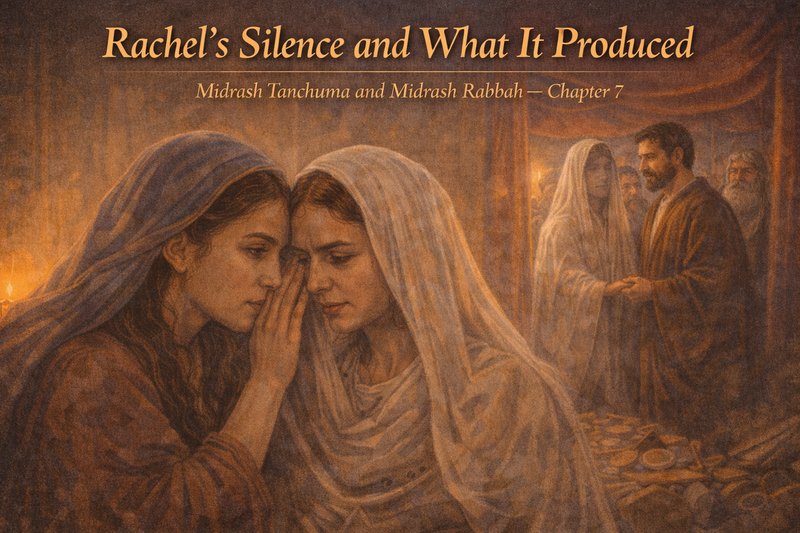
37. Rachel's Silence and What It Produced
Midrash Tanchuma and Midrash Rabbah — Chapter 7
When Jacob came to marry Rachel and Laban substituted Leah under the wedding canopy, Rachel knew. She had time to warn Jacob. She had arranged private identifying signs with him — signals that only they knew — precisely to prevent this kind of substitution.
She gave the signs to Leah. She told her sister everything — every identifying mark, every secret signal that was meant to be only Rachel's. So that Leah would not be humiliated under the canopy. So that Leah would not be exposed.
Rachel held all of this inside herself in silence, on the night she had been waiting for through seven years of labor.
What the Midrash says
The Midrash Tanchuma (Vayetzei) records the generational consequence of Rachel's silence. Rabban Shimon ben Gamliel said: "In all my days I was raised among the sages and I found nothing better for a person than silence." He derived this from Rachel — who stood in silence and by that silence raised up two tribes in Israel more than the others: Ephraim and Manasseh (the sons of Joseph) and Benjamin.
The Midrash traces the inheritance through the generations. Benjamin was born from Rachel and kept silence at his coronation. Joseph kept silence when sold. The quality of silence — of holding what you know, of not weaponizing your pain — passed through the lineage as a living inheritance.
Then the Midrash brings the verse from Jeremiah: "A voice is heard in Ramah, lamentation and bitter weeping. Rachel is weeping for her children; she refuses to be consoled because they are not there." And God answers: "There is reward for your work. Your children will return."
The Midrash says: "For your work" — not for your tears. The word is specifically for the act, the deed, the thing she did. The account that was opened on the night she gave her signs to Leah was never closed. When her children needed intercession in their darkest hour, the merit was still there, still accruing, still waiting.
38. The Shunamite and Her Single Word
Second Kings 4 — Chapter 16
The Shunamite woman had a fixed practice: every Shabbat and every Rosh Chodesh she would travel to the prophet Elisha to receive Torah from him. Her husband did not share this level of devotion — he was a decent man but this was not his world.
One day — not Shabbat and not Rosh Chodesh — she saddled the donkey to go. Her son had just died. She was going to find Elisha.
Her husband asked: "Why are you going today? It is neither New Moon nor Sabbath."
She said one word: Shalom. All is well.
She did not explain. She did not argue. She did not tell him what had happened. She said Shalom — and she rode to find Elisha.
What Sefer Derech Eretz says
The book cites the commentary on this verse that says: there is a level of wisdom in a marriage where a woman knows when explanation will help and when it will only create noise. The Shunamite needed to act quickly and she needed her husband not to stop her. At that moment, the best and truest thing she could say was Shalom — because in the deepest sense, she believed that all would be well. She was going to the man of God. She trusted that God would act through him. She was right.
The book cites this story in the chapter on the proper speech of a wise woman. It notes that wisdom sometimes expresses itself in a single word. The Shunamite woman's "shalom" was not evasion. It was the compressed confidence of a person who knows where she is going and why, and who does not need her husband's permission or understanding to take the right step. The Talmud praises her: she is called a "great woman" in the text, and the sages said that what makes a woman great is exactly this kind of purposeful, grounded confidence in her service of God.
39. What the Altar Knows About First Wives — The Full Teaching
Tractate Gittin 90b; Maharal, Be'er HaGolah — Closing of Chapter 23
The Talmud preserved three positions on what justifies divorce. Beit Shammai said: only if she has committed a matter of immorality. Beit Hillel said: even if she burned his food. Rabbi Akiva said: even if he found someone more beautiful than she is.
The halacha permits what the halacha permits. The sages did not prohibit divorce. But immediately after recording these three positions, the Talmud adds: "Anyone who divorces his first wife — even the altar weeps for him."
What the Maharal says
The Maharal explains: the fact that all three opinions agree that one who divorces his first wife causes the altar to weep teaches that the altar's tears are not about whether the divorce was technically permitted. They are about what is lost in every dissolution of a first marriage, regardless of the formal grounds.
A first marriage is, in the language of the Zohar, the reunion of what was always one. The couple was paired before they descended to the world. They found each other in this world. They built a household together. They learned how to be a household together. When that structure comes apart — whatever the reason — something real, something built, something divine is undone. The altar registers this not as judgment but as grief.
The teaching is not that divorce should be avoided when it causes harm or when the marriage is genuinely over. The teaching is: know what you are doing when you do it. The altar's tears exist so that a person does not walk away from a first marriage casually, without understanding the full weight of what is being set aside.
Thirty-nine stories from Sefer Derech Eretz. Every fact, every character, every line of dialogue — from the original sources as cited in the book. Every explanation — drawn only from the sources the book itself cites: the Maharal, the Zohar, the Arizal, the Ben Ish Chai, the Chafetz Chaim, the Rambam, and the Talmud. Nothing added. Nothing invented. The stories are what they always were, and the teachings behind them are what the tradition actually says.
Sefer Derech Eretz: Halachot and Teachings on Shidduchim — Rafi Newman