
How This Works
Yismach AI matched you based on your Love Map — your relational patterns, not just your preferences. Tonight you will practice the skills that determine whether two compatible people can actually connect when they sit across from each other.
Each of you has this document on your own device. Some sections are marked JUST YOU — those are private coaching notes, only for the person reading them. When a step says “when you’re both ready,” talk to each other and continue together. The full protocol takes approximately four hours. Move at the pace that feels right.
The protocol produces genuine encounter between two people who would not reach it through any standard shidduch format. The structure does the work. Your only job is to show up without the mask.

The Five Things Being Practiced
Every exercise in the protocol trains one or more of these five competencies. They are not personality traits — they are behavioral skills, each trainable through structured practice regardless of temperament or prior experience.
– Authentic self-presentation — communicating who you actually are without performing a curated version of yourself.
– Attunement — accurately perceiving another person’s emotional state from behavioral cues: posture, vocal quality, micro-expressions, response patterns.
– Calibrated self-disclosure — sharing genuine personal material at a depth and pace that matches the relational context and your partner’s reciprocal disclosure.
– Perceived partner responsiveness — demonstrating through word and behavior that you have genuinely heard, understood, and valued what your partner shared.
– Commitment expression — communicating interest clearly and without ambiguity, nonverbally before verbally, in ways that feel honest rather than performed.
The Play Frame
The word “play” in Play Date is not branding. It is a pedagogical claim. Jaak Panksepp’s affective neuroscience identifies PLAY as one of seven primary emotional operating systems in the mammalian brain. The PLAY system, when active, is incompatible with the FEAR system. A person whose FEAR system is activated — monitoring how they appear, rehearsing their next statement, calculating their odds — has no bandwidth left for actual encounter. Every standard shidduch date activates the FEAR system. The Play Date, by establishing a play frame through the architecture of the exercises themselves, activates PLAY and suppresses FEAR. This is the mechanism. It is not reassurance. It is structure.
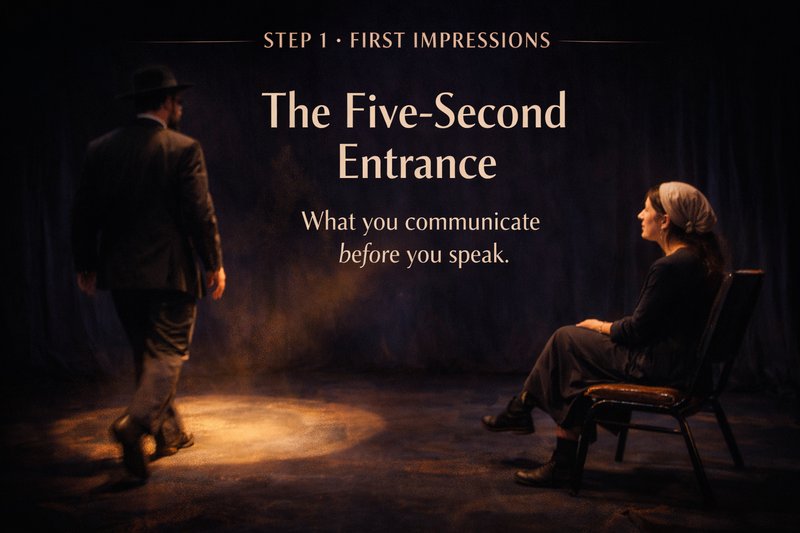
The First Impression
Before you speak to each other — before the exercises begin — each of you writes your first impression privately. Write what you actually notice, whatever is there. This stays private until the very end of the evening, when you will both show your screens or papers simultaneously. Keep it somewhere you can find it.
JUST YOU Write this now, before you speak: I notice… I feel / assume… Set it aside. You will return to it at Step 9.
One at a time: stand up, walk to the other side of the table or across the room, make eye contact, say your first name, sit back down. While the other person walks, write two things on a piece of paper:
– I noticed… (something behavioral — how they stood, where they looked, how they moved)
– I felt / assumed… (the impression it created in you)
After you have both gone: read what you wrote to each other. Not as criticism. As data.
READ ALOUD TOGETHER BEFORE YOU BEGIN
“This is data, not destiny. What you’re about to hear is what your entrance communicates — not who you are. Say what you actually noticed. Receive it without defending it.”
WHY THIS MATTERS
Most connections fail before they start because of a first impression that was never examined. Almost no one in shidduchim has ever received honest feedback about what their entrance communicates. This exercise delivers it — between two people who have agreed to handle it with care.
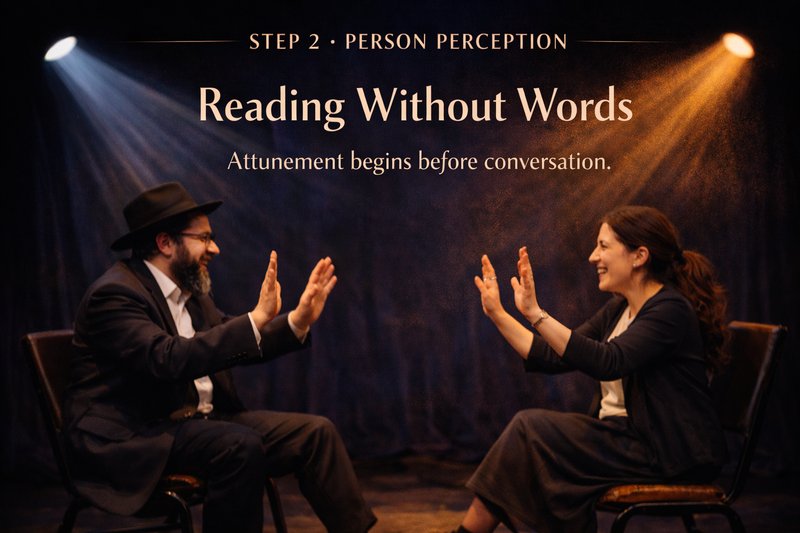
Somatic Check-In + Three Improv Exercises
Begin with the somatic check-in, then move through three improv exercises in order. Each one builds a different attunement muscle.
JUST YOU Do this silently and separately first. Close your eyes for 60 seconds. Notice: where in your body do you feel the most tension right now? Where do you feel the most ease? What is one word for the overall state you walked in with tonight? Open your eyes and say your one word out loud to each other — no explanation needed. Just the word.
EXERCISE 01 — MIRROR WITHOUT TOUCH · 5 MINUTES
Face each other. One leads movement; the other mirrors as precisely as possible. Switch leader at 60 seconds. Then 60 seconds with no designated leader — find shared movement together.
“Your job is to make your partner feel easy, not impressed. Slow is kind.”
EXERCISE 02 — YES-AND STORY SPINE · 8 MINUTES
One person starts: “Once there was a…” The other continues: “And every day…” Alternate back and forth, each addition beginning with “Yes, and…” If one person takes two turns in a row, pause and offer the thread back.
“If it goes somewhere unexpected, that’s correct.”
EXERCISE 03 — SILENT SCENE · 4 MINUTES
No words. One person silently acts out receiving good news, then bad news. Their partner responds — also silently — to each. Switch.
“Read your partner’s face, not their words. There are no words.”
WHY THIS MATTERS
The somatic check-in activates your ability to read your own internal state — the prerequisite for accurately reading someone else’s. You cannot attune to another person if you cannot first locate yourself. The improv exercises then build the attunement muscle outward: nonverbal co-regulation before verbal disclosure.
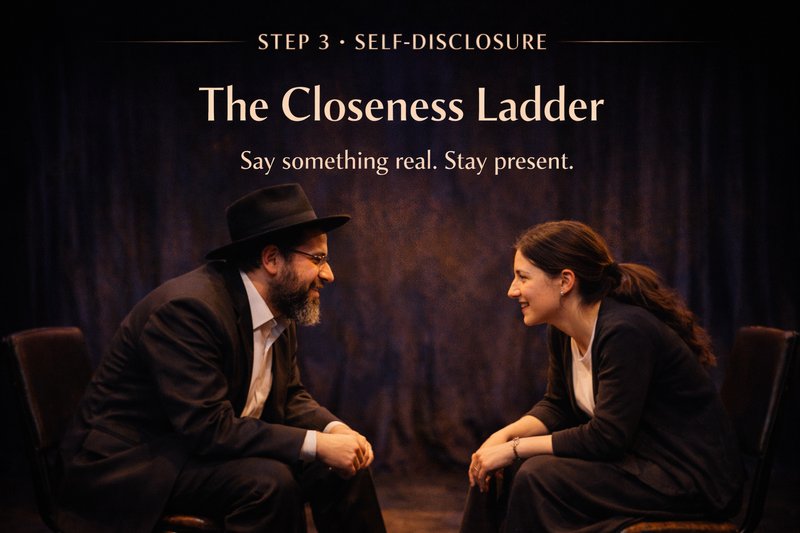
Step 3 Self-Disclosure · Together · 2 minutes per prompt
Closeness Ladder
Take turns picking a prompt from the list below. One person answers it fully. The other responds — not with their own answer yet, but with one follow-up question: what made you say that? tell me more. Then switch. Either of you can skip any prompt — no explanation needed.
JUST YOU Before the prompts: make a simple observation about your partner — something you actually notice right now. They repeat it back exactly. Then switch. If it becomes emotional, stay simple. Don’t explain. Just repeat and let it land.
CLOSENESS LADDER PROMPTS
Work through as many as feels right. Skip freely.
– What’s something you’re proud of that your résumé wouldn’t show?
– What helps you feel calm when life is stressful?
– What are you working on in yourself right now?
– What’s something most people misunderstand about you?
– What does home feel like to you — not a place, a feeling?
– What’s the last thing you changed your mind about?
– What do you need that you find hard to ask for?
– What would you want your partner to know that you’d never put on a shidduch résumé?
WHY THIS MATTERS
A marriage built on performances collapses the moment the performance stops. These prompts create structure for honest disclosure without making either partner responsible for managing the depth. The prompt sets the depth. You choose whether to go there.
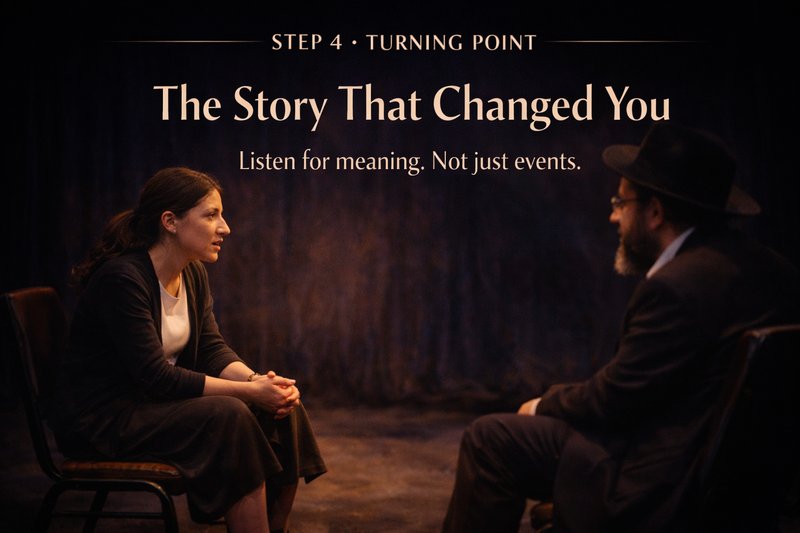
Step 4 Turning Point · Together · ~18 minutes
Narrative Identity: The Turning Point Story
Each person tells a three-minute story about a moment that changed them — not a tragedy, not a triumph, just a pivot. A moment where you became someone slightly different from who you were before it. The other person listens without interrupting.
After the story, the listener offers exactly two things:
– One reflection: “What I heard underneath that was…”
– One question: something that goes one layer deeper into the story’s meaning, not its facts.
Then switch. The original storyteller now listens.
READ BEFORE YOU BEGIN
“The story doesn’t need to be dramatic. It can be quiet. A conversation that shifted something. A decision you almost made differently. A moment that clarified what you actually value. Tell it as if you’re still slightly surprised by what it meant.”
JUST YOU When your partner finishes: resist the instinct to relate their story to your own experience. Your job is not to match — it is to understand their particular logic. What made this moment a turning point for them specifically? That’s what your question should reach toward.
WHY THIS MATTERS
The stories people tell about pivotal experiences — how they explain change, growth, and meaning — are among the most reliable predictors of relational maturity. This exercise reaches a layer the Closeness Ladder cannot: not what you value, but how you make sense of your own life. Can you track someone’s narrative logic and respond to what it means rather than what it describes?
Step 5 Connecting · Together · ~30 minutes
Repair + Acknowledge – Validate – Ask
Two exercises. The first practices recovering from friction. The second practices demonstrating that you genuinely heard what your partner said. Both train responsiveness — in different conditions.
EXERCISE 01 — REPAIR REHEARSAL · 10 MINUTES
Read your statement aloud to your partner when you are ready. Your partner responds authentically — don’t manage the response, just have it. Then together repair whatever small friction the statement created: acknowledge what happened, offer a true reframe, ask one genuine question. The goal is not to pretend it didn’t land — it is to move through it together.
– Person A reads aloud: “You remind me of someone I used to know.”
– Person B reads aloud: “I almost didn’t come tonight.”
“Notice: is your first instinct to defend, explain, or smooth it over? The repair is the exercise — not avoiding the friction.”
EXERCISE 02 — ACKNOWLEDGE – VALIDATE – ASK · 20 MINUTES
Partner A shares a mild current stress — something real but not the hardest thing in your life. Partner B responds with only three moves:
– Acknowledge — “What I heard you say is…”
– Validate — “That makes sense because…”
– Ask — one genuine question to learn more.
No advice. No fixing. No relating it to yourself yet.
After the exchange — before switching — the person who disclosed says one sentence: “What I needed from that was — and I [got it / didn’t quite get it].” If they didn’t fully get it, the responder adds: “What would have helped is .” This is calibration, not criticism. Then switch.
WHY THIS MATTERS
Almost no one in shidduch dating has practiced repairing friction, because no format has ever created a safe rupture to practice on. Repair capacity — not conflict avoidance — predicts whether a relationship lasts. The confirmation loop after AVA closes the gap the exercise usually leaves open: the person who disclosed never learns whether their partner felt the response land.
Step 6 Shared Vision · Together · ~14 minutes
Guided Imagery: Waking Up Five Years From Now
Read the visualization below silently, at your own pace. Close your eyes when you are ready and stay there for two minutes. Then each person describes what they saw — three minutes each, no interruptions. After both descriptions, one question each.
READ SILENTLY — THEN CLOSE YOUR EYES
“It’s a weekday morning. Five years from now. You’re waking up in the home you live in. Notice the quality of the light. Notice what sounds you hear — near and far. Notice what you’re moving toward for the day — not the tasks, the feeling of it. Don’t name who is there with you. Just notice the feeling of the space, the rhythm of the morning, what’s on the table, what’s out the window. Stay there for a moment before you open your eyes.”
JUST YOU When you describe what you saw: don’t interpret it or explain what it means. Just describe the image — the sensory details, the texture of the morning. The meaning can come later. The image first.
AFTER BOTH DESCRIPTIONS — ONE QUESTION EACH
“What surprised you about what you saw?”
WHY THIS MATTERS
Guided imagery accesses implicit knowledge — what you actually want rather than what you’ve decided to say you want. People with practiced self-presentation can answer almost any direct question strategically. They cannot strategically visualize. What surfaces here is often the most honest self-disclosure of the evening — including things the person didn’t know they were carrying until the image appeared.
Step 7 Implicit Commitment · Together · ~22 minutes
Turning Toward
The body communicates interest and care before words do. Micro-bids — small, low-stakes offers of connection — are the basic unit of relational investment. Turning toward them is what builds a relationship. Turning away is what erodes it.
EXERCISE 01 — MICRO-BIDS · 12 MINUTES
In the next five minutes, Partner A makes three small bids — verbal or nonverbal. Point something out. Make a brief observation. Ask a small question. Partner B: turn toward each bid — acknowledge it, respond, follow it with a question. Then switch.
“Turning toward the small things is how big things get built.”
EXERCISE 02 — WARMTH WITH BOUNDARIES · 10 MINUTES
Find the physical distance, posture, and tone of voice that feels warm and safe — without touch. After 60 seconds, each write one word describing what helped. Share simultaneously.
“Warmth is not closeness. It is safety. Notice the difference.”
WHY THIS MATTERS
People who cannot communicate commitment implicitly will struggle to sustain it explicitly. The vocabulary of care that precedes words — the turn toward, the bid, the held attention — is the foundation that makes later verbal commitment feel true rather than performed.
Step 8 Explicit Commitment · Together · ~22 minutes
Commitment Language
The shidduch crisis is partly a commitment language crisis. People who cannot say what they feel will not get engaged — not because they don’t feel it, but because they’ve never practiced saying it. The first time you do something in a high-stakes context is almost always too late. This step is practice.
EXERCISE 01 — THREE-LEVEL CLARITY LADDER · 12 MINUTES
Each person completes all three sentence stems out loud, in order. After each sentence — pause for a full five seconds in silence before moving to the next.
– Preference — “I enjoyed ___ about being with you tonight.”
– Intention — “I would like to ___ next.”
– Request — “Would you be open to ___?”
“The silence after a clear statement is not awkward. It is the statement landing. Let it land.”
EXERCISE 02 — FIVE MICRO-PROPOSALS · 10 MINUTES
Each person says this phrase five times — with small natural variations each time: “I would like to see you again.” By round three or four, the nervous laughter usually drops and the tone clears. That is not performance. That is the skill arriving. Notice it.
WHY THIS MATTERS
This step does not create artificial commitment. It develops the capacity for real commitment — the muscle that atrophies when it is never used. The exercise does not ask you to feel something you don’t. It asks you to practice saying something clearly — so that when you feel it, the words are already there.

Step 9 Duality · Together · ~14 minutes
Edge + Home
A sustainable marriage requires both safety and vitality — the held warmth of home and the alive energy of something that still surprises. This exercise practices holding both at the same time, with this person, right now.
CONVERSATION 1 · EDGE · 3 MINUTES
“What’s something you’d want to try that scares you a little — in a healthy way?”
CONVERSATION 2 · HOME · 3 MINUTES
“What does reliability look like day to day for you — the small things, not the big ones?”
DEBRIEF · ~8 MINUTES · UNSTRUCTURED
“What did you feel in each mode? Did one come more naturally? Can you hold both at the same time — with this person — right now?”
WHY THIS MATTERS
The ability to hold complexity together — excitement and safety, novelty and reliability — is what separates a good date from a sustainable partnership. Most people can do one. The question this step asks is whether they can do both, together.
The First Impression Reveal
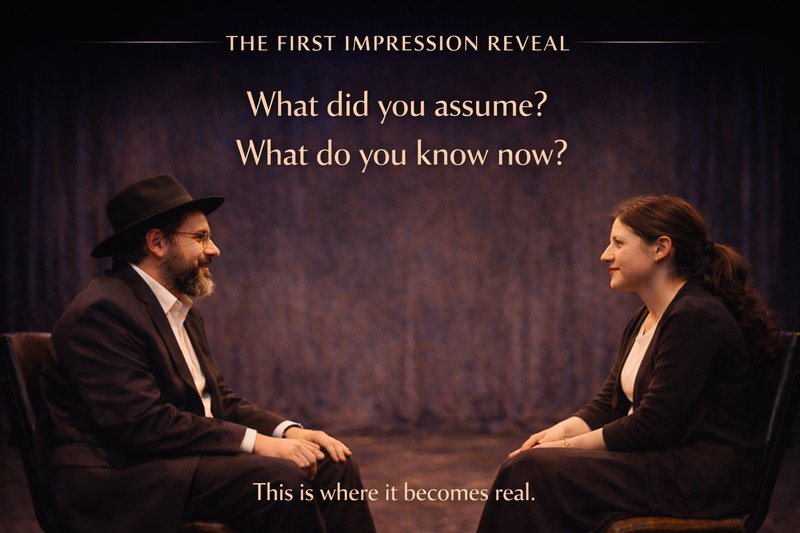
You each wrote something before you spoke a word. Read yours silently first. Then — on a count of three — show your screens or papers to each other simultaneously. Read what your partner wrote. Then talk about it.
“What did you assume before the evening began? What do you know now?”
That’s the Play Date.
First. Play. Then the date.
Yismach will follow up with both of you within 24 hours. If there is a mutual yes, you will hear from us.

This is In development. Let us know if you want to try this.
yismach.com · 501(c)(3) · admin@yismach.com