Why shidduchim fail at the gates—and what a system without gates looks like
Every relationship that has ever worked began gradually. Not with a decision. With an accumulation. A laugh. A moment. The way someone handled something small. Interest built the way interest actually builds—underneath awareness, without announcement, at its own pace.
The shidduch system takes this process and installs gates.
The first gate is the resume. Someone reads two pages and decides whether a human being is worth an evening. If the answer is no—and it usually is—the story ends before it begins. If the answer is yes, the gate opens and the next gate appears immediately.
Will you go on a first date. Gate. Will you go on a second. Gate. Third to fourth is the narrowest gate of all—the moment when people most often stop, because three dates have given them just enough information to be uncertain and not nearly enough to be sure. Then the gate before engagement, which is not a gate so much as a wall.
At every gate, you are asked to make a decision with the least information you will ever have about this person, at the moment when the stakes feel the highest.
This is not how human beings form attachments. It is how they avoid them.

When you know a verdict is coming at the end of the evening, you spend the evening deliberating. You are not present with the person. You are assessing them. The evaluation posture and the connection posture are mutually exclusive—you cannot simultaneously appraise someone and be open to them. The gate, by existing, prevents the very thing that would help you decide.
Barry Schwartz’s research on the paradox of choice demonstrates that every decision point is also a moment of anticipated regret about the alternatives not chosen.
Schwartz demonstrates that every decision point is also a moment of anticipated regret about the alternatives not chosen. [1] When the pool of candidates is notionally infinite—when the shadchan has other suggestions waiting—the brain never settles. It keeps one eye on the exit. Each gate is not just a moment of assessment; it is a moment of cataloguing what else might be out there. Romantic commitment and the maximizer’s perpetual search are mutually exclusive. Every gate invites the search.
The gate also selects for the wrong person. Who survives the first-date filter? Not the person best suited to you. The person who performs best under evaluation—most comfortable being assessed, most skilled at the first-date persona, most at ease in the artificial theater of courtship-as-interview. These are not the same people. The person who is warm and right for you after eight encounters may be guarded and flat after one, because they do not perform well under observation. The person who dazzles on date one may have nothing underneath the dazzle. The gate selects for performance. A life together is not a performance.
Robert Zajonc’s mere exposure research, first published in 1968 and replicated across hundreds of subsequent studies, established that repeated exposure to a stimulus produces liking at a neurological level, independent of conscious evaluation.[2] The person you saw once is a stranger. The person you have seen seven times in ordinary circumstances is someone your brain has already begun to categorize differently, before you have consciously decided anything about them.
The effect is logarithmic—the first few exposures are the most potent—and it operates even without conscious awareness. You do not need to be trying to like someone. Familiarity produces liking on its own, if the context is not aversive. The date context, with its evaluation frame and financial signals, is precisely the kind of aversive context that suppresses the effect.
The deeper finding is in research on how love develops in arranged marriages. Usha Gupta and Pushpa Singh at the University of Rajasthan studied love in both arranged and self-selected Indian marriages using the Rubin Love Scale. Their finding was counterintuitive and has been replicated: love in romantic marriages starts high and declines over time. Love in arranged marriages starts low—the couples barely know each other—and grows. It surpasses love-marriage levels at around five years. At ten years it is roughly twice as strong.
Robert Epstein’s cross-cultural studies of arranged marriages across twelve countries confirmed the mechanism: love can be learned, and it grows through proximity, shared experience, commitment, and sacrifice.[3] The factors that build love—being near someone frequently, doing things together, seeing them navigate difficulty, sharing private things—have nothing to do with the first-date performance and everything to do with accumulated ordinary contact.
The science says: love does not arrive at a decision point. It accumulates between them.
Behavioral economists have documented the default effect across domains: organ donation, retirement savings, health enrollment. The consistent finding is that people stick with whatever default they are given. Opt-out participation rates are dramatically and reliably higher than opt-in rates—not because people prefer the option, but because changing a default requires effort, and inertia is powerful.
In one landmark study, auto-enrollment in employer retirement plans increased participation from 40 percent to 90 percent—not by persuasion, but by making enrollment the default.[4] People who had to opt out rarely did. The structure did the work.
The shidduch system runs on opt-in defaults. After every encounter, the default is stop. The shadchan calls and asks for a verdict. To continue requires a positive act—saying yes. To stop requires nothing. Inertia works against the relationship at every gate.
Flip the default and everything changes. If the next encounter is already assumed—if stopping requires an active decision while continuing requires nothing—inertia now works for the relationship. The person who would have said a passive “no” because they weren’t sure, who would have let the relationship end by not returning a call, now continues. And continues again. And again. Until something has accumulated that makes the question moot.
Here is what a system without decision points requires.
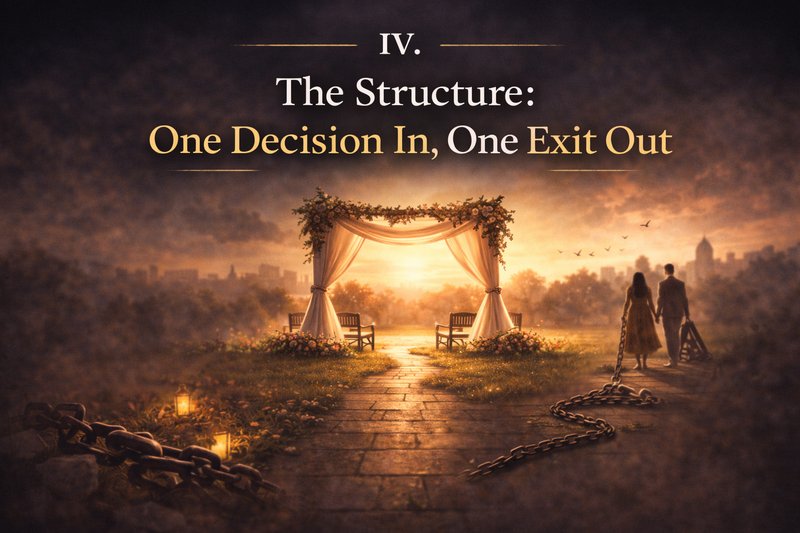
When the shadchan makes a suggestion, both people agree to one thing before the first meeting: they will meet at least eight times. Not eight dates. Eight encounters. Before engagement is discussed, before any verdict is rendered, before anyone is asked how it is going. Eight meetings is the commitment they are both making when they say yes to the suggestion. There is no other stopping point. The only exit is the chuppah—or finding another shadchan entirely and starting over.
That is the friction. Not punishment. Not pressure. Simply the recognition that opting out now requires a positive act: locating a different shadchan, explaining your reasons, beginning again. The path of least resistance runs forward, not sideways.
From the first meeting, no financial transaction passes between them. He does not pay for her dinner. He does not call a taxi for her home. The payment is a signal that both parties read instantly: this is a date, I am being evaluated, a verdict is coming. Remove the payment and the signal disappears. They are simply two people in a place together. The encounter is not an audition. Nothing is being decided.
No call after. No verdict requested. The next encounter is already assumed.
The shadchan does not call to ask how it went. There is no verdict to return. The agreement is already in place. Seven more meetings, then six, then five. The countdown runs without anyone managing it. What is being managed instead is something more important: the conditions under which two people can actually begin to know each other.
Over time, what the research predicts begins to happen. Repeated, low-stakes encounters accumulate. The mere exposure effect operates without the evaluation frame suppressing it. The brain’s familiarity response runs its course. Something builds that was not there before—not manufactured, not decided into existence, but arrived at through the same process by which every lasting attachment has ever been formed.
Commitment escalation research shows that time investment itself builds attachment.[5] The shared history of eight encounters creates a different psychological situation than the shared history of two. Not because the person has changed, but because you have both invested enough that the relationship has become something worth protecting. The commitment builds the love as much as the love builds the commitment.

In the original two-stage Jewish marriage, erusin and nissuin were separate ceremonies, sometimes separated by a year. The erusin was legally binding—it required a get to dissolve. The nissuin, the chuppah, was the completion of something that had already begun. The couple was not moving toward the chuppah as a destination; they were moving through a year of becoming, and the chuppah named what they had already become.
This structure encodes a deep understanding of how attachment forms. The commitment preceded the completion. The relationship existed before it was celebrated. The chuppah was not a decision—it was an acknowledgment.
In the system described here, the chuppah retains this function. The shadchan, who has been watching, eventually says: it is time to talk about the future. Not asks—says. Names what has become obvious to everyone who has been paying attention. The couple does not manufacture the moment. Someone who knows them both witnesses the arrival of the conclusion and speaks it.
The only way out is through the chuppah.
This is the structure that takes the decision points out of dating without taking the choice out of marriage. The shadchan chooses once. The couple continues. The relationship accumulates what it needs. And someone who loves them both says: it’s time.
The Midrash records that the Roman noblewoman challenged Rabbi Yose bar Chalafta: if God created the world in six days, what has He been doing since? Matchmaking, Rabbi Yose answered—and that is as hard as splitting the sea. [6]
The sea split for Nachshon because he walked in. Not to the ankle. Not to the knee. He walked in until the water was at his neck and there was no other way out. The sea split because leaving was no longer an option.
That is the system. Not a gate at every step. One decision to enter the water. And then the only way out is through.
────────────────────────────
NOTES
[1] Schwartz, B. (2004). The Paradox of Choice: Why More Is Less. HarperCollins.
[2] Zajonc, R.B. (1968). Attitudinal effects of mere exposure. Journal of Personality and Social Psychology Monograph Supplement, 9(2), 1–27.
[3] Epstein, R., Pandit, M., & Thakar, M. (2013). How love emerges in arranged marriages: Two cross-cultural studies. Journal of Comparative Family Studies, 44(3), 341–360. Gupta, U. & Singh, P. (1982). An exploratory study of love and liking and type of marriages. Indian Journal of Applied Psychology, 19, 92–97.
[4] Madrian, B.C. & Shea, D.F. (2001). The power of suggestion: Inertia in 401(k) participation and savings behavior. Quarterly Journal of Economics, 116(4), 1149–1187.
[5] Staw, B.M. (1976). Knee-deep in the big muddy: A study of escalating commitment to a chosen course of action. Organizational Behavior and Human Performance, 16(1), 27–44.
[6] Bereishis Rabbah 68:4.