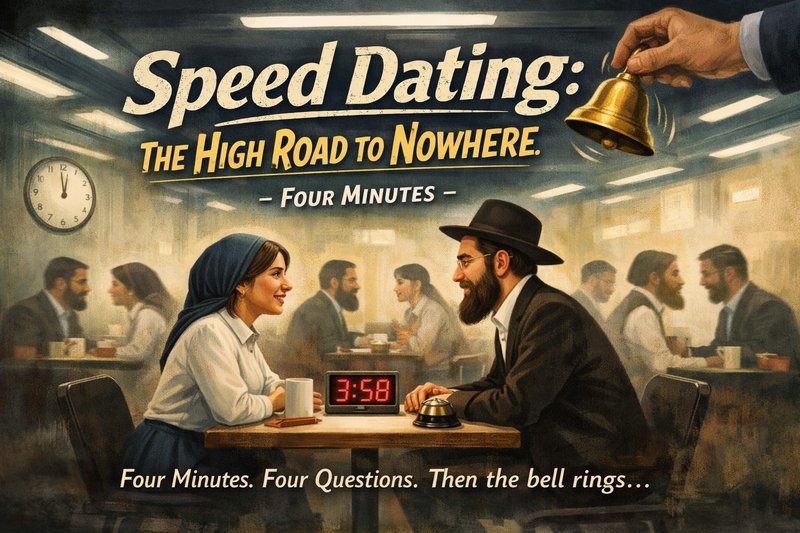
Four Minutes
You sit down. The person across from you smiles. You have four minutes.
You do not know their last name. You do not know what they sound like when they are not performing for a stranger. You do not know how they talk to their mother on the phone or what they look like when they are reading something that interests them or what happens to their voice when they describe the life they want to build. You know what they look like under fluorescent lighting and you know the first sentence they prepared in the car on the way here. Four minutes.
You say your name. They say theirs. You ask what they do. They ask what you do. Someone makes a joke. Someone laughs. The laugh is the kind of laugh people produce when they are being watched — not the real one, the one they keep for the people who already know them. Two minutes left. You are both scanning. Both performing. Both trying to compress the most attractive version of yourselves into a window so small that nothing true can fit through it. The bell rings. You move.
The next person sits down. They smile. You ask what they do. They ask what you do.
By the third rotation you are saying the same sentences. By the fifth you are hearing the same sentences back. By the eighth you cannot remember whether the person who said they were in marketing was the one who also mentioned a sister in Israel or whether that was someone else. By the tenth your face hurts from smiling. By the twelfth you are performing the motions of interest while something behind your eyes has gone quiet.
Fifteen people. Four minutes each. One hour of faces you will not remember by Thursday.
You check the boxes on the card. Yes. No. Maybe. The maybe means nothing. The yes means you would be willing to repeat the four minutes, which is not the same as wanting to know someone. You hand in the card and drive home and the whole evening sits inside you like something unfinished. Not disappointment exactly. Something flatter than disappointment. The sense that you were in a room full of people and somehow left it emptier than when you arrived.
———
The organizers call it efficient. Fifteen introductions in one evening. In the old model you would meet one person at a time — one suggestion, one date, one slow evening of trying to figure out if the person across from you is someone you could build something with. That takes time. That takes energy. That produces one data point per evening. Speed dating produces fifteen. The math looks better on paper.
But the math is counting the wrong thing. Fifteen introductions is not fifteen chances. It is fifteen four-minute auditions in which the only signals that can transmit are the ones that travel fastest — how you look, how quickly you are funny, whether your energy fills a room or needs a room to fill you. The person who is warm and open and comfortable performing for strangers wins the four-minute format. The person who takes ten minutes to relax, who opens slowly, whose best thing lives underneath the surface and needs safety before it shows itself — that person is never seen. The bell rang before they arrived.
And the person who wins? They win fifteen four-minute connections that feel like something and lead to nothing. Because the thing that made them win — the ability to perform intimacy under time pressure — is not the thing that builds a marriage. It is the thing that builds a first impression. And a first impression that cannot deepen into a second hour is a parlor trick.
———
After an evening of four-minute rotations you have trained yourself to evaluate fast. To make a decision in the first ninety seconds and spend the remaining two and a half minutes confirming it. To scan for the spark — the chemical hit, the instant yes — and to interpret its absence as an answer. I didn't feel anything. Next.
You carry that training into every date afterward. Someone suggests a person. You meet for an hour. But your nervous system is still set to the four-minute clock. Within the first ten minutes you have already decided. The remaining fifty minutes are a performance of politeness while you wait for it to end. The person across from you might have been the one. You will never know. Because the format trained you to stop looking before the thing worth finding had a chance to show up.
And the next date is the same. And the one after that. And slowly, without anyone noticing, the problem shifts. It is no longer that you haven't met the right person. It is that you have lost the ability to recognize them. The muscle that would have let you sit with someone past the discomfort of the first twenty minutes — past the awkward silence, past the moment where the performance runs out and the real person begins — that muscle has atrophied. Speed dating did not exercise it. Speed dating replaced it.
———
Here is what four minutes cannot hold.
It cannot hold the moment — forty minutes into a conversation — when someone says something they did not plan to say and their face changes and you see them for the first time. It cannot hold the slow recognition that this person's mind works like yours, that the thing you care about most is the thing they care about most, that the silence between you is not empty but comfortable. It cannot hold the particular way someone's voice drops when they are being honest instead of interesting. It cannot hold any of the things that actually make one person right for another — because those things do not arrive in four minutes. They do not arrive in ten. They arrive when two people have been sitting together long enough that the performance has burned itself out and what remains is the person.
Four minutes selects for performers. It selects for people who are good at beginnings. And then it sends those people home wondering why nothing that begins ever continues.
———
The woman who drove forty minutes to get here and sat through fifteen rotations and smiled until her face ached and checked two maybes on her card drives home in silence. She will not tell her roommate it was bad. She will say it was fine. She will say the people were nice. She will not say that somewhere around the ninth rotation she felt something close to despair — not about the people, about the format, about the way it made her feel like a product on a conveyor belt being inspected and passed over, inspected and passed over, four minutes at a time. She will not say that she sat across from one person — the eleventh or the twelfth, she cannot remember — who said something interesting, something real, and then the bell rang. And the person moved. And someone new sat down. And the interesting thing that was said will never be finished. She will not say any of this. She will say it was fine. And she will not go back.
The man who checked four yeses and got no matches back opens the email two days later and reads the word and closes his laptop and sits with it. Four yeses and none of them said yes to him. Four minutes each and he was not enough for any of them. He does not think: the format is broken. He thinks: I am broken. Because the format never tells you it is the problem. The format tells you it is fair — everyone had the same four minutes, everyone had the same chance — and if you were not chosen, the math is clear. You were not what they were looking for. The format does not say: nobody is what anyone is looking for in four minutes. The format does not say: the person who would have chosen you needed twenty minutes to see what you actually are, and the bell rang at four. The format says nothing. The silence says everything.
———
The evening cost four hours — including the drive, the parking, the standing around with a name tag trying to look approachable. Four hours to produce fifteen interactions so shallow that by Thursday morning the faces have blurred into a single composite. Four hours during which a person could have sat across from one other person in a quiet room and talked long enough for something real to happen. Not fifteen somethings. One something. The kind that takes an hour to start and two hours to mean anything and a lifetime to finish.
That is what was traded. Not time for efficiency. Depth for volume. And the volume produced nothing. And the depth was never attempted. And the person who might have been right — who was sitting three seats away, who also needed more than four minutes, who also performs badly under fluorescent lighting, who also would have opened up at the forty-minute mark and said the thing that changes everything — that person went home too. Unchosen. Unseen. Convinced, like everyone else, that the problem is them.
The problem was never them. The problem was the bell.