A woman shows up to a Purim party dressed in aluminum foil. Someone asks her what she is. She says: leftovers.
The room laughs. And somewhere in that laugh is everything wrong with the shidduch world. Because she’s been in the parsha five years, seven years, and before a single question gets asked about who she actually is — what she’s built, what she knows, what she has become — the calculation has already run. If she were so great, wouldn’t she be married by now?
But here is the brutal truth the joke doesn’t tell: .
Shidduchim is a market. A meet market. And like all markets, they fail.

There are two market failures operating simultaneously. They work together, they feed each other, and together they explain why so many quality people have not yet made it to the chuppah.

The Market for Lemons
Two economic failures explain the shidduch crisis. The community doesn’t name them because naming them implicates everyone.
A woman shows up to a Purim party dressed in aluminum foil. Someone asks what she is. She says: leftovers.
The room laughs. And somewhere in that laugh is everything wrong with the shidduch world. Because she’s been in the parsha five years, seven years, and before a single question gets asked about who she actually is — what she’s built, what she knows, what she has become — the calculation has already run. If she were so great, wouldn’t she be married by now?
Every system has a logic. The shidduch system’s logic has produced this laugh, and the woman standing there receiving it, and the years of nos that brought her to this party still unmatched. That logic is worth examining carefully. Not because it is evil. Because it is rational. And because a rational logic can produce catastrophically irrational outcomes when the information it’s working from is wrong.
Two market failures explain why so many people who deserve a chuppah haven’t found one. They work together, they feed each other, and together they explain the woman in the aluminum foil. The first is an information problem. The second is a timing problem. Neither is anyone’s fault in isolation. Together they are everyone’s problem.
THE ARITHMETIC
Here is what the joke doesn’t say: no one who said no got to the chuppah.
Not the shadchan who passed on the profile with too many years in the parsha. Not the date who screened out based on age. Not the parent who told their child that someone better was coming. Not the person who kept saying no because nothing was quite right, while the market moved and the pool thinned and eventually the choice narrowed to something worse or nothing at all.
Every no is a chuppah that didn’t happen. That is the arithmetic of this market, and the community doesn’t say it because it implicates everyone. It implicates the shadchan who passed. It implicates the date who said no after one meeting. It implicates the parents who counseled patience when patience had a price. And it implicates the person who believed, for years longer than the market could sustain, that something better was always coming.
Shidduchim is a market. A meet market. The only path to the chuppah is a yes — the only question is whether the yes comes from clarity or from collapse. And the two failures described in this article are the mechanisms by which the system converts people who should find a yes of clarity into people who eventually accept a yes of collapse, or find no yes at all.
Every no is a chuppah that didn’t happen. That is the arithmetic, and the community doesn’t say it because it implicates everyone.In 1970, George Akerlof published a paper that would win him a Nobel Prize. He called it “The Market for Lemons,” and it described what happens to any market where buyers cannot distinguish quality from defect before they commit.¹
His example was used cars. A seller knows whether the car runs well or hides a serious problem. The buyer doesn’t. Because the buyer can’t tell the difference at the point of transaction, they’re only willing to pay an average price — something between what a genuinely good car is worth and what a lemon is worth. But at that average price, sellers of good cars won’t sell. Why accept an average price for something above-average? They pull their cars from the market. What’s left, increasingly, is what isn’t worth much. And because buyers know this — because they can read the logic of who remains — they lower their offers further. Good cars disappear. The market fills with lemons. The very mechanism meant to protect buyers from being cheated ends up destroying the market’s ability to surface anything worth buying.
The shidduch world runs the same calculation on people.
A shadchan, a parent, a potential date — none of them can see who someone actually is from a resume and a reference check. So they use the signals available: age, years in the parsha, schools, family name, the neighborhoods their references come from. And those signals are not neutral. They carry an embedded question that nobody asks aloud: if this person were so great, wouldn’t they already be married?
The resume does not show what someone has built during those years. It does not show the career that deepened, the character that clarified, the self-knowledge that only comes from years of honest examination. It shows the gap between their age and the age at which the market expected them to marry. And that gap does its damage before the first phone call is made.
The person who has been in the parsha for seven years gets filtered before anyone asks the real questions. Not because they are worse than someone who married at twenty-two. Because the signal of duration has been assigned a meaning it does not actually carry. This is not cruelty. It is a rational response to a market without accurate information. It is also a market failure — one that systematically destroys value by pricing it on the wrong variable.
The used-car buyer who passes on a perfectly good vehicle because they’ve been in the lot too long is not irrational. They are working from the best signal available. The tragedy is not the individual decision. It is what the aggregate of those decisions produces: a market that has learned to punish presence.
The resume shows the gap between their age and the age at which the market expected them to marry. That gap does its damage before the first phone call is made.
THE WRONG INSTRUMENT
A job resume tells you about qualifications and accomplishments. It was built for the workplace, and it functions adequately there, because qualifications and accomplishments are more or less what employers need to know. A shidduch resume tells you the same things. But qualifications and accomplishments are nearly irrelevant to a marriage. What makes two people right for each other — the emotional register they live in, the way each one handles tension, the implicit script each carries about what love is supposed to feel like — none of that appears on a page.
The reference check doesn’t find it either. References are chosen to confirm a narrative. They tell you the narrative the person’s community has built around them. They do not tell you what happens in the room when two specific people sit across from each other — whether something clicks or stalls, whether there is ease or chronic low-grade friction, whether the way she processes difficulty is something he can actually live inside of and vice versa. These things are invisible on paper. They are only visible in person.
And yet the shidduch system has built its entire filtering infrastructure around the paper stage. The resume arrives. It is examined. A decision is made. The meeting — the only stage at which the actual relevant information becomes available — is treated as a reward for a successful paper application, not as the purpose of the whole enterprise. The result is a system that has perfected the art of saying no to information it has never actually gathered.
This produces a specific kind of error: the false negative. The person who would have been exactly right, whose compatibility was real and specific and discoverable only through encounter, never gets to the encounter. The filter ran on a signal that had nothing to do with the actual question, and the filter issued a no, and another chuppah didn’t happen.
The lemons problem in shidduchim is not just about duration in the parsha. It is about the entire epistemology of how people are evaluated. Every criterion applied before meeting is a criterion applied in the dark. Every no issued before meeting is a no issued against someone the decision-maker has never actually seen.

THE MARKET MOVES
The lemons analysis leaves out something essential: the pool does not stay fixed.
Young men in their early twenties enter the parsha wanting to marry women who are eighteen, nineteen, twenty-one. This is the moment of maximum selection — the widest pool, the least pressure, the most genuine possibility of finding what is actually right. The men who navigate this window well, who say yes when yes is warranted, marry. The women who were known and visible and well-matched at twenty marry too.
Then the window shifts. The men age. The women age. The people who were right for the twenty-three-year-old version of someone are no longer available to the twenty-eight-year-old version. Not because the people who remain are worse. Because the people who were most compatible have already made their decisions, and decisions, once made, are not available again.
This is not an observation about declining quality. It is an observation about timing. The pool that existed at twenty-two is a different pool from the pool that exists at twenty-seven, not primarily because the individuals have changed but because the composition of who is still searching has changed. The people most likely to be right for you were most concentrated in that earlier pool. Some of them waited. Many did not.
A field experiment tracking hiring outcomes found exactly this dynamic in a related context: the longer someone remains in a search process, the more they are discounted by others — regardless of their actual quality.² Duration in the market becomes a signal of defect even when it is a signal of nothing except time. The mechanism is self-reinforcing. The longer someone is in the pool, the more they are penalized for being in the pool, which reduces their chances of exiting the pool, which increases their duration, which increases the penalty.
And the discounting does not only come from the outside. Research on singlehood stigma finds that prolonged single status causes people to accept conditions they would have refused earlier in their search.³ The pressure doesn’t just thin the pool. It distorts the judgment of everyone still inside it. The person who would have held a reasonable line at twenty-four is holding a different line at thirty, not because their standards were wrong at twenty-four but because the stigma of still being single has worked on them from the inside, recalibrating what they believe they deserve.
There is a further complication that the research surfaces. In competitive matching markets, high-quality participants exit the pool fastest — precisely because they are most likely to receive and accept offers.⁴ The longer the search runs, the more the distribution of who remains shifts toward those who are harder to match. This is not a moral judgment about the people who remain. It is a structural observation about what extended search does to any population over time. The people who were easiest to match have already matched. What remains is a more complex distribution.
Duration in the market becomes a signal of defect even when it is a signal of nothing except time.
WHEN BOTH FAILURES RUN AT ONCE
The lemons problem and the scarcity market do not operate in separate channels. They interact, and their interaction produces outcomes worse than either would produce alone.
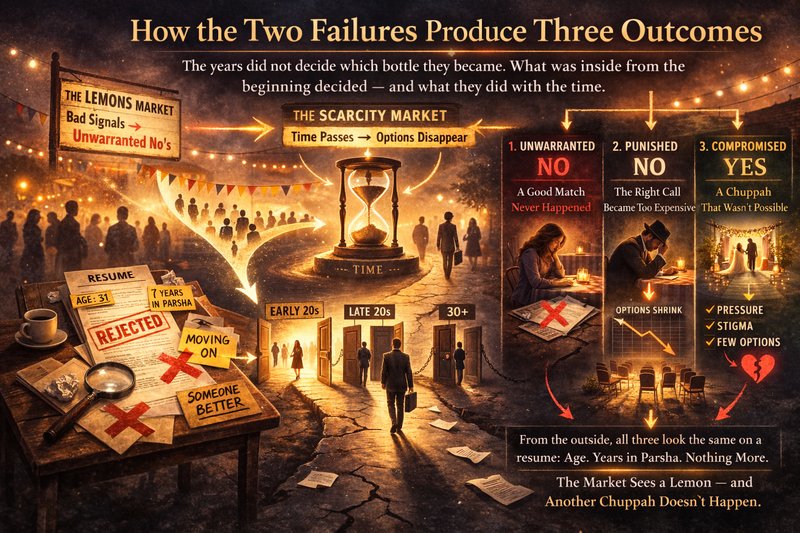
The lemons problem generates unwarranted nos. It hands people a bad signal — years in the parsha, age, whatever the marker is — and says: this is due diligence. Pass. Someone better is coming. Those nos feel responsible. They feel like discernment. They are chuppahs that didn’t happen.
Those unwarranted nos increase someone’s duration in the market. Increased duration triggers the scarcity penalty. The scarcity penalty makes the next round of consideration harder to survive — the signal is worse, the pool is thinner, the competing options are fewer. A person who entered the market strong, who was a genuine find at twenty-two, has been filtered and re-filtered on signals that had nothing to do with their actual quality, and they emerge from seven years of this with a profile that carries damage the lemons mechanism will continue to exploit.
The scarcity problem then punishes the nos that were actually correct. The person who refused a bad match at twenty-four — who exercised genuine discernment, who held a standard worth holding — is now holding that standard in a thinner pool, against a background of accumulated stigma, with the best years of the opportunity window behind them. Every correct no becomes more expensive than the last. Until the person who was right to hold the line is holding the line in a market that has already moved past the options that were once available to them.
And then there is the yes that should have been a no. The yes that came not from clarity but from the accumulating weight of pressure — from a shelf that was emptying, from a stigma that was building, from something inside that finally gave way. This is where the two failures produce their most damaging joint product: not the single who never found someone, but the marriage that happened under conditions that bent the judgment of both people. The research on singlehood stigma documents exactly how this happens: the longer someone is single, the more they internalize the stigma, and the more that internalized stigma bends what they will accept.³ⁱ⁵ The market doesn’t just filter from the outside. It works on people from the inside.
Three kinds of people result, and the resume cannot tell you which one you are looking at.

GRAPE JUICE, VINEGAR, AND THE FINEST BOTTLE IN THE CELLAR
There is grape juice. These are the people who married the first serious suggestion at twenty-two, before the parsha had time to apply any pressure. There is nothing wrong with grape juice. It is real, it nourishes, it is exactly what it says it is. But it never had the chance to become anything other than what it was on day one. Some of those marriages are genuinely wonderful. Some are the ordinary product of insufficient time and inadequate information. Grape juice cannot tell you which.
There is vinegar — and vinegar is the market’s saddest product, because vinegar starts as wine. Something that had the potential to become excellent was subjected to the wrong conditions for long enough that the process reversed. Not bad people. Not people who deserved what happened to them. People on whom the pressure of scarcity worked from the outside and then from the inside, until the yes that finally came was not the yes they were capable of giving. The years did not ruin them. The market did. And a different market, with better information and better timing, would have produced something extraordinary instead.
And then there is the bottle that became the most expensive one in the cellar. The career that deepened. The character that clarified. The self-knowledge that only comes from years of honest examination that married-at-twenty-two never required. The capacity for a real partnership that got built, slowly, through years of actually living. The person who knows exactly who they are and what they are looking for, not because they read it in a book but because they earned it. This person is still in the market not because they failed but because what they are looking for is real, and they have not found it yet.
The years did not decide which bottle they became. What was inside from the beginning decided — and what they did with the time.
From the outside, all three look the same on a resume. Thirty-one years old, seven years in the parsha. The resume does not say what happened during those years. It does not say whether the standards that kept them single were wisdom or avoidance. It does not say whether what remains is something rare, or something the market has already priced correctly. And because the resume cannot say these things, the lemons problem runs its calculation, and the next no gets issued, and another chuppah doesn’t happen.
The years did not decide which bottle they became. What was inside from the beginning decided — and what they did with the time.

WHAT YISMACH WAS BUILT FOR
The answer to both market failures is the same answer, and it is the answer Yismach was built around: be known accurately, and be known early — before the market moves, before the pressure builds, before the signals start doing damage that no amount of profile-building can undo.
The lemons problem is an information problem. Its solution is better information. Not more reference checks. Not longer resumes. Real information: the kind that can only be gathered by building an actual picture of who two people are at the level of the variables that actually drive compatibility — emotional attunement, communication patterns, implicit relationship scripts, values as lived rather than stated. This is what the Yismach AI does. Not match preferences against preferences. Build a structural picture of each person and find what is actually complementary between them, at the level the resume cannot reach.
The match comparison the shadchan receives is not a score. It is a narrative — a plain-language account of why these two specific people are worth meeting, what is congruent between their Love Maps, how their communication styles interact, where their lived values align and where they diverge. The shadchan reads it and makes a human judgment. The AI is regularly overridden. That is as it should be. The AI’s job is not to replace the shadchan’s discernment. It is to give that discernment something real to work with, instead of a two-page resume and a reference who will say the same three things about everyone they’ve ever known.
The scarcity problem is a timing problem. Its solution is earlier entry and faster information. A young woman of nineteen who enters Yismach is not being rushed. She is being smart about a market that does not wait. The men who will be looking for her in two years are in the parsha now. The pool that exists today is different from the pool that will exist when she decides she is ready. And the information problem — the inability to see who someone actually is from a resume — gets worse, not better, as duration increases. Getting into the right system early, before the scarcity penalty begins to accumulate, is not desperation. It is the opposite.
This is why Yismach offers free registration for women eighteen to twenty. Not because they need charity. Because they are the people with the most to gain from entering a market that can actually see them, before the market has had years to thin and distort. The finest bottles don’t become fine from sitting ignored on a shelf. They become fine because the conditions were right from the beginning.
Yismach also built the Dating Pool Calculator to make both forces visible at once — the pool three years ago, the pool today, the pool three years from now. Add a criterion. Watch it shrink. Add another. Watch it shrink again. The scarcity market, made undeniable. Not to frighten people. To clarify the actual stakes of the decisions being made, for the person making them and for the parents counseling patience and for the shadchanim watching the pool move.
And for the person who has been in the parsha for years, who is tired of being read through the wrong lens, who knows that what they have become in those years is not a liability but an asset — Yismach was built for them too. Not as a last resort. As the platform designed from the beginning to distinguish between grape juice, vinegar, and something rare. To surface who someone has actually become, not just how long they have been waiting. To help them find the yes that comes from clarity, before the market makes that yes harder to reach.
THE PRICE OF NO
Shidduchim is not Tinder. There is no infinite scroll. There is a shadchan who looked at the real pool and found the best fit in it — who took their knowledge of two people and made a considered judgment that this particular meeting was worth having. That judgment deserves to be honored with an actual meeting.
When you say no without meeting, the shadchan hears it. Hear it enough times and they stop calling. This is not a punishment. It is an honest recognition of the terms of the relationship. A shadchan who has brought their best thinking and been told, repeatedly, that it is not worth an hour of someone’s time will eventually direct their best thinking elsewhere. And the pool available through that shadchan, which represented real matches with real people, shrinks by precisely the amount of their engagement.
The next suggestion will almost certainly not be better. The shadchan already brought their best thinking. The AI already identified the highest-probability structural match in the current pool. The person being declined is, by the logic of how the match was made, the most compatible person available right now. The belief that a better match is waiting just around the corner — that sufficient patience will eventually produce a candidate who requires no risk, no awkwardness, no tolerance of uncertainty — is the belief that fills the parsha with people who are still waiting at thirty-five for the no-risk option that was never available.
Every no before a meeting is a no issued against someone who has never been seen. Against someone’s resume, their age, the years they’ve been in the parsha, the zip code their references come from. Not against the actual person. The actual person has not yet been encountered. And the no that feels like discernment, that feels like holding a standard, may be the lemons mechanism running its calculation on a signal that has nothing to do with reality.

TTHE WOMAN IN THE ALUMINUM FOIL
She is still at the party. Still getting the laugh. The market is still running its calculation. The pool is still moving.
She is not a leftover. She is the finest bottle in the cellar. And the person who would recognize that — who would know what they were looking at the moment they sat down across from her — is somewhere in this market right now, saying no to suggestions that don’t match on paper.
Two rational people. Two correct-feeling nos. One chuppah that doesn’t happen.
Yismach was not built for leftovers. It was built for people who refused to accept less than something real — and for the people who are looking for them. It was built to solve the information problem before the scarcity problem makes the information problem irreplaceable. It was built to give the finest bottles in the cellar a way to be known as what they are, before the market has spent seven years deciding what they must be.
The calculation has been running long enough. It is time to meet.
◆
REFERENCES
[1] Akerlof, G.A. (1970). The market for “lemons”: Quality uncertainty and the market mechanism. Quarterly Journal of Economics, 84(3), 488–500.
[2] Kroft, K., Lange, F., & Notowidigdo, M.J. (2013). Duration dependence and labor market conditions: Evidence from a field experiment. Quarterly Journal of Economics, 128(3), 1123–1167.
[3] Wongsomboon, V., & Gesselman, A.N. (2025). Single and stigmatized: How internalized singlehood stigma shapes romantic decision-making. Journal of Social and Personal Relationships.
[4] Antler, Y. (2023). Optimal search for a good match. American Economic Review, 113(1), 1–36.
[5] Fisher, A.N., & Sakaluk, J.K. (2020). Are single people a stigmatized “group”? Evidence that singularism is a form of prejudice. Journal of Experimental Social Psychology, 86, 103877.