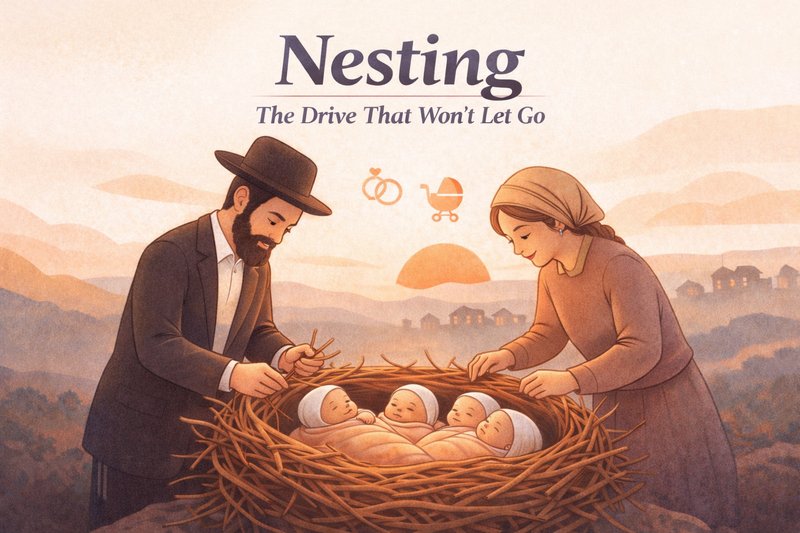
The drive to nest is not a preference. It is not a cultural expectation. It is not something your mother installed in you over Shabbos meals. It is biological. Hardwired. Written into the genome with the same insistence as hunger and thirst and the need to breathe. Every species that reproduces carries this drive—the compulsion to find a mate, build something stable enough to raise offspring in, and sustain it long enough for the next generation to survive. Birds build nests. Wolves dig dens. Humans build homes. A bayis ne’eman b’Yisrael is not a metaphor. It is the Jewish articulation of an instinct that embedded in creation.
The drive is ferocious. It overrides comfort, logic, self-interest. A woman carrying a child will eat differently so the baby can grow. A man will work a job he hates for decades to keep a roof over his family. Parents run into burning buildings. Soldiers charge fortified positions. The calculus of individual survival says don’t do that, and the body does it anyway, because the drive to preserve what you’ve built—the nest, the family, the next generation—outranks the drive to preserve yourself.
This is not sentimental. This is biology at its most ruthless. When survival of the species and survival of the individual come into conflict, species wins. Lemmings swarm toward cliffs not because they are suicidal but because the migration instinct overrides the individual’s capacity to assess danger. Salmon swim upstream until their bodies disintegrate. Bees sting and die. The Iranian basij sent waves of teenagers across minefields in the Iran-Iraq war—and the teenagers went, because the collective drive, once activated, is stronger than the rational mind’s objection to walking into a minefield.
The nesting instinct in humans is not as dramatic as a lemming migration. But it is every bit as powerful. The ache that singles feel—the one they learn to hide, the one the system tells them to manage with bitachon and patience and another round of resumes—is not emotional weakness. It is the species talking. Build the nest. Find the mate. Start the family. The drive is so deep and so relentless that people who have been searching for years, who have been rejected dozens of times, who have every rational reason to stop trying, do not stop trying. They cannot stop trying. The genome will not let them.
Everyone in shidduchim is desperate to nest. Every single one of them.
THE OVERRIDE
But species survival only overrides individual survival when there is no way out. The lemming has no exit. The salmon has no alternative route. The soldier charging the position has no escape hatch. The instinct wins because the organism has no mechanism for opting out of it.
Nexting is the way out.
The moment you can say no to a suggestion and feel relief—the moment the system provides a mechanism for avoiding the pain of exposure, vulnerability, and potential rejection—individual survival has an escape route. And when individual survival has an escape route, it takes it. Every time. The nesting drive doesn’t disappear. It screams. But the no is louder, because the no is immediate and the nest is pending, and the nervous system is wired to prioritize immediate threats over distant rewards.
Saying no to a shidduch suggestion is operant conditioning. A suggestion arrives and with it comes a spike of anxiety—the possibility of a date, the possibility of disappointment, the possibility of sitting across from a stranger and feeling something that might not survive the week. The fastest way to kill that anxiety is to say no. Relief floods in. The nervous system logs it: no equals calm, yes equals danger. After enough repetitions the no is automatic. The nesting drive is still there, underneath, still desperate, still aching. But it has been overridden by a reflex that is faster, louder, and reinforced thousands of times.
The approach-avoidance conflict at the heart of nexting is not complicated. Everyone wants love, companionship, a home, children. That’s the approach. Everyone wants to avoid the pain of getting there—the awkward dates, the vulnerability, the possibility of rejection. That’s the avoidance. The avoidance wins because the pain is immediate and the nest is indeterminate. The nesting instinct says charge the minefield. The individual survival instinct says there’s an exit, take it. In every other species, the exit doesn’t exist, so the nesting drive prevails. In the modern shidduch system, the exit is built into every interaction. Another date? No. Who’s next.
The conditioning disguises itself as discernment. You don’t experience yourself as afraid. You experience yourself as selective. The relief after each no doesn’t register as escape—it registers as clarity. Except you weren’t evaluating a person. You were managing your own anxiety. And underneath the anxiety, the nesting drive is still there, still aching, still unsatisfied, growing more desperate with every passing year while the reflex that was supposed to protect you walls you off from the only thing that could satisfy it.
WHAT BLOCKS THE NEST
Prof. Shmuel Neumann has spent years writing about shidduchim—over two dozen books that examine every facet of what goes wrong between the nesting drive and the chuppah. Each one is a deep dive into a different obstacle. Each one, in its own way, is a study of what happens when the most powerful instinct in the human genome runs into a system that was supposed to serve it and instead learned to obstruct it.
The obstacles are not random. They form a pattern. And the pattern, once you see it, explains why so many good people remain single for so long despite wanting marriage more than anything else in their lives.
Why does a woman reject a man in seven minutes? Why does a bochur walk away from a date he cannot explain was wrong? Because neither of them is responding to the person in front of them. They are responding to a map. Everyone who walks into a first meeting is carrying an emotional blueprint—drawn in childhood, revised by every significant relationship since, invisible to the person carrying it. How love should feel. How a spouse should behave. What safety means. What intimacy costs. Neumann’s Love Maps: The Scripts That Bind uncovers these buried scripts—the ones shaped by attachment figures who held you or didn’t, by early wounds, by the stories your family told about love without speaking a word. You don’t keep choosing the wrong person, the book argues. You keep choosing what’s familiar. The Love Map determines who you’re drawn to and who you reject, and you think you’re making choices when you’re being operated by a script you didn’t write and can’t see. The map can only become accurate through repeated, unhurried encounter. That pull you felt on the first date? That absence of feeling? Projection. The map you’re reading is not theirs. It’s the one you brought. Nexting after one or two meetings means you nexted a projection, not a person. You never met the person.
But even if the Love Map were accurate, the system would still fail, because the system screens for the wrong things. The shidduch resume was supposed to help—too many singles, too many names, shadchanim needed a way to keep track. Neumann’s Shidduch Resume: The Solution That Became the Problem traces what happened next. The tool became the gatekeeper. “Just meet them” turned into “Send me a resume first.” We started screening instead of meeting. Analyzing photos like detectives. Passing on people because of font choices. The resume enables a fantasy—that sufficient research will eventually produce a candidate who requires no risk—and that fantasy has not produced more marriages. It has produced more nexting, more exhaustion, and the peculiar loneliness of looking endlessly for something you’ve never actually reached for. The resume screens for variables that have almost no bearing on whether two people will build a life together. It screens out the encounter that is the only place the real variables can be discovered.
The damage goes deeper than bad screening. Through the Looking Glass, Darkly examines what happens to a person who has been performing for years—crafting profiles, curating photos, describing themselves in ways designed to pass an audit. The performance begins before the first meeting. By the time two people sit across from each other, both are wearing the version of themselves they think will be acceptable. Neither is present. Both are performing. And underneath the performance, something has fractured. The Mirror’s Lie—a book about the root distortion behind insecurity, self-sabotage, and shame—shows what happens when a person can’t see themselves clearly anymore. A fractured inner mirror. The distortion projects outward, onto every potential match. You’re not unlovable, the book argues. You’re looking at yourself through a broken lens. But the resume culture keeps handing you the broken lens and calling it preparation. Nesting requires being known. The resume culture has made hiding the prerequisite for entry.
The map is invisible. The resume screens for the wrong things. The performance is habitual. And then there is the date itself. The Play Date asks a question nobody else in the shidduch world has asked seriously: do the people sitting across from each other actually know how to connect? A system that frames every meeting as a marriage audition has produced adults who have never developed the competencies genuine connection requires—authentic self-disclosure, attunement, responsiveness, reading another person’s emotional state, being present without agenda. So when they sit down, their minds run the only program they have: the audit. Is this the one? Do I feel it? That audit actively crowds out the attachment mode—the mode in which warmth and curiosity can emerge. The attachment mode and the assessment mode cannot occupy the same moment. And in the current system, attachment never gets a chance.
Do this long enough and the damage is no longer just psychological. It is physiological. Shidduch Trauma documents what happens to the nervous system after years of nexting—years of first-date auditions as the dominant interpersonal experience of young adulthood. The book’s title is not metaphorical. The dysregulation is measurable. The anxiety-performance-relief cascade that began as a response to individual suggestions becomes the baseline state. The nervous system recalibrates around threat. Dating is no longer an activity. It is a survival event. The nesting drive is still screaming underneath. But the body has learned that every encounter is dangerous, and the reflex fires before the conscious mind has a chance to override it.
And there is a cognitive dimension that makes the whole thing worse. The mind doesn’t just react. It locks. Prophets of Annihilation—a book about what happens when certainty-seeking hardens into ideology—traces the same mechanism in shidduchim that it traces in geopolitics. The need for cognitive closure: seize a conclusion fast, freeze around it. In geopolitics this loads missiles before the evidence arrives. In shidduchim it produces someone who has already decided, who screens with increasing rigidity, who mistakes the narrowing of possibility for the refinement of taste. Nesting requires openness. Closure punishes it. And because each closure delivers a hit of relief, the shutting gets reinforced and the opening gets punished.
THE DEEPER WOUNDS
The obstacles above are systemic—they belong to the shidduch world as a whole. But underneath the systemic problems are personal ones, and they are harder because they live inside the person, not inside the system.
Why do marriages fail between people who agree on everything? Same hashkafa, same community, same goals—and they exhaust each other within months. Because the variable that determines whether a marriage survives is not what two people believe. It is how they talk to each other. He needs to process aloud; she needs silence before she can think. She asks questions to connect; he hears interrogation. He withdraws when hurt; she pursues. Reclaiming the Lost Art of Listening makes the case that these communication patterns—invisible on a resume, invisible in a photo, unresearchable through references—determine more about whether a marriage will work than everything the shidduch system currently screens for. The skill that holds every marriage together is not the right words. It is the right silence. You can want to build a nest with every fiber of your being. But the nesting drive doesn’t specify the blueprints, and two people with incompatible blueprints will build something that collapses under its own weight.
The nesting instinct doesn’t just want a mate. It wants to build—to shape and be shaped, to grow together, to create something that neither person could have created alone. In His Own Image examines this process: how every act of attention, every moment of judgment or grace, leaves an imprint on the person you love. We sculpt those we love. And they sculpt us. But that mutual shaping requires showing up as yourself—not the version you think the other person wants—and it requires staying long enough for the shaping to begin. Nexting prevents the shaping from ever starting.
And the drive itself is not always wise. How Close Is Too Close—a raw, unsparing look at boundaries in love—maps where nesting shades into entanglement. The drive wants closeness, and it doesn’t always distinguish between closeness that nourishes and closeness that consumes. In wounded people, the drive to nest becomes a drive to merge—to lose yourself inside another person and call it love. That is not nesting. That is drowning. The line between intimacy and entanglement is real, and crossing it damages both people.
Then there are wounds that sit directly on top of the nesting instinct and smother it. Someone is kind to you and you flinch. Someone sees you clearly and you hide. Warmth arrives and you sabotage it. Undeserved Love—a book for anyone learning to receive what they did not earn—names the conviction buried deep in the Love Map: that you do not deserve what is being offered. The wound was installed before the nesting drive had a chance to mature, and it wins every confrontation because it got there first.
And beneath the wound is shame. Putting Shame to Shame addresses what surfaces when someone is pushed toward being actually seen by another person. Shame and nesting are locked in combat. Shame insists you are not fit to be seen. Nesting insists that being seen is the only way home. For people carrying deep shame, every date is a war between the two. Neumann reframes shame not as pathology but as sacred compass—calling you back to who you truly are, stripping away the performance, exposing the real self hiding underneath. The Yismach eight-date-challenge does not ask anyone to be unashamed. It asks them to stay in the room with their shame and discover that someone else can hold it with them.
The Naked Truth of Eden takes this all the way back. From Gan Eden to today. Adam and Chava were naked and unashamed—the original nesting, before the performance, before the fig leaf, before anyone learned to hide. The fig leaf was the first resume. We’ve been hiding behind paper ever since. Nesting demands nakedness—not physical, but emotional, spiritual, the willingness to be known. And every wound, every trauma, every bad date and rejected suggestion has added another layer of covering.
And there is something the nesting drive depends on that the modern world has spent decades dismantling. The Binary Man is not a polemic. It is a return to the original blueprint of creation. Man and woman as distinct by Divine design, not societal invention. Masculine and feminine, giver and receiver, initiator and nurturer—not because society said so, but because the Torah does. Neumann draws from Chazal, Zohar, Maharal, Rav Hirsch to reassert that each role is not a limitation but a sacred tafkid—a vessel through which the Shechinah enters the home. Nesting requires two distinct halves. The modern confusion around gender has blurred the distinctions the nest was built on. A man who does not know what it means to be a man, a woman who has been told that femininity is weakness—neither can build what the other half was designed to complete. The book is a map back to the original blueprint, written not in social theory but in the sacred breath of the Creator.
THE FEAR BENEATH THE FEAR
Underneath the systemic obstacles and the personal wounds is something more fundamental. Fear. Not the fear of a bad date. Not the fear of rejection. The fear that proximity itself is dangerous. That letting someone close enough to nest with means letting them close enough to destroy you.
What are you actually afraid of when you dread a first date? Not the person. You haven’t met the person. You are afraid of the observation—the moment when possibility collapses into reality and you have to deal with what’s actually there. Quantum Fear reframes this as a quantum state: multiple possible outcomes existing simultaneously, collapsing into one only when observed. As long as you don’t look, all outcomes remain possible, including the one where you are safe. The moment you look, you might see something that ends the possibility. Nesting requires observation. Fear prevents it. Nexting is the refusal to observe. It keeps all possibilities open by never collapsing any of them.
Unshackling Fear is the practical side of that argument. Not coping with fear. Reclaiming what fear took from you. The nesting drive doesn’t need you to be fearless. It needs you to be in the room. Fear took the room away. This book is about getting it back.
And then there are people for whom the obstacle is not fear of danger but fear of safety. Living on the Edge describes a person whose nervous system was calibrated to threat—for whom calm feels threatening, for whom chaos has become addictive, who experiences the ground floor of love as boredom. Nesting requires stillness. Settling in—not settling for less, but settling in. Making a home. Being still. And for the person whose body has been wired to equate stillness with danger, that settling feels like dying. The Pleasure of Danger traces the neurotheology of that pattern—the sacred pursuit of intensity, the person who feels most alive on the brink. For these people, the obstacle to nesting is not that they can’t find the right person. It is that the right person feels wrong, because the right person is safe, and safe doesn’t feel like anything at all.
And for those who have been through all of it—the nexting, the trauma, the shame, the fear, the years of searching—Bravehearts. Bravery redefined: not the absence of fear but the refusal to vanish. The nesting drive at its most naked. The willingness to show up one more time.
WHAT THE RESEARCH SAYS
The most comprehensive synthesis of a century of pair formation research—Who Marries Whom and Why, 300 pages—lands on a fact the shidduch world has spent decades ignoring: the variables that predict who ends up together and stays together are not the ones on a resume. Not height. Not seminary. Not neighborhood. Emotional regulation style. Communication patterns. Implicit relationship scripts. Values as lived rather than stated. Invisible on paper. Discoverable only through encounter.
Repeated contact is the most powerful driver of attraction in human pair formation. More powerful than shared values. More powerful than personality compatibility. Familiarity creates safety. Safety is the ground floor of love. The nesting drive already knows this—it has been pushing people toward proximity since before language existed. But the shidduch system has built an apparatus that intercepts the drive before proximity can do its work.
Quantum Love treats relationships as what they actually are: chaotic systems. Nonlinear. Irreducible to initial conditions. Two people meet and they are not two fixed objects being compared for fit. They are two complex systems interacting, and the interaction itself changes both of them in ways no profile, no photo, no first impression could predict. The signals that predict whether a relationship will sustain over decades are not the loudest signals on date one. They are faint. Easily missed. Emerging slowly as novelty fades and two people settle into the actual patterns of being together. The shidduch world treats initial chemistry as signal and its absence as disqualification. Initial chemistry is noise. The signal is underneath, and it takes time and proximity and the willingness to sit with uncertainty before it becomes audible. Nexting is the refusal to sit with uncertainty. The nesting drive would sit with it forever. But individual survival won’t tolerate the discomfort.
THE BOCHUR FROM CHEVRON
A bochur from Chevron Yeshiva. First date. Reports to his Rosh Yeshiva: I don’t know. Do you have hakpados? Chas v’shalom. So continue. Same after four. Same after six. After eight he walks in still not sure. The Rosh Yeshiva looks at him: Eight dates and no engagement? What kind of person are you?
He gets engaged.
The charedi system never asked do I feel it yet. It asked is there a reason not to. One question tries to taste coffee before it’s brewed. The other protects the brewing. Remove the objections. Stay in the room. Let it percolate. The Rosh Yeshiva’s question was not harsh. It was precise. Eight meetings is enough time for the nesting drive to do its work if you let it. If after eight meetings the drive has produced nothing, the question is no longer about the other person. It is about you.
Nobody gets to eight anymore. Nexting happens at one, at two, almost always by four. The nesting drive never gets a chance to operate. It is overridden by the reflex before the second meeting. And people walk away convinced they haven’t found the right person. They have. They nexted that person on a Tuesday afternoon and forgot about it by Wednesday morning.

THE YISMACH PERCOLATOR
Pull coffee before it percolates and you get something thin and bitter. Not bad ingredients. Wrong timing.
The Yismach Percolator was built to close the escape hatch. Eight meetings. No exit after each one. No “another date?” after every encounter. The commitment is made before the first meeting starts: eight times, and only then consider marriage. An awkward second date is not a reason to stop. An uncertain third is not a reason to stop. Stopping requires a decision. Continuing does not. The default is nesting, not nexting.
One rule, without exception: no talk of marriage, children, timelines, or future plans across all eight meetings. Take the verdict off the table and the assessment mode shuts down. The audit stops running. And in the quiet, the nesting drive—the one that has been screaming underneath the anxiety and the conditioning and the shame and the fear—finally has space to do what it was built to do. You cannot fall in love by trying harder. You can only fall in love by trying less.
Eight meetings is not a number we invented. It is approximately how long the Love Map you brought—the one drawn in childhood, invisible to you—takes to get corrected by the actual person sitting across from you. By meeting eight the map is built from encounter, not fantasy. And a relationship is a chaotic system—irreducible to initial conditions—so the signals that predict whether it will sustain over decades are faint, slow, emerging only in the space that opens up when two people stop performing for a verdict. The nesting drive knows how to read those signals. It has been reading them since creation. But it needs time. And nexting steals the time.
WHAT THE AI ACTUALLY BUILDS
The AI in the Yismach Percolator does not match you to your wish list. The correlation between what people say they want and who they wind up happily married to is nearly zero. The wish list—the height, the seminary, the neighborhood—is the survival instinct’s attempt to control the nesting drive by pre-screening it into submission. The AI ignores it.
The AI builds a picture of each person from five domains. Cognitive and communication style—the patterns of friction and ease that Reclaiming the Lost Art of Listening identifies as the most consequential variable in whether a marriage survives. The Love Map itself—the implicit relationship script, drawn from scenario responses, narrative prompts, and preference rankings. Not identical maps. Congruent ones. Two scripts that fit rather than collide. Values as lived rather than stated—the gap that Who Marries Whom and Why identifies as one of the most consequential and least examined variables in mate selection. Emotional attunement—whether two people’s regulatory patterns would stabilize each other or escalate each other, the complementarity that Quantum Love shows is more predictive than sameness. And relational intelligence in the behavioral sense developed in The Play Date—the competencies of authentic self-disclosure, attunement, and responsiveness that enable genuine presence.
The analysis the shadchan receives is a narrative, not a score. A Love Map summary. A compatibility analysis. A communication comparison. A plain-language account of the AI’s reasoning. The shadchan reads it and makes a human judgment. The AI gets overridden regularly. The Wisdom of the Heart names what the shadchan brings that the AI cannot: the intuition, the felt sense, the Torah-anchored emotional intelligence that sees people clearly. The AI is a tool for that discernment. Not a replacement.
HOW THE PROGRAM RUNS
The shadchan brings the suggestion with the AI’s match comparison. Due diligence follows—references checked, facts verified. The Shidduch Handbook is direct: the research is for facts. The meetings are for truth. Do not use one as a substitute for the other.
The commitment is to eight meetings. Made before the first one starts. Nexting is not the default. Showing up is.
The meetings carry the no-marriage rule. Neither person is performing for a verdict. The question of marriage is not in the room. Something else is. Two people, across from each other, with nothing to evaluate and nowhere to be except here. For the first time in their dating lives, the nesting drive has space.
After each meeting, each person speaks to the AI. By voice or text, in their own time, without a script or prompts. Not what you observed about the person. What arose in you. The AI holds the full arc across all eight reflections. It heard what you said after meeting one. It knows how that changed by meeting four. The feelings accumulated across eight meetings are the most reliable data that will ever exist about this specific relationship. Name them honestly and you will know something true by the end.
After the eighth meeting, seven prompts. Drawn from Eight Steps to the Chuppah. All oriented toward the yes. Something about this person that surprised you, in a good way. A moment you keep returning to. How you feel about yourself when you’re with them. The quality you most want your children to inherit from them. What you imagine your home feeling like together. Something they said that you haven’t stopped thinking about. Why you believe they would be a faithful spouse.
The prompts do not ask for concerns. Concerns exist in every marriage worth having. It’s Not Who You Marry says it plainly: marriage does not work because you found the right person. It works because you stayed when it was hard. What fades is chemistry. What remains is covenant. The prompts ask whether, after eight genuine meetings, the nesting drive has found what it was looking for. Something alive. Something that wants to say yes.
The responses come back as testimony—your own words, across weeks of real encounter. Shared through the shadchan as a summary. The shadchan convenes a final conversation. The question of marriage enters the room for the first time. No longer abstract. Asked by real people about a relationship they have actually begun to build. Rooted in Heaven frames what they are being asked to consider: marriage not as partnership—a business arrangement with emotional benefits—but as spiritual merger. The sacred scaffolding. The nest.
WHAT THE PROGRAM CANNOT DO
If after eight genuine meetings you still cannot say yes—the Rosh Yeshiva’s question applies to you too. What kind of person are you?
The program creates the conditions. Removes the obstacles. Closes the escape hatch. Gives the nesting drive space to operate. Holds the reflections. Surfaces the yes. What it cannot do is produce the yes if it’s not there. And if it’s not there after eight genuine meetings, a ninth will not produce it.
For those who leave still searching, Almost Forever—a piercing, honest postmortem on relationships that ended before they became something permanent. Not every almost-forever is a failure. Some are essential preparation. The Love Map corrected. The person made more ready for what comes next.
And for those who have been waiting long enough to have nearly stopped hoping, What It Will Feel Like was written directly to that ache. The nesting drive does not diminish with time. It grows more desperate. What is coming, when it comes, will be worth what it cost.
The nesting instinct is the oldest drive in the genome. Older than language. Older than consciousness. Older than fear. It built every civilization, every family, every bayis ne’eman b’Yisrael that ever stood. It is still building. It is building inside every single person reading this, right now, underneath the conditioning and the shame and the scar tissue and the reflex that says no. The drive has not gone away. It cannot go away. It is waiting for a way through.
The Yismach Percolator is the way through. Eight meetings. The escape hatch closed. The audit silenced. The nesting drive, finally, given room to work.
Stop nexting. Start nesting.
THE DIVINE IMPERATIVE
The nesting drive is not just embedded in the genome. It is embedded in creation by explicit Divine instruction. And the Torah records that instruction not once but repeatedly, across the entire arc of Bereishis, in language that shifts between bracha and tzivui—between blessing and command—because the drive to nest is both.
On the fifth day, Hashem blessed the creatures of the sea and the birds of the air: pru urvu umil’u es hamayim—be fruitful and multiply and fill the waters. The language is vayevarech. A bracha. The capacity to reproduce placed into their nature as a gift. No choice involved. The fish do not deliberate. The birds do not hesitate. The drive operates without resistance because there is no mechanism for resistance. There is no exit.
On the sixth day, Hashem created Adam and Chava, and again the language is vayevarech—He blessed them. Pru urvu umil’u es ha’aretz. The same words. The same bracha. But now spoken to beings with bechira, with free will, with the capacity to refuse. A fish cannot next. A bird cannot next. A human being can. The bracha is the same. The stakes are entirely different. Because a being with free will can receive a bracha and choose not to act on it. Can feel the drive and override it. Can want the nest with every fiber and still say no to the suggestion because the no feels safer than the yes.
The Rambam counts pru urvu as the first mitzvah in the Torah. Not a bracha. A command. The Sefer HaChinuch lists it as mitzvah number one. And this is the tension the Torah builds into the opening chapters of Bereishis: the same words—pru urvu—are both a bracha planted in creation and a mitzvah imposed on free beings. A bracha because the drive is real and it operates on its own when nothing blocks it. A mitzvah because human beings, unlike fish, can block it. And do.
Then mankind broke it. The Gemara in Sanhedrin teaches that the generation of the mabul was condemned because they corrupted the natural order. Same-sex unions. Cross-species mating. A systematic perversion of the drive that was supposed to produce families and instead produced chaos. The nesting instinct was not absent in the dor hamabul. It was perverted. Redirected. Used for everything except what it was created for. And Hashem’s response was not correction. It was destruction. Total. The entire world unmade and rebuilt from scratch.
And the first instruction to Noach when he stepped off the teivah, into a world emptied of everything that had come before: pru urvu. Again. The same words spoken to the fish. The same words spoken to Adam. Now spoken to a man standing in mud, surrounded by nothing, tasked with rebuilding civilization from the ground up. The entire world was destroyed and rebuilt around this single imperative. Build the nest. Again.
Nexting is not the sin of the dor hamabul. But it shares a structural feature. The nesting drive—the drive Hashem planted in creation on the fifth day, blessed into Adam on the sixth, commanded as the first mitzvah, and reinstated as the foundation of the post-mabul world—is being obstructed. Not perverted. Not redirected. Blocked. By a system that installed an exit where Hashem did not put one. The fish have no exit. The birds have no exit. Noach, standing in mud with the world destroyed around him, had no exit. The drive operated because there was no mechanism for refusing it.
The modern shidduch system gave the drive a mechanism for refusal. And the nexting reflex took it. All it takes is meeting instead of nexting. The bracha and the mitzvah—the drive planted in creation and the obligation imposed on free beings—given room to operate the way they were designed to. Not by forcing anyone to marry. By removing the reflex that prevents the drive from doing what it has been trying to do since the fifth day of creation.
Pru urvu. Be fruitful and multiply. Spoken to the fish. Spoken to the birds. Spoken to Adam and Chava in Gan Eden. Spoken to Noach in the mud. Spoken, right now, to every single person reading this, in the quiet underneath the conditioning and the fear and the scar tissue.
The drive has not gone away. Hashem does not retract imperatives. It is waiting for a way through.
You cannot marry someone you never met.
Stop Nexting - Start Nesting
◆
BOOKS REFERENCED IN THIS ARTICLE
Love Maps: The Scripts That Bind — The hidden childhood architecture of who we love, how we trust, and what we run from.
Who Marries Whom and Why — A 300-page synthesis of a century of research on human pair formation.
Quantum Love — Relationships as chaotic systems—nonlinear, irreducible to initial conditions. Why initial chemistry is noise and the real signal takes time to emerge.
The Play Date — The evidence-based curriculum in relational competencies—and the skills problem at the heart of the Orthodox dating crisis.
Shidduch Resume: The Solution That Became the Problem — How a practical tool became a cultural pathology, and what it costs.
The Shidduch Handbook — A direct guide to dating with dignity, depth, and freedom from the mythology of the perfect match.
It’s Not Who You Marry — A Torah-based, psychologically grounded model of what makes love endure—covenant over chemistry.
Rooted in Heaven — Marriage not as partnership but as spiritual merger—the sacred scaffolding most couples never learn.
The Wisdom of the Heart — Torah-anchored emotional intelligence for shadchanim and mentors who need to see people clearly.
Eight Steps to the Chuppah — The practical framework for serious preparation for marriage.
Reclaiming the Lost Art of Listening — The one skill that holds every marriage together: not the right words, but the right silence.
In His Own Image — How we sculpt those we love—and how they sculpt us.
Undeserved Love — Love stripped of its performance requirements. For anyone learning to receive what they did not earn.
The Binary Man — Man and woman as Divine design, not social construct. The sacred tafkid that the modern world has blurred and the Torah has never changed.
How Close Is Too Close — Where intimacy ends and entanglement begins.
The Naked Truth of Eden — From Gan Eden to today: shame, intimacy, and the human condition.
Putting Shame to Shame — Shame not as pathology but as sacred compass, calling us back to who we truly are.
Bravehearts — Bravery redefined: the refusal to vanish, for those who have been through the fire.
Quantum Fear — Fear not as survival mechanism but as a quantum state—the physics of our deepest anxieties.
Unshackling Fear — Breaking the chains. Not coping—reclamation.
Living on the Edge — Why calm feels threatening to trauma survivors, and how chaos becomes addictive.
The Pleasure of Danger — The neurotheology of thrill-seeking and the sacred pursuit of intensity.
Prophets of Annihilation — What happens when certainty-seeking hardens into ideology—and why the missiles are already loaded.
The Mirror’s Lie — The fractured inner mirror and how distorted self-perception quietly sabotages connection.
Through the Looking Glass, Darkly — How hiding behind performance keeps you from being genuinely known.
Shidduch Trauma — The dysregulation produced by a system designed for love that has learned to operate on threat.
Almost Forever — A piercing postmortem on relationships that ended before they became something permanent.
What It Will Feel Like — Prophetic hope for hearts that have only known waiting.