A man sits across from a woman he might marry. She is interesting. She is warm. Something about the conversation has been easy in a way that conversations at these things are not usually easy. And instead of letting that happen — instead of following where it seems to want to go — he is conducting a quiet audit in the back of his head. Red flags. Yellow flags. Is she balanced? Is she mature? How did she handle the thing with her family she mentioned? Is this sustainable? Is the attraction real, or is it just that she laughs at his jokes and he has been lonely?
He goes home and writes it all down. Pros. Cons. Impressions. Concerns. He has learned to do this. He has been told, in various ways, by various authorities on self-improvement and conscious dating, that this is how thoughtful people make serious decisions. He is being mindful. He is being intentional. He is doing everything right.
He will not call her back.
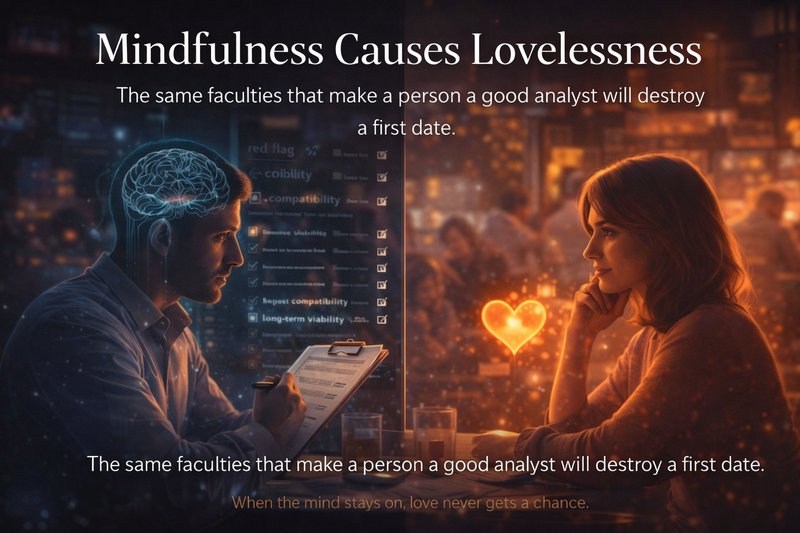
This is what mindfulness does to love.
There is a story told about Freud — apocryphal or not, the point survives the uncertainty.[1] A patient, after years of psychoanalysis, walked into his office and handed him a sheaf of papers: a careful accounting of the pros and cons of marrying a particular woman. Freud looked at the list, tore it in half, and threw it on the floor. “There are two decisions in life that no conscious reasoning should determine — choice of spouse and choice of career. In both, if you consciously know why, it will never be satisfying. In both, if the decision does not meet your subconscious needs, it never will be.”
What Freud was describing is not irrationality. It is the specific incompetence of the conscious mind in one domain of human experience, even as it is exactly the right tool in almost every other. The same faculties that make a person a careful surgeon or a methodical analyst are the faculties that will destroy a first date. The prefrontal cortex is a marvel. In love, it is the enemy.
The Mishnah understood this two thousand years before the neuroscientists arrived with their fMRI machines.[2] All love dependent on something — when the thing ceases, love ceases. Love not dependent on anything will never cease. Two examples, stated without elaboration. Amnon loved Tamar conditionally — passion for beauty, which collapsed into hatred the moment what it wanted was spent.[3] David and Yehonatan had no such object. Jonathan gave up his throne, his father’s loyalty, his own safety — without reciprocation, without account. The love could not be located in any attribute of David’s that Yehonatan valued, because when everything Yehonatan valued was at stake, the love only deepened. The Mishnah is not philosophizing. It is stating an observable structural fact: love that knows its reasons is fragile, because the reasons can change. Love that cannot be explained has its roots somewhere below the level at which reasons live.
When a person views the face of someone they are in love with, activity concentrates in the ventral tegmental area and the caudate nucleus — the dopamine-rich reward and motivation circuitry of the brain, the regions associated with drive, wanting, and goal-directed behavior.[4] That part is expected. What is less often discussed is what goes quiet.
Significant deactivation occurs in the right prefrontal, parietal, and middle temporal cortices — the regions responsible for critical reasoning and social judgment.[5] The amygdala, the brain’s alarm system, goes partially offline. The ventromedial prefrontal cortex, which handles moral and social evaluation, reduces its activity. The brain does not add love on top of everything else. It reorganizes. It turns down the machinery of judgment in order to allow something else to happen.
Serotonin drops. In the early stage of romantic love, serotonin transporter density falls to levels statistically comparable to those found in patients with obsessive-compulsive disorder — both groups significantly below baseline.[6] The result is a narrowed, recurring, intrusive focus on one person, structurally similar to clinical OCD but aimed outward. You cannot stop thinking about her. Not because you chose to. Because your serotonin dropped and your brain reorganized itself around a single object of attention.
Cortisol rises. The heart rate goes up. Oxytocin generates trust and closeness. Vasopressin drives attachment and protectiveness. The combined effect is heightened sensitivity, suspended judgment, obsessive attention, and a physical pull toward the other person — organized by neurochemistry to accomplish exactly one thing: to decrease resistance to love long enough for a bond to form.
This is not a bug. The deactivation of the critical mind is not a side effect of falling in love. It is the mechanism by which falling in love becomes possible at all. If the prefrontal cortex stayed fully online, cataloguing every flaw, running every comparison, maintaining every defense, no bond would form. The brain knows this. So it shuts the judge down.
“Love is blind” is not a romantic metaphor. It is a neurological description. When people say they couldn’t see his faults — they’re right. The circuits for seeing faults were suppressed. That suppression was the point.
Mindfulness as currently practiced is the deliberate, sustained cultivation of non-judgmental awareness — the attempt to remain fully conscious of one’s own mental and emotional states, to observe experience without distortion, to name what is happening in real time. As a practice for managing anxiety, regulating difficult emotions, developing patience — it has real value.
As a framework for dating, it is catastrophic.
The mindful dater arrives at each date as a trained observer of her own experience. She notices what she feels and what she doesn’t feel. She registers what is happening in her body — the interest, the flatness, the mild discomfort when he said that one thing — and she takes it seriously as data. She has been told this awareness is wisdom. What she is actually doing is keeping the judge online at the exact moment the brain is designed to take it offline. The connection she is evaluating is being evaluated to death. The circuit that was supposed to go quiet is running at full power.
The checklist is the same problem in a different form. The person who screens across forty dimensions before agreeing to meet is using the prefrontal cortex to do a job the prefrontal cortex cannot do. Whether two people will fall in love cannot be determined from a profile, a photograph, or a list of attributes. It can only be determined by what happens when they are in the same room and the brain chemistry runs its course — if it is allowed to run its course. If it is not allowed to run its course, nothing is determined. The opportunity is simply lost.
The shidduch system has organized itself entirely around keeping that judge running. The résumé asks the person to describe herself in attributes. The date asks him to evaluate her in attributes. The follow-up conversation asks whether all the attributes cleared a sufficient threshold. The whole apparatus is designed to make the experience as analytically legible as possible. And then it is surprised that people don’t fall in love.
Early romantic love cannot sustain itself as a permanent neurological state. The dopamine surge moderates. Serotonin returns toward baseline. The prefrontal cortex comes back online. And with it, all the critical faculties that were suspended during the fall return — with an agenda. Now it starts looking for discrepancies. Cataloguing grievances. Noticing everything that was invisible six months ago. The soul-mate image starts to develop edges.
This phase is not a sign that the relationship was wrong. It is the beginning of what comes next. In couples who remained intensely in love after two decades of marriage, the ventral tegmental area — the dopamine-reward region active in early love — was still firing when they viewed images of their spouses.[7] The brain regions that lit up were different from early-stage love: alongside the reward circuitry, there was activation in areas associated with calm attachment and reduced anxiety rather than obsessive focus. Long-term love in these couples was not a diminished version of early love. It was a different kind of love — deeper, calmer, neurologically richer.
The difference between couples who made this transition and those who did not had nothing to do with compatibility scores or shared interests or anything a shidduch profile measures. It had everything to do with what each person chose to do when the judge came back online. The judge comes back with an agenda: find the discrepancies, catalogue the grievances, run the audit. If the couple feeds that agenda — if they let the analysis continue to run, treat every friction as evidence for a verdict — the relationship does not survive. The alternative requires something the analytical mind cannot produce on its own.
Five independent sources in the Talmud — Sanhedrin, Berachos, two Midrashim, and a Tosefta — all give the same teaching: just as no two faces are identical, no two inner lives are identical, and every person has a different reason for marrying.[8] The teaching implies something the shidduch world has largely ignored. There is no universal answer to why you should marry. There is only your answer, which lives at a depth that résumé screening cannot reach and first-date analysis cannot touch. The reason you will marry who you marry is not something you will be able to explain to the shadchan with a checklist. It will be something you recognize — if you allow yourself to be in a state where recognition is possible.
The Gemara’s formulation of the ideal is direct: it is impossible for a man without a woman, and impossible for a woman without a man, and impossible for both without the Shechinah.[9] Marriage is not a functional arrangement. It is a structure within which something divine can rest. The love that sustains that structure is not the love of the early months, which is managed by neurochemistry and cannot be chosen. It is chesed — giving without condition, without calculation, without the rational mind running its equity analysis in the background.
The rational mind, raised in a world that measures everything by return on investment, looks at unconditional giving and calls it a loss. What the rational mind cannot see is that the love which knows exactly what it is owed, and keeps careful track of the balance, is the love Amnon had for Tamar. It burns hot and dies cold. The love that does not keep track is the love of David and Yehonatan. That love does not die. The Mishnah stated this as a fact. The neuroscience documented it. The couples who were still in love at year twenty-one were not the ones who cleared every threshold. They were the ones who, when the judge came back online after the honeymoon, chose to give anyway.
The time and place for the analytical mind is before a suggestion is accepted — evaluating whether the basics make sense, whether there are obvious disqualifiers. Once the date is agreed to, the analytical mind has done its job. What comes next belongs to the encounter.
Be interested instead of evaluating interest. Build toward friendship and let whatever is there become visible, rather than conducting a real-time inventory of whether whatever is there is enough. The conversation that wants to go somewhere — let it go there. The quiet audit running in the back of the head is not wisdom. It is the enemy of the only process that can produce what the person running it actually wants.
Fall in love. Not with the idea of a person, not with a sufficiently high-scoring evaluation, not with someone who cleared every threshold. With a person. A specific, irrational, inexplicable pull toward someone the checklist might have eliminated. Trust the pull. The brain designed it for a reason. The Mishnah validated it two thousand years ago. The fMRI confirmed it last decade.
Then choose. When the honeymoon ends and the judge comes back online, choose the love that doesn’t keep score. Choose chesed. That is not the loss of early love. It is its maturation into something the analytical mind could never have produced — and cannot, now, produce a reason to abandon.
The only thing standing between most people and all of it is the list they keep making.
[1]The story appears in various forms attributed to Freud; whether apocryphal or not, the structural point it makes is consistent with his writings on unconscious motivation in love and career.
[2]Pirkei Avos 5:16. The Mishnah gives two illustrations without elaboration: the love of Amnon for Tamar as love dependent on desire, and the love of David and Yehonatan as love not dependent on anything external.
[3]Bartenura on Pirkei Avos 5:16. He explains that Amnon’s love was dependent on Tamar’s beauty; once that was, in his perception, destroyed, the love inverted to hatred. David and Yehonatan’s love had no such object.
[4]Fisher, H.E., Aron, A., & Brown, L.L. (2005). Romantic love: An fMRI study of a neural mechanism for mate choice. Journal of Comparative Neurology, 493(1), 58–62. The study found activation concentrated in the ventral tegmental area and caudate nucleus — dopamine-rich reward and motivation circuitry — rather than in cortical regions associated with higher reasoning.
[5]Bartels, A., & Zeki, S. (2000). The neural basis of romantic love. NeuroReport, 11(17), 3829–3834. When subjects viewed images of their beloved, significant deactivation occurred in the right prefrontal, parietal, and middle temporal cortices — the regions responsible for critical reasoning and social judgment. The amygdala and ventromedial prefrontal cortex also showed reduced activity.
[6]Marazziti, D., Akiskal, H.S., Rossi, A., & Cassano, G.B. (1999). Alteration of the platelet serotonin transporter in romantic love. Psychological Medicine, 29(3), 741–745. Serotonin transporter density in subjects in early romantic love was statistically comparable to levels in patients with obsessive-compulsive disorder — both groups significantly below baseline controls. Subsequent research has refined the picture: the serotonin depression appears most pronounced in the earliest stage of infatuation, and the mechanism is now understood as part of the broader neurochemical reorganization that narrows attentional focus toward the attachment figure.
[7]Acevedo, B.P., Aron, A., Fisher, H.E., & Brown, L.L. (2012). Neural correlates of long-term intense romantic love. Social Cognitive and Affective Neuroscience, 7(2), 145–159. Subjects who had been intensely in love for an average of 21 years showed VTA activation alongside areas associated with calm attachment, suggesting romantic love can persist without the obsessive elements of early-stage love.
[8]Sanhedrin 38a; Berachot 58a; Tosefta to Berachot; Bamidbar Rabbah 21:2; Midrash Tanchuma, Pinchas 10. Five independent sources give the same teaching: just as no two faces are identical, no two minds are identical, and every person has a different reason for marrying.
[9]Berachos 62b.