The Problem
The shidduch system is broken in ways everyone feels but no one has fixed.
Singles wait months without suggestions—not because they're unmatchable, but because they don't fit easy categories. Shadchanim burn out under impossible workloads, drowning in names they can't remember and follow-ups they can't track. Matches die on paper before anyone meets. The ratio of suggestions to engagements is a thousand to one. A thousand. The math is brutal. The system makes it rational to give up.
We built something different.
The most comprehensive AI-powered shidduch platform ever built.
The System
Yismach AI is not a feature. It is a system—over twenty-five tools that work together like clockwork, each one feeding the next, the whole greater than the sum of its parts.
Here is how it works.
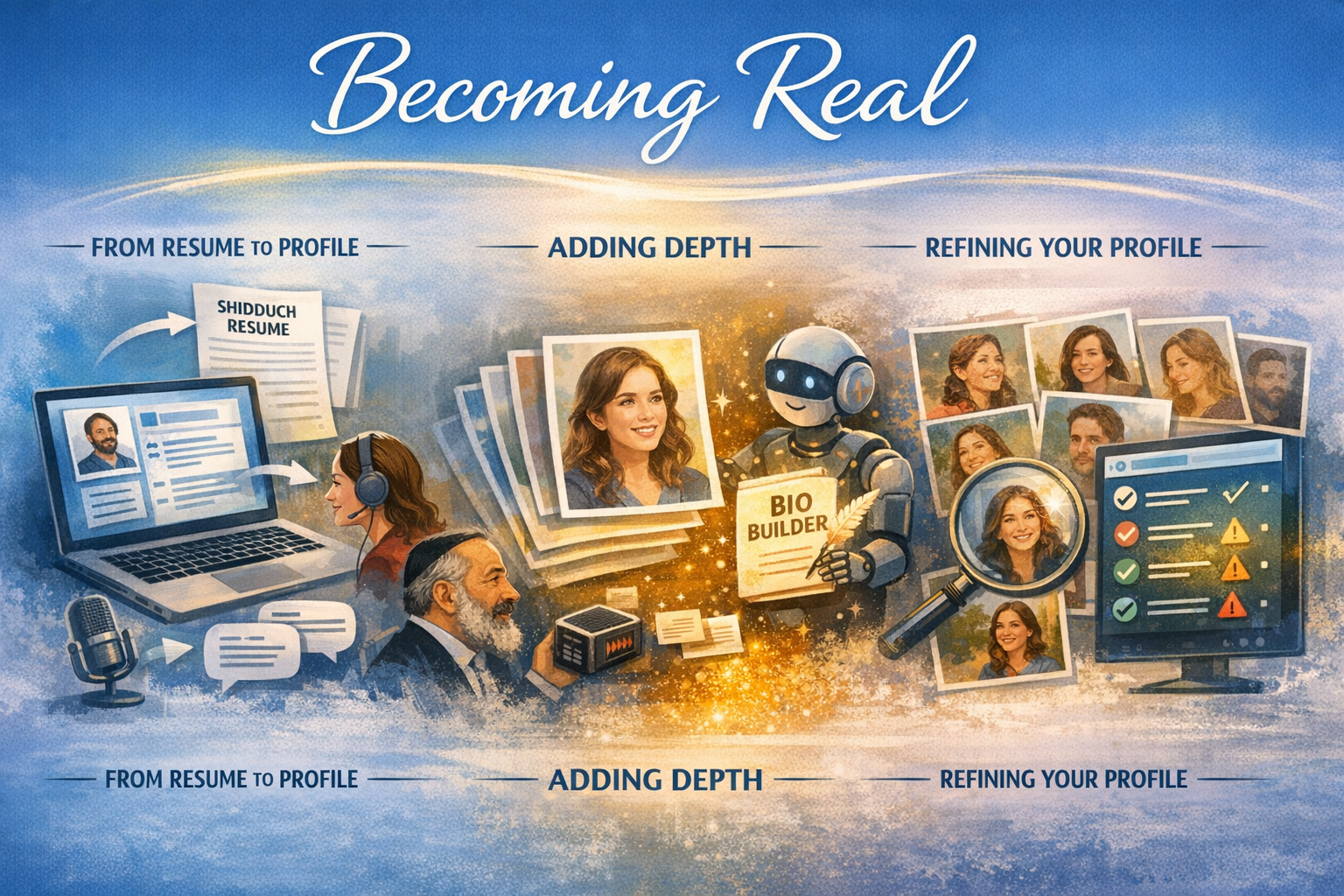
You start with what you have. Upload your shidduch resume and the Resume Importer and Parser pulls everything into a structured profile automatically—no retyping, no forms. But this is just the foundation, just the raw material. A resume is two dimensions where there should be three.
So you go deeper. Voice Profile Setup lets you complete your profile by having a natural conversation with an AI interviewer. It asks questions, follows up on interesting answers, captures nuance no form could capture. Prefer typing? Chat Profile Interview offers the same experience in text. Either way, you're no longer a list of facts. You're becoming a person.
Then the shadchan calls. Shadchan Interview Capture records and transcribes the conversation, and the AI extracts what's relevant—the insights, the hesitations, the things that matter—and adds them directly to your profile. The gold from the intake call doesn't disappear into someone's memory. It becomes part of your permanent record, enriching everything else.
Now your profile has depth. But can you describe yourself? Most people can't. Bio Builder generates your bio based on everything the AI now knows about you. Enhance with AI takes your "About Me" and "Looking For" sections and makes them clearer, more compelling, more true to who you actually are. You're no longer staring at a blank page. The AI has seen you from multiple angles—your resume, your voice, your conversation with the shadchan—and it helps you articulate what you couldn't articulate alone.
Then come the photos. Pic Pick analyzes your images and helps you select the best one—not the most flattering, but the most accurate. A warm person can photograph as cold. A confident woman can come across as intimidating. Personality from Pics extracts what your photos reveal about you: warmth, approachability, confidence, openness. Now you know how you're being perceived. You can close the gap between who you are and how you appear.
Finally, Profile Health Scanner checks everything for conflicts, inconsistencies, areas for improvement. Do your photos look consistent with each other? Does your resume match your profile claims? Do your stated preferences align with your actual behavior? Prioritized suggestions for what to fix. The profile that emerges is not a resume. It is a living document—three-dimensional, verified, real.
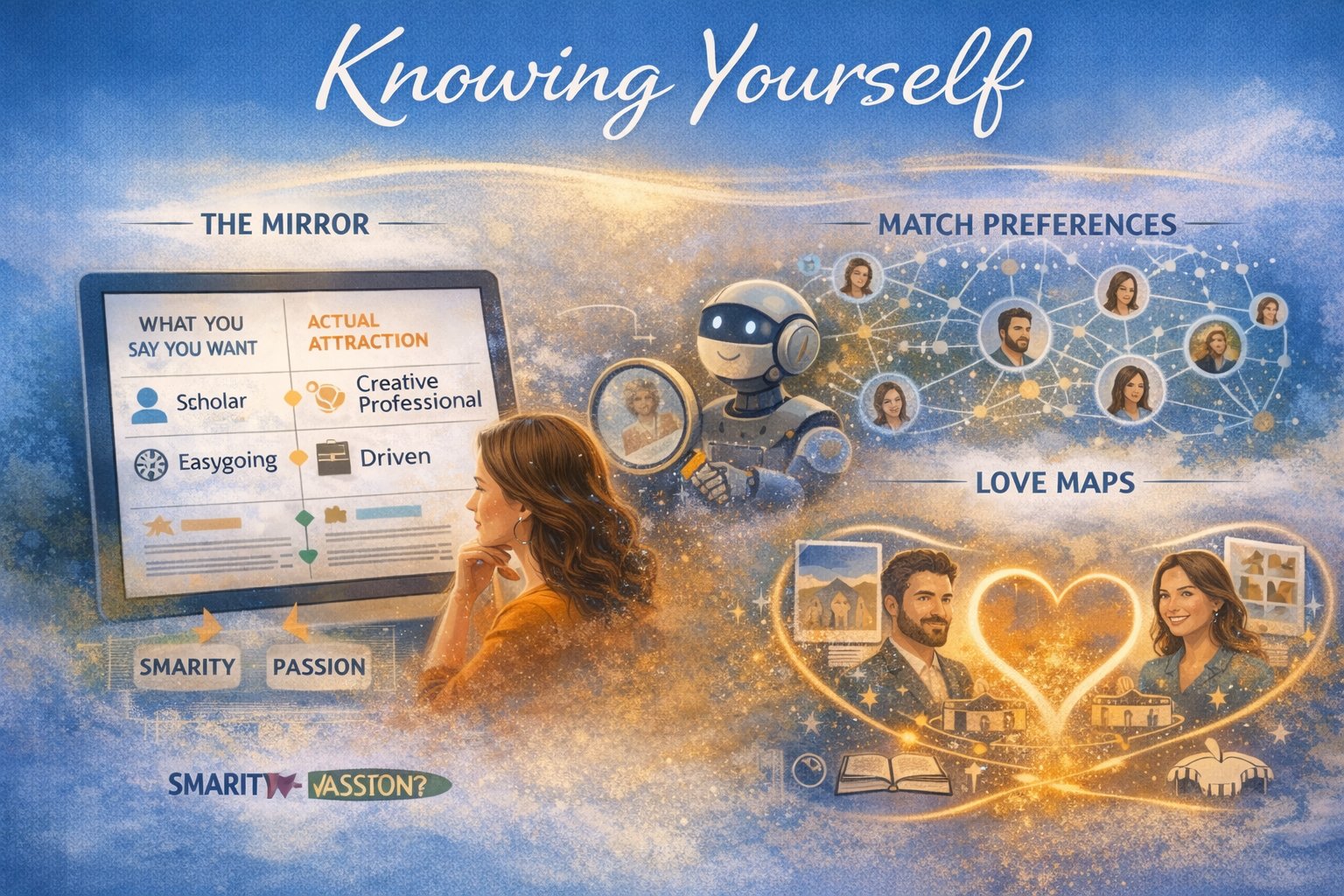
A profile tells others who you are. But do you know who you are? Do you know what you actually want—not what you say you want, but what you respond to when it appears?
The Mirror puts two columns side by side: what you say you want versus what the data says you actually attract. You claim you want a scholar, but creative professionals keep showing interest. You describe easygoing, but driven ambitious types are drawn to you. The gap between stated preference and actual attraction becomes visible—resonance factors where you align, friction points where you clash. This is not judgment. It is information. What you do with it is yours to decide.
Match Preferences goes deeper still. It analyzes your behavioral patterns—not what you claim, but how you actually respond to suggestions over time. You say height doesn't matter, but you've rejected four people under 5'8". You say you want ambitious, but you keep saying yes to the laid-back ones. The AI discovers the gap between what you declare and what you do, and this feeds directly into the matching engine. Your true preferences—the ones you reveal through action—become the basis for better suggestions.
Love Maps captures something else entirely: the vision you carry for your marriage. What does "learning home" mean to you? What does "close to family" look like in practice? When two people are compared, what emerges is not just whether they match on paper, but whether they're building toward the same thing. Shared vision is harder to measure than shared demographics. But it matters more.
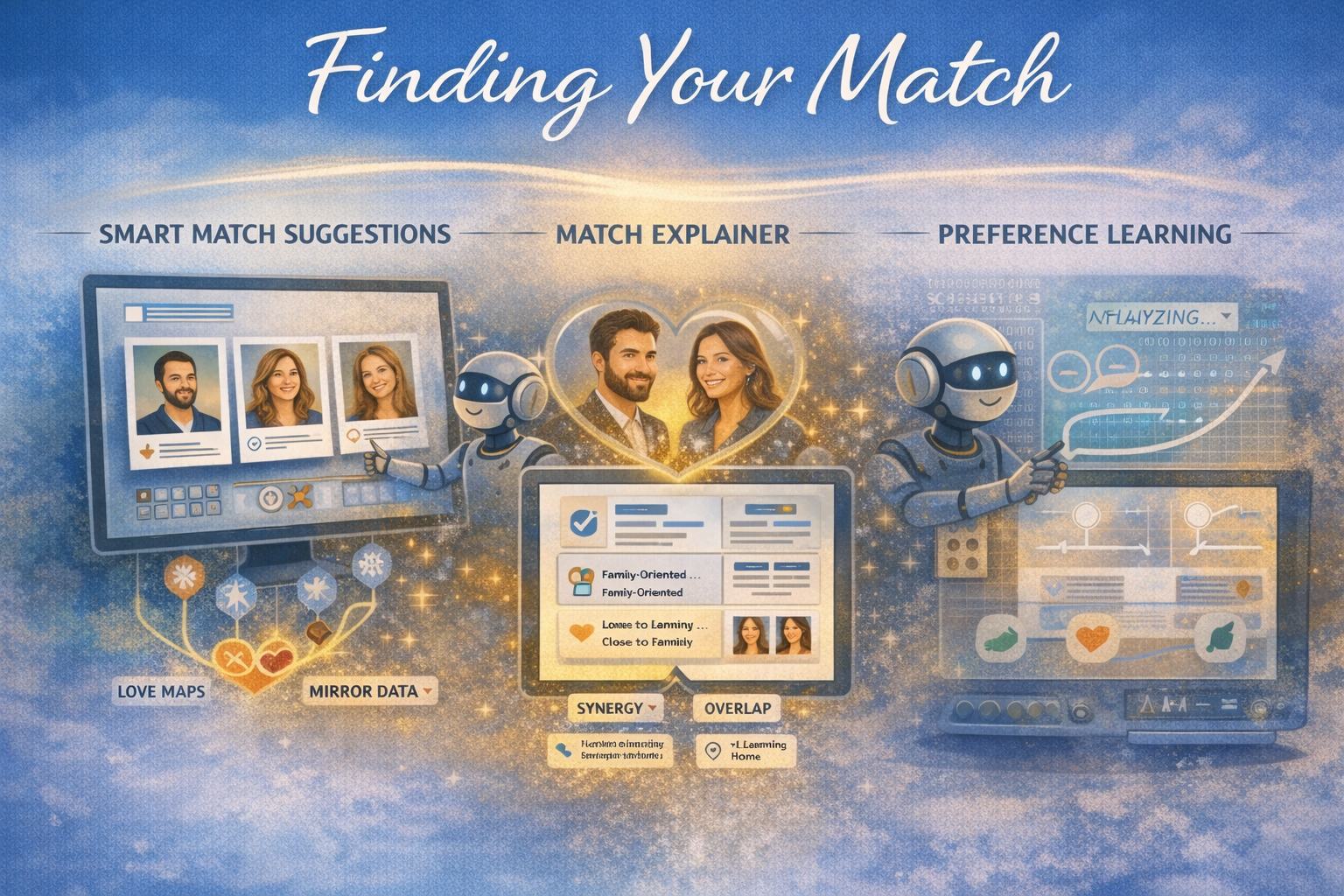
All of this feeds the core engine: Smart Match Suggestions. The AI analyzes your living profile, your stated preferences, your learned preferences from past behavior, your Love Maps, your Mirror data—everything—and surfaces the most compatible matches. This is not resume-to-resume matching. This is person-to-person matching at a depth that was never possible before.
But a suggestion without reasoning is just "trust me." Match Explainer shows you why. The echoes between what you said and what they said. The values that align. The vision of life that overlaps in ways that would take months of dating to discover—surfaced before you ever meet. You walk into the date understanding why you're there. Skepticism becomes curiosity. Guardedness becomes presence.
And with every suggestion you accept or reject, Preference Learning watches. It extracts patterns. It calibrates. The suggestions get sharper over time, aligning less with the person you think you should want and more with the person you actually respond to. The system learns you.
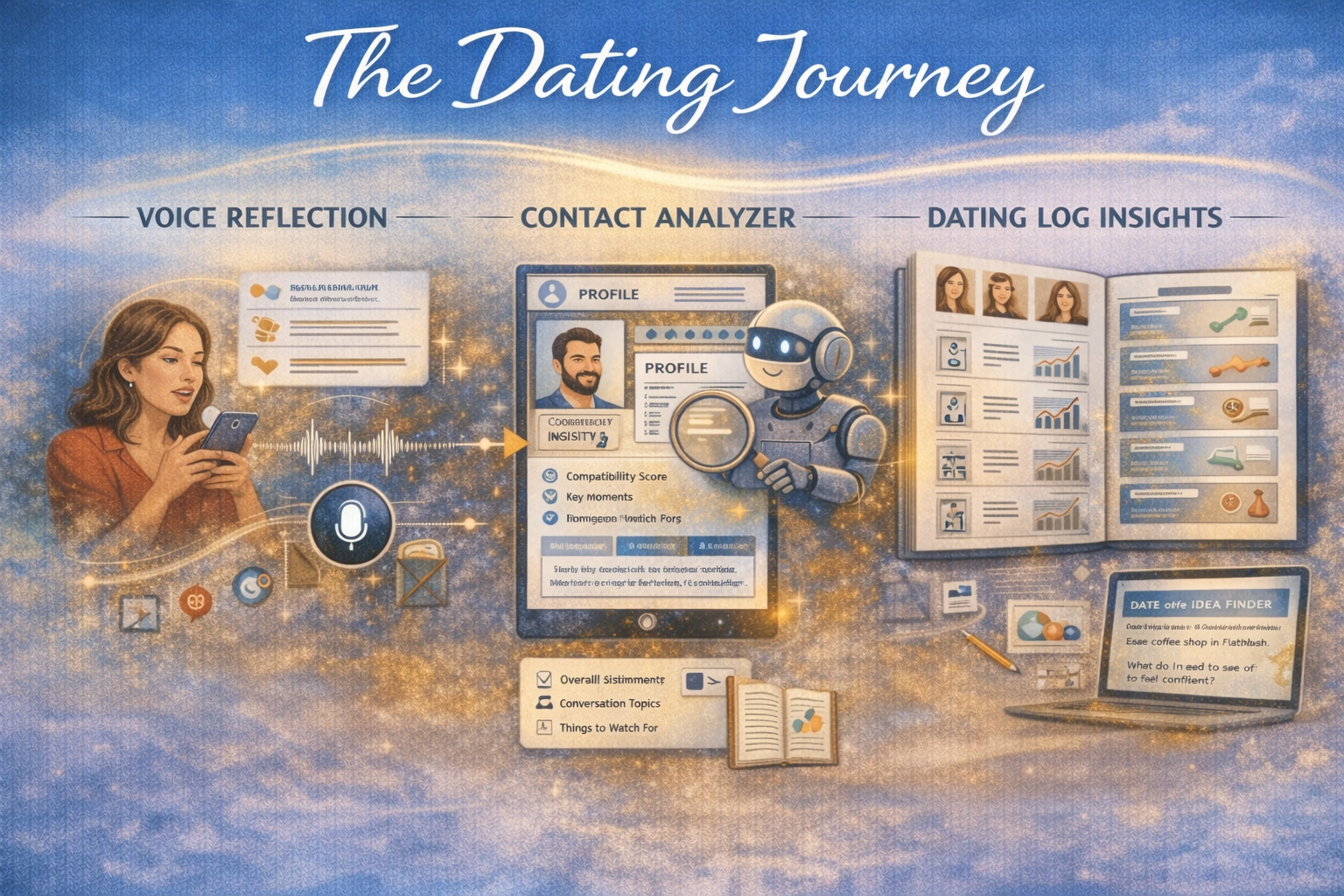
You go on a date. You come home. Someone asks how it went. You don't know. It was... something. Impressions, fragments, a swirl of reactions that haven't settled into anything coherent.
Voice Reflection lets you capture it before it fades. Record a voice memo—ramble, process, think out loud. The AI transcribes and extracts structured insights: overall sentiment, key moments, concerns, whether you want a second date. Your immediate experience, preserved before memory distorts it. Three weeks from now, when you're trying to remember what you felt after date two, the record will be there.
As dates accumulate, Dating Log Insights watches the trajectory. Five dates over six weeks. The initial electricity has settled into something steadier. You've mentioned feeling relaxed with her—that appears three times. You've also noted, three separate times, that she deflects when conversations get personal. Patterns that would be invisible from inside become visible. The AI offers questions, not advice. Is the ease a sign of compatibility, or a way of avoiding harder topics? What would you need to see to feel confident about emotional depth?
Before things even start, Contact Analyzer helps you prepare. A name comes in—you have a resume, maybe notes from research calls. The AI generates a profile: personality insights, compatibility scores, conversation topics that might resonate, things to watch for. The date becomes a place to test hypotheses, not just pass time.
And when you need a place to go, Date Idea Finder lets you search in natural language: "quiet coffee shop in Flatbush," "something active for a third date," "romantic but not overwhelming." One less source of friction in a process that has enough friction already.
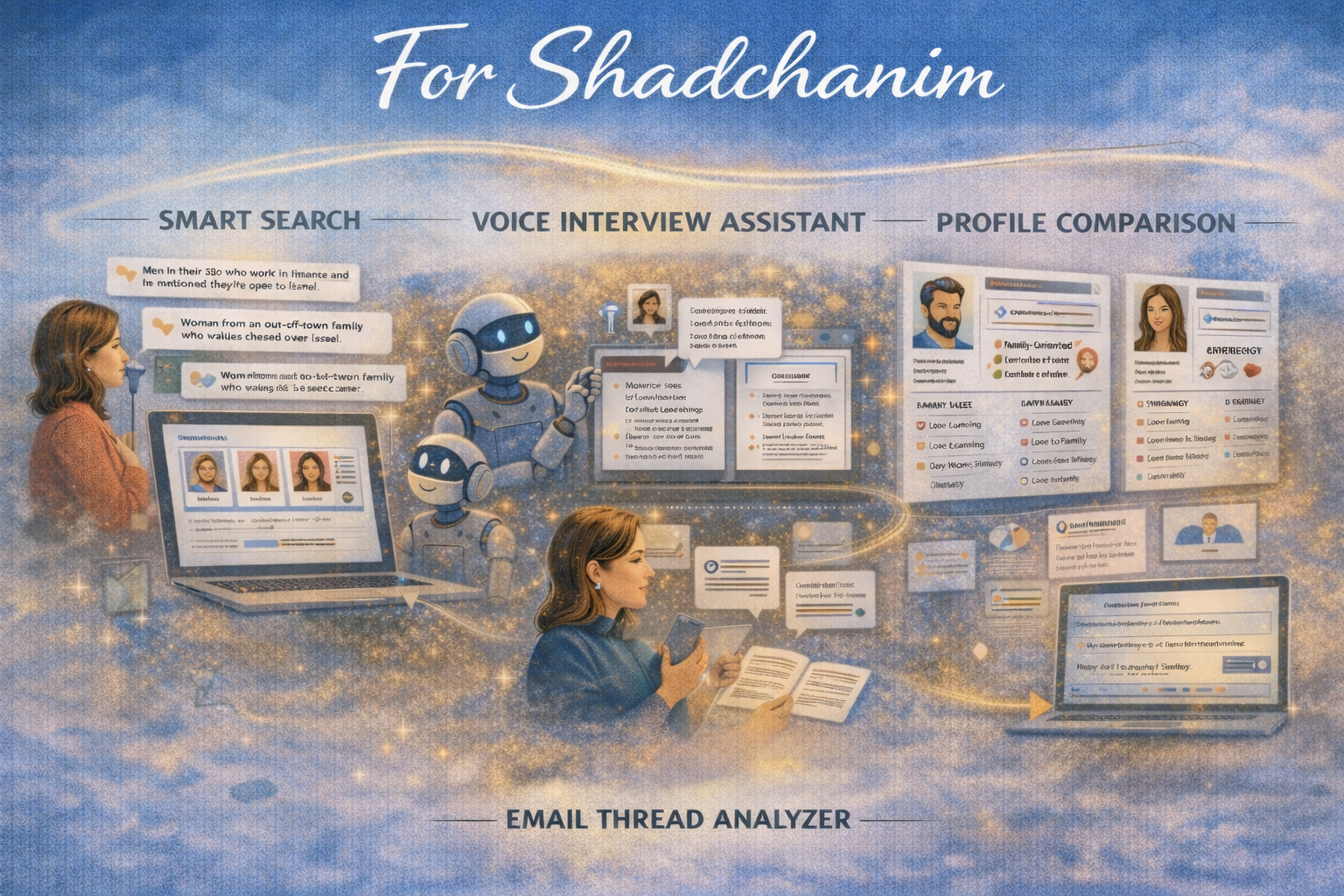
The shadchan's job exceeds human capacity. Hundreds of singles. Thousands of details. The system asks for more than any person can give. AI doesn't replace the shadchan—it carries what the shadchan cannot.
Smart Search lets you search the way you think. "Men in their 30s who work in finance and mentioned they're open to Israel." "Woman from an out-of-town family who values chesed over career." "Someone who mentioned struggling with anxiety but is working on it." The AI understands nuance, searches across everything—not just fields, but conversations, notes, the full picture—and ranks results by relevance. People who don't fit easy categories become findable. The single who would have been buried in a traditional system surfaces because the AI understands meaning.
Voice Interview Assistant transforms intake calls. Have your natural conversation while the AI guides you through the topics that need covering, takes structured notes, and formats everything into documentation. When you hang up, the work is done. No drowning in paperwork afterward. You can do more intakes, better intakes.
You have an instinct about two people. Profile Comparison lets you check it against the data before you make a suggestion—shared values, potential friction points, conversation starters for the introduction. Match Comparison goes further: it shows what the AI sees across every dimension, confirms your intuition or reveals that the feeling was misleading. Your instinct doesn't disappear. It becomes visible, checkable, explainable. When you make the suggestion, you're not just saying "trust me"—you're saying something specific, grounded, persuasive.
Email Thread Analyzer cuts through the chaos of communication. A thread has been going back and forth for days—did they say yes? Who said no? What were the reasons? The AI reads the conversation and tells you what happened. Fifteen emails reduced to actionable information in seconds.
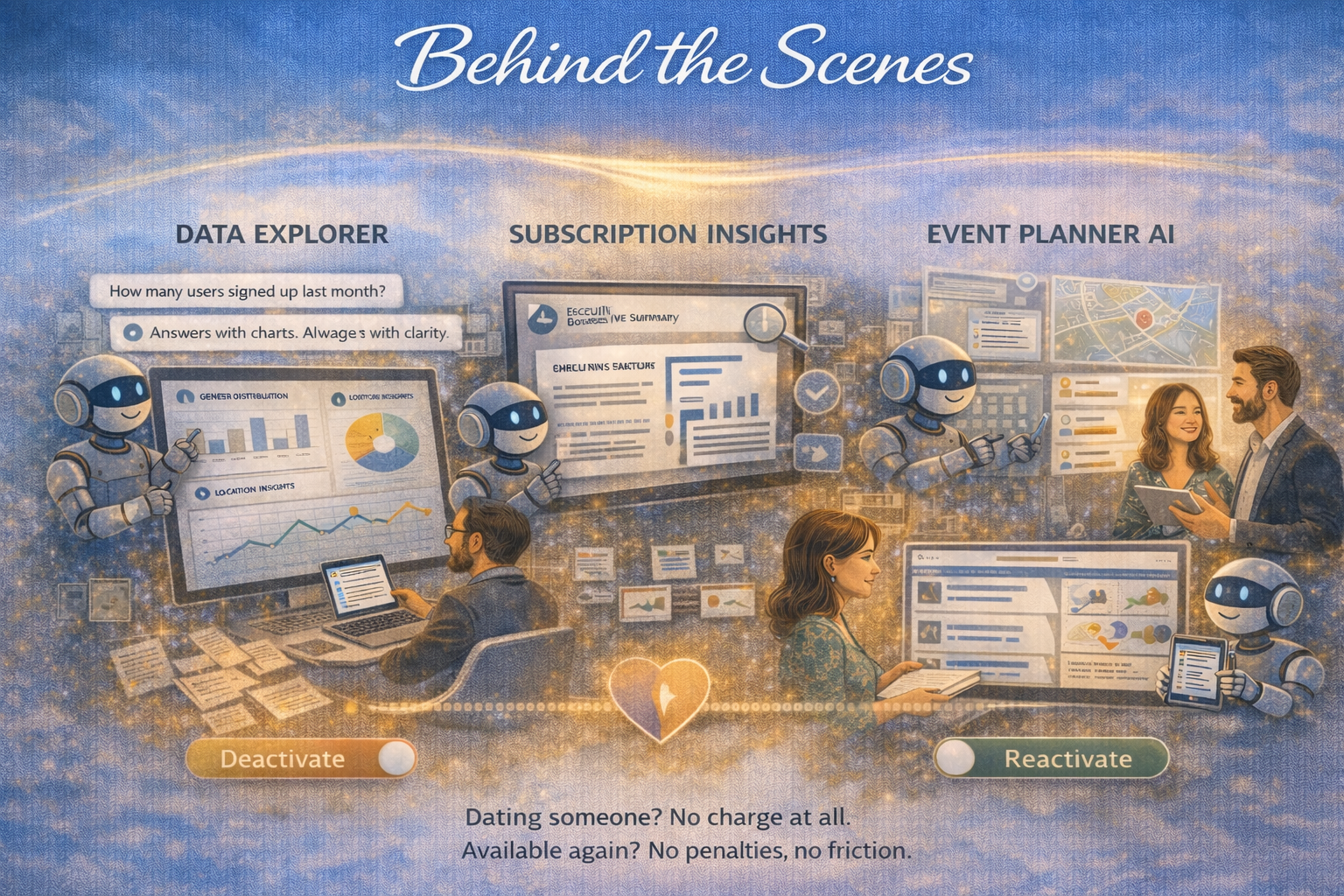
Infrastructure is invisible until it fails. Yismach runs on a layer of operations that determines whether you get attention or get lost, whether problems get caught early or fester, whether the whole thing works or doesn't.
Data Explorer lets us ask questions about the database in plain English. How many users signed up last month? What's the gender distribution by location? Where are people dropping off? Answers with charts, always with clarity. Problems get spotted early. Trends get noticed. The organization adapts instead of flying blind.
Subscription Insights generates AI-powered analysis of business health—executive summaries, churn risk factors, demographic insights, recommended actions. Bulk Email Analysis processes many threads at once to extract feedback at scale. Every response counts. Nothing gets lost.
Event Planner AI transforms how we bring people together. It builds cohorts based on compatibility data—not just availability—suggests venues, optimizes schedules, predicts attendance. Events that used to take weeks to plan come together in hours. And they're better events: more thoughtfully constructed, more likely to produce real connections. This is how shidduchim worked before resumes took over. Events bring back something that got lost.
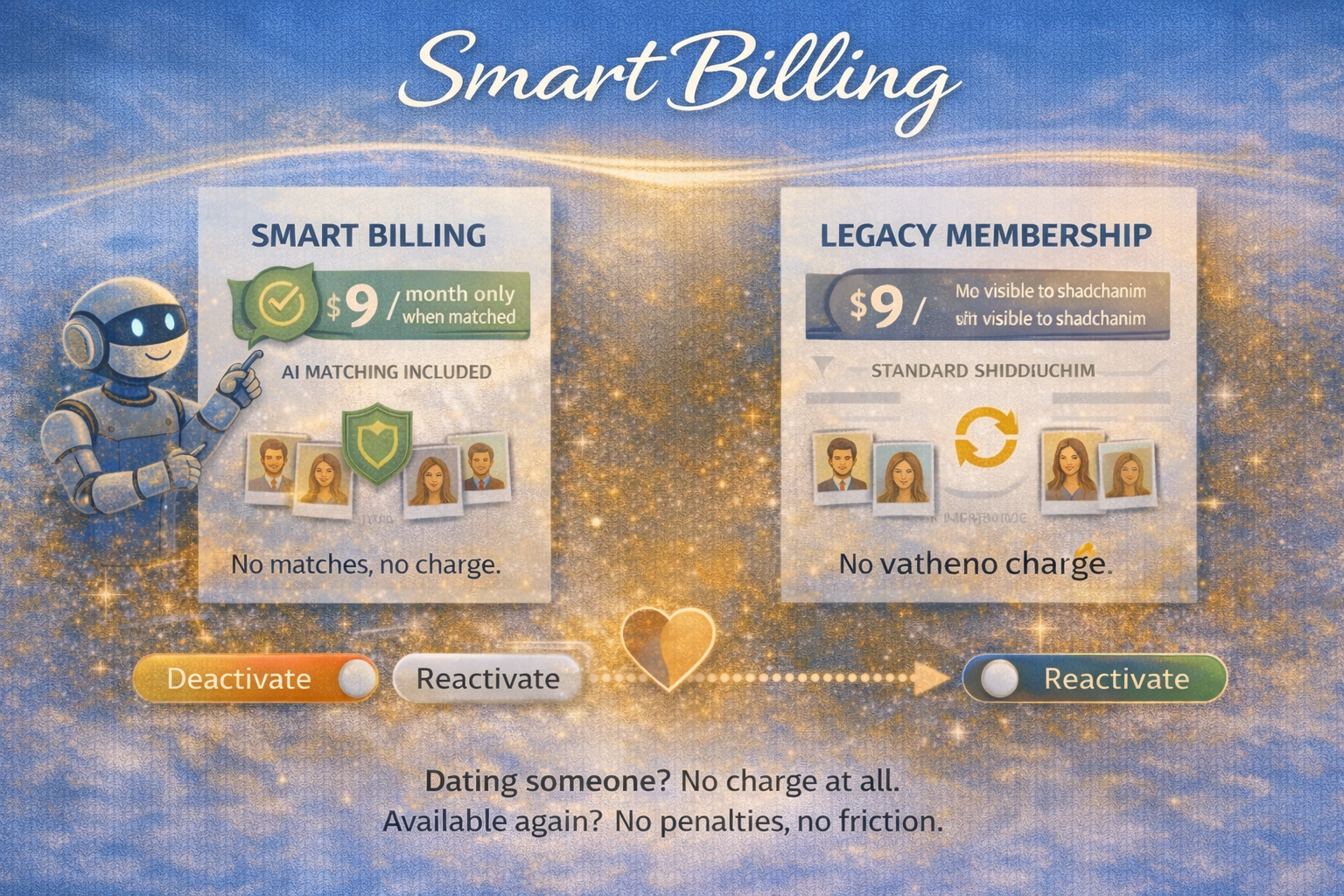
The pricing is as rational as the system.
You only pay when the AI finds you compatible matches—nine dollars a month. No matches, no charge. Zero. The system has to work for you before you pay for it.
Prefer the traditional approach? Legacy membership is nine dollars a month to be visible to shadchanim for standard shidduchim—no AI matching, just access to the network.
Already paid the one-time signup fee? You get what you paid for—your information remains visible to shadchanim, exactly as before. To benefit from the AI features, sign up again and select Smart Billing.
Dating someone? Deactivate your account and no subsequent charge. Available again? Reactivate. No penalties, no friction, no games. The system works for you, not the other way around.
The Ask
We ask one thing: show up. Meet the people we suggest. Give honest feedback. That's how the system learns. That's how you find what you're looking for.
The AI doesn't make the shidduchim. People do. But the AI makes it possible to serve more people, better, with fewer things falling through the cracks. It catches what would otherwise be missed. It sees what would otherwise stay hidden. It carries what would otherwise crush.
Twenty-five features. One system. Every piece feeding the next.
If it fits, nothing can break it. If it doesn't, nothing can make it. But you have to be in the room to find out.