What the body knows that the mouth can’t say
A siren blares. You run into the shelter. You sit on a plastic chair or a concrete floor and you wait, and the people around you are quiet in the particular way people get quiet when the sound overhead is real. Then the all-clear comes. You walk back out into the light. And for most people, within a few minutes, the body settles. The heart rate comes down. The hands stop shaking.
For some people, it doesn’t.
Not because they are weak. Not because they are choosing to remain afraid. Their body is doing something their conscious mind has no access to and no control over. The fear is still running, in a system that does not receive memos from the part of the brain that knows the siren has stopped.
To understand why requires abandoning the model of fear that most people carry without knowing they carry it. The commonsense model is simple: something threatens you, an internal alarm sounds, the alarm drives behavior and experience, and when the threat is gone the alarm stops. One input. One state. Proportional response. The model is intuitive, parsimonious, and almost entirely wrong.
The data that exposed this came from a study that, by conventional measures, failed. We tested three standard methods for eliminating fear and measured outcomes across three channels simultaneously: what the body does physiologically, what the person does behaviorally, and what the person says they feel. Every treatment moved one channel while leaving the others unchanged. One method produced large drops in physiological arousal with no change in verbal report or behavior. Another shifted approach behavior while the body continued to register full threat intensity. A third changed self-reported fear while the other two channels were unmoved.[1]
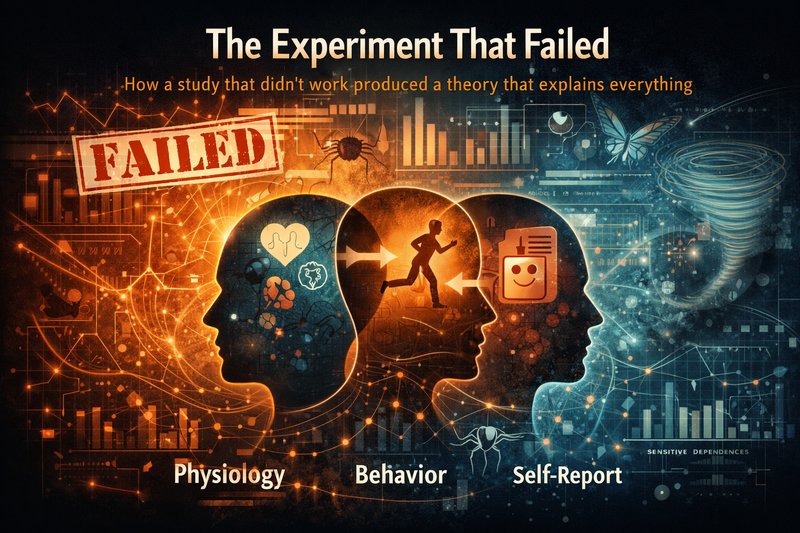
The study was shelved as a failure. The assumption was that a real treatment should have moved all three channels together. Years later, a different question emerged from the same data: what does it mean that the channels are capable of not converging at all? The answer to that question required two bodies of mathematics that had never been applied to fear. One developed to model weather. The other developed to describe subatomic particles. Both fit the data better than anything psychology had produced.
Fear is a nonlinear dynamical system. Its three channels — physiological, behavioral, verbal — are coupled oscillators, each running at its own natural frequency, each capable of influencing the others but not governed by them. The coupling is loose enough that they regularly diverge. The Lorenz equations, originally derived to model atmospheric turbulence, describe exactly this kind of system: three coupled variables with nonlinear interactions, producing trajectories that are exquisitely sensitive to initial conditions.[2]
That sensitivity — the butterfly effect, in technical language — is quantified by the Lyapunov exponent, which measures how fast two nearby trajectories diverge. When the exponent is positive, arbitrarily small differences in starting conditions grow exponentially. Two people who ran into the same shelter, heard the same siren, sat through the same interval of waiting, emerge into the same light with physiological states that may be completely different from each other — not because of anything that happened today, but because of small differences that compounded over years into entirely different nervous system landscapes.[3]
The destination of that landscape is what mathematicians call a strange attractor. Unlike a simple equilibrium, where the system settles at a fixed point, or a limit cycle, where it oscillates periodically, a strange attractor is fractal: the trajectory never repeats exactly, yet it stays within a bounded region of recognizable shape. The healthy human nervous system is a strange attractor. Heart rate variability in a healthy individual is not metronomic — it fluctuates in patterns that are complex, irregular, and fractal across different time scales. More variability means better health. The rigid, overly regular heart is the diseased one. Chronically frightened nervous systems show dramatically reduced fractal dimension: the rich, high-dimensional activity of a free system collapses into a narrower, more repetitive pattern. The attractor has simplified. The basin around it has deepened.[4]
The depth of the attractor basin is everything. A shallow basin requires only a small perturbation to escape — the system can reorganize easily. A deep basin requires enormous energy, or the right kind of perturbation at the right moment. This is the mathematical reason standard reassurance does not work on entrenched fear. It is not that the person chooses to remain afraid. Their nervous system has organized itself around a deep attractor, and the gentle push of words is nowhere near sufficient to shift the trajectory out of it.
Feedback loops are what dig the basin deeper. Noticing a racing heart triggers threat appraisal. Threat appraisal increases arousal. Increased arousal is detected interoceptively and reinterpreted as confirming the danger. The loop amplifies itself, not through any rational process but through the basic architecture of a coupled dynamical system with gain greater than one. The transition from anxious to panicked is not a gradual increase on a single scale. It is a bifurcation — a sudden qualitative change in the system’s behavior as a parameter crosses a threshold, the system jumping from one attractor state to another. Recovery requires moving back across that bifurcation boundary.[5]
And because the three channels are coupled oscillators with different natural frequencies, an intervention that reaches one channel does not automatically propagate to the others. The coupling strength between channels varies by individual, by history, by the current state of the system. When coupling is weak, the channels evolve nearly independently. Pharmacology that suppresses physiological arousal may leave behavioral avoidance and verbal fear report completely intact. Exposure therapy that shifts behavioral approach may leave physiological activation unchanged for months. This is not treatment failure. It is the mathematically expected behavior of weakly coupled oscillators subjected to single-node interventions.[6]
Chaos theory explains the dynamics of fear — how it moves, why it gets stuck, why two people diverge from the same event, why certain interventions reach one channel and not the others. It does not explain something else the data revealed: that at any given moment, a fear state does not occupy a single definite configuration at all.
This is where quantum mechanics enters, and it requires precision about what quantum mechanics actually claims. It is the most rigorously tested theory in the history of science, confirmed to more decimal places than any other physical theory. What makes it strange is not vagueness but a specific, empirically verified property of the universe: at the quantum scale, systems do not have definite states before they are measured. An electron does not have a definite position. It occupies a superposition of possible states simultaneously, each weighted by a probability amplitude, and the superposition resolves into one definite outcome only when a measurement is made. Einstein spent decades trying to prove this was merely incomplete knowledge — that there had to be definite hidden values underneath the probabilities. Bell’s theorem proved him wrong. The superposition is not ignorance. It is the actual structure of the system.[7]
The claim being made about fear is not that neurons are quantum computers. The claim is more specific: the mathematical framework of quantum probability fits the empirical data of human emotional states more accurately than classical probability does. Every one of classical probability’s foundational assumptions fails for fear. Events do not have definite values before they are assessed. The order of measurement changes the result. Distributions over different emotional dimensions cannot be multiplied together as if they were independent. These are exactly the signatures of a quantum system, and they are exactly what the data shows.
When a person is asked how they feel, the question does not retrieve a pre-existing state. It collapses one. Before the question, the fear state exists as a genuine superposition — multiple simultaneous configurations, some pulling toward threat, some away, some unresolved — that the act of asking resolves into a single verbal answer. The answer is real. It is not fabricated. But it is not a description of what existed before the question was asked. It is a description of what the question produced. The most diagnostically significant information — the full probability distribution over all possible states, and the relationships between them — is destroyed by the act of measurement.[8]
This is why the person who walks out of the shelter and says they’re fine — and means it, in the only sense they have access to — can be in the grip of a physiological state their verbal system has no window onto. They are not lying. Their verbal channel collapsed toward “safe” while the physiological channel, running its own nonlinear trajectory, collapsed toward something else. The two systems measured the same superposition and got different answers. That is not a paradox. It is the expected behavior of non-commuting measurements applied to the same quantum state.
The order of measurement compounds this. Asking “how safe do you feel?” before “would you return to that location?” produces different answers than the reverse sequence, in ways that classical probability cannot predict but quantum probability can. The first question crystallizes a state that becomes the substrate for everything that follows. The measurement operators do not commute: applying A then B is not the same operation as applying B then A. Every clinical assessment instrument that assumes question order is irrelevant is built on a false premise.[9]
Entanglement is the deepest quantum property of fear, and the one with the most clinical significance. When two quantum systems interact under the right conditions, their states become non-separable — the joint state cannot be written as a simple product of the individual states. Any description of one system alone is incomplete, because the full information about it is encoded in the joint state. Traumatic experience creates exactly this structure in the nervous system. A memory of danger becomes entangled with every sensory and physiological feature that surrounded it — a tone of voice, a time of day, a quality of light, the specific feeling in the chest just before impact. When any element of that context is encountered later, the full entangled state activates. The terror arrives complete, before the conscious mind has categorized what triggered it, because the trigger and the terror are not associated by a learned link. They are the same quantum state, and the measurement of one is the measurement of all.[10]
This is why trauma does not respond to the explanation that the danger is past. The danger being past is information that exists in the verbal channel. The entanglement exists at a level the verbal channel cannot reach. The physiological response to the trigger is not irrational. It is the activation of an entangled state by one of its components. There is nothing irrational about quantum mechanics.
The quantum Zeno effect adds a further layer. In quantum mechanics, a system that is measured continuously — observed at very short intervals — is paradoxically prevented from changing state. The act of frequent observation freezes the system in its current configuration. Applied to recovery from fear: therapeutic protocols that constantly measure, constantly assess, constantly demand verbal report of the patient’s fear state can prevent the nervous system from reorganizing. The system needs unmeasured time to evolve. The states it passes through on the way to a new configuration are fragile superpositions that collapse the moment they are observed. Constant checking destroys exactly the transitions that constitute recovery.[11]
And yet recovery happens. Sometimes suddenly, in ways that no linear model can account for. A conversation that breaks something loose. An experience of safety that arrives at the right moment in the right context and reorders the entire attractor landscape. Classical physics would say the barrier is too high: the system lacks the energy to climb over it. Quantum mechanics allows for tunneling — a probabilistic passage through the barrier rather than over it, occurring when the configuration of factors creates the right conditions simultaneously. The breakthrough cannot be predicted in advance. It cannot be manufactured on demand. But the conditions that make it more probable can be deliberately cultivated: sustained exposure to non-activating safety, reduction of the environmental noise that causes decoherence, and enough uninterrupted time for the system to evolve without being frozen by observation.[12]
Decoherence is the last mechanism, and the one most often mistaken for treatment failure. A quantum system maintains its coherence — the precise phase relationships between its superposed states that make interference effects possible — only when it is sufficiently isolated from its environment. Environmental coupling scatters the phase relationships, causing the off-diagonal terms of the density matrix to decay. The system stops behaving quantum mechanically and starts behaving like a classical probability distribution. Applied to fear: a nervous system in a chronic threat environment — ongoing conflict, persistent financial precarity, a social world that continuously reactivates the fear system — cannot maintain the coherence needed to reorganize. The entanglement is still there. The underlying structure is intact. But the coherence that would allow it to express itself as something other than raw activation has been scattered by the noise. The fear that looks intractable in a chaotic environment sometimes resolves rapidly when the environment changes. It was not the fear that changed. The decoherence lifted.[13]
Two people sit in the same shelter. They hear the same siren, wait through the same silence, emerge into the same light. Their starting conditions differ by a fraction — not in what they consciously know or believe, but in the attractor landscape their nervous systems have built over years of amplified small divergences. The all-clear is a measurement event that collapses a superposition into a definite state. What state it collapses into depends on the attractor basin they are standing in, the depth of the entanglements their experience has created, and whether the environment around them will permit the coherence needed to reorganize.
The one who is still afraid when they walk back out is not choosing fear. They are a nonlinear dynamical system obeying nonlinear dynamical laws. The siren has stopped. The quantum state has not.
This is why talk therapy, alone, cannot reach it. Talking is the verbal channel addressing the verbal channel. It is a closed loop. The words land in the same system that produced them. The physiological channel does not speak in sentences. The behavioral channel does not respond to explanations. The entangled fear state encoded in the nervous system was not written in language, and it cannot be unwritten in language. The therapist who only talks, and the patient who only talks back, are two people communicating fluently in a dialect that the body does not recognize.
You can talk the talk. The body walks its own walk. And the feeling — the actual quantum state running in the physiological channel, deep in the attractor basin, entangled with memories the verbal system has no access to — does not care what either of them said.
Effective treatment reaches all three channels because fear lives in all three channels. The body requires somatic intervention — something that enters through the physiological channel and shifts the attractor landscape from within. Behavior requires exposure, conducted carefully enough that the system accumulates new experience rather than new entanglement. And language — the verbal channel, the talk — has its role, but only after the other two have moved. Words that describe a shift the body has already made are integration. Words addressed to a body that has not moved are decoration.
Talk the talk. Walk the walk. Feel the feel. In that order, or in no order that matters.
[1]Peter Lang’s tripartite model partitions emotional experience into three partially independent channels: phenomenological (subjective report), physiological (autonomic arousal), and behavioral (observable action). Each channel follows its own dynamics; interventions targeting one will not necessarily produce proportional changes in the others. The divergence between channels — desynchrony — is not measurement error but a structural property of the system. See Peter J. Lang, “Fear Reduction and Fear Behavior: Problems in Treating a Construct,” in Research in Psychotherapy, ed. J. M. Shlien (Washington, DC: American Psychological Association, 1968), 90–103.
[2]The Lorenz system, originally derived for atmospheric convection, models any coupled nonlinear dynamical system: dx/dt = σ(y − x), dy/dt = x(ρ − z) − y, dz/dt = xy − βz. Applied to fear, x = physiological arousal, y = behavioral readiness, z = subjective state. The coupling constants σ, ρ, β are not fixed across individuals — they vary with developmental history, making the same external event produce entirely different trajectories in different nervous systems. See Edward Lorenz, “Deterministic Nonperiodic Flow,” Journal of Atmospheric Sciences 20 (1963): 130–141.
[3]Sensitive dependence on initial conditions is quantified by the maximal Lyapunov exponent λ: |δZ(t)| ≈ eλt|δZ(0)|, where δZ(0) is the initial separation between two trajectories. When λ > 0, arbitrarily small differences in initial state grow exponentially over time, making long-term prediction impossible in principle — not merely in practice. Two individuals entering a bomb shelter with nearly identical prior histories can emerge with drastically different physiological outcomes because small differences in initial conditions — a prior episode, a specific sensory association — have been amplifying across years. See Steven Strogatz, Nonlinear Dynamics and Chaos (Westview Press, 1994), ch. 9.
[4]A strange attractor is a fractal subset of phase space toward which a chaotic dynamical system evolves. Unlike fixed-point or limit-cycle attractors, it is bounded but never periodic: the trajectory never exactly repeats, yet it remains within a recognizable structure. The fractal dimension D of the attractor — typically non-integer — quantifies its complexity. Healthy heart rate variability has a fractal dimension consistent with a strange attractor; pathological states (PTSD, severe anxiety) show reduced fractal dimension, indicating collapse toward a lower-dimensional attractor. The depth of an attractor basin determines how much energy is required to escape it — which is why standard verbal reassurance, applied to a nervous system organized around a deep attractor basin, produces no change. See Ary Goldberger et al., “Fractal Dynamics in Physiology,” Proceedings of the National Academy of Sciences 99, suppl. 1 (2002): 2466–2472.
[5]Feedback loops in the fear system create positive feedback (amplifying) circuits: physiological arousal is detected by interoceptive monitoring, which generates a cognitive threat appraisal, which increases arousal, completing the loop. Mathematically, a positive feedback loop with gain G > 1 produces exponential growth until the system reaches a new attractor state (panic). Formally: x(t+1) = G⋅x(t) for the amplifying phase, where x is the arousal level and G is the loop gain. The transition to the panic attractor is a bifurcation — a sudden qualitative change in the system’s behavior triggered by a smooth change in a parameter. Recovery from panic requires moving the system back across the bifurcation boundary, which requires more than verbal intervention. See Joseph LeDoux, Anxious: Using the Brain to Understand and Treat Fear and Anxiety (Viking, 2015).
[6]Coupled oscillator dynamics are governed by: dθᵢ/dt = ωᵢ + Σᵢⱼ Kᵢⱼ sin(θⱼ − θᵢ) (Kuramoto model), where θᵢ is the phase of oscillator i, ωᵢ is its natural frequency, and Kᵢⱼ is the coupling strength between oscillators i and j. The three fear channels are oscillators with different natural frequencies and coupling strengths. A perturbation applied to one oscillator (e.g., pharmacological suppression of physiological arousal) will propagate to the others only if the coupling K is strong enough relative to the frequency difference ωᵢ − ωⱼ. When coupling is weak, desynchrony is stable and the channels evolve independently. See Yoshiki Kuramoto, Chemical Oscillations, Waves, and Turbulence (Springer, 1984).
[7]The emotional state vector in Hilbert space: |ψ⟩ = α|safe⟩ + β|threatened⟩ + γ|uncertain⟩, with the normalization constraint |α|² + |β|² + |γ|² = 1. The probability amplitudes α, β, γ are complex numbers; their squared moduli give the probability of each state being realized upon measurement. Crucially, the state vector is not a summary of ignorance — the superposition is physically real. Bell’s theorem (1964) proved that no hidden-variable theory can reproduce quantum predictions; subsequent experiments confirmed the superposition is irreducible. Applied to emotion: the person who feels simultaneously safe and threatened is not confused. The superposition is the accurate description of their state. See Alain Aspect et al., “Experimental Tests of Bell’s Inequalities,” Physical Review Letters 49 (1982): 1804–1807.
[8]The measurement postulate: applying an observable operator Ô to a state vector |ψ⟩ collapses it onto an eigenstate |φᵢ⟩ with probability Pᵢ = |⟨φᵢ|ψ⟩|². After measurement, the system is in state |φᵢ⟩, not in its pre-measurement superposition. Asking a trauma survivor “how are you feeling?” is a measurement event: it collapses the superposition and produces a definite verbal output. That output then becomes the new state from which subsequent assessments proceed. The pre-measurement superposition — which may have contained the most diagnostically significant information — is destroyed by the act of asking. See Jerome Busemeyer and Peter Bruza, Quantum Models of Cognition and Decision (Cambridge University Press, 2012), ch. 2.
[9]Non-commuting observables satisfy [Â, B̂] = ÂB̂ − B̂Â ≠ 0. For conjugate observables, the Heisenberg uncertainty principle gives ΔA⋅ΔB ≥ ℏ/2. Applied to psychological assessment: measuring subjective safety (A) before behavioral readiness (B) produces a different result than B before A. Empirically confirmed in questionnaire order effects that classical probability cannot predict but quantum probability can. The implication for clinical assessment is that no instrument can simultaneously measure all relevant dimensions of a fear state with full precision; measuring one dimension irreducibly disturbs the others. See Busemeyer and Bruza (2012), ch. 4.
[10]When two quantum systems interact, their joint state can become entangled — non-separable — such that the full state cannot be written as a product: |Ψ⟩ ≠ |ψ₁⟩ ⊗ |ψ₂⟩. Any attempt to describe either subsystem independently loses information that is physically real. Traumatic memory creates entanglement between the memory representation and its sensory context — a tone of voice, a quality of light — such that encountering any element of the context activates the full entangled state. The Hamiltonian governing this entangled system is H = H₀ + Hᵢₙₜ + Hᵉˣₜ(t), where Hᵢₙₜ is the coupling term that binds the components together. Separating them analytically — treating the memory and the physiological response as independent variables — destroys the information that is actually determining the outcome. See Alexander Wendt, Quantum Mind and Social Science (Cambridge University Press, 2015).
[11]The quantum Zeno effect: if a quantum system is measured at intervals Δt, the probability of transition out of the initial state is proportional to (Δt)² rather than Δt. In the limit of continuous measurement, the transition probability goes to zero — the system is frozen in its current state by the act of observation. Formally, for a system with Hamiltonian H and initial state |ψ₀⟩, the survival probability under frequent measurement is: P(t) ≈ 1 − (ΔE)t²/ℏ² for short intervals, where ΔE is the energy spread of the initial state. Applied to trauma recovery: therapeutic protocols that reassess the patient’s fear state at every session — constantly measuring, constantly demanding verbal report — can paradoxically prevent the nervous system from reorganizing. The system needs unmeasured time to evolve. See Baidyanath Misra and E. C. G. Sudarshan, “The Zeno’s Paradox in Quantum Theory,” Journal of Mathematical Physics 18 (1977): 756–763.
[12]Quantum tunneling: a particle can traverse a potential energy barrier V(x) even when its total energy E < Vₘₐˣ. The tunneling probability is: T ≈ e⁻²κᴸ, where κ = √(2m(V₀ − E))/ℏ and L is the barrier width. The probability is non-zero regardless of barrier height, provided the barrier has finite width. Applied to fear: the nervous system organized around a deep attractor basin does not require climbing over the barrier of accumulated fear. Under the right conditions — sufficient relational energy, a precisely timed intervention, the convergence of multiple favorable factors — the system can tunnel through. The breakthrough is not gradual. It is sudden, probabilistic, and cannot be manufactured on demand, but the conditions that make it more likely can be deliberately created. See Richard Feynman, Robert Leighton, and Matthew Sands, The Feynman Lectures on Physics, vol. 3 (Addison-Wesley, 1965), ch. 7.
[13]Decoherence occurs when a quantum system becomes entangled with its environment, causing the off-diagonal elements of the density matrix ρ to decay: ρ(t) = Trᵉₙᵥ[|Ψ(t)⟩⟨Ψ(t)|]. The rate of decoherence scales with the complexity of the environment — more environmental coupling means faster decay of quantum coherence into classical probability distributions. Applied to fear: chronic stress, ongoing threat, and social environments that continuously reactivate the fear system scatter the phase relationships between the three channels, preventing them from achieving the synchronized state that indicates genuine resolution. A fear state that looks “gone” by verbal report but shows persistent physiological activation is not in remission — it is decoherent. The underlying entanglement is intact; the coherence needed to express it has been scattered by environmental noise. See Wojciech Zurek, “Decoherence and the Transition from Quantum to Classical,” Physics Today 44 (1991): 36–44.