The Experiment That Failed
How a study that didn't work produced a theory that explains everything
The study was supposed to be straightforward. Three standard methods for eliminating fear. Three standard measures to determine which one worked. Physiological measures — heart rate, galvanic skin response, the body's involuntary signatures of arousal. Behavioral measures — what the subject actually did when confronted with the feared stimulus. And subjective report — what the person said they felt. Three methods, three measures, a clean experimental design. Run the numbers. Find the winner.
The numbers did not cooperate.
When the data came back, the three measures disagreed. One method produced dramatic changes in physiological arousal but virtually no change in self-reported fear. Another shifted behavior — subjects approached the feared stimulus more readily — while their bodies continued to register threat at the same intensity. The third method changed what subjects said they felt, but the body told a different story entirely. By the conventional logic of experimental psychology, none of the treatments had worked. A successful intervention should have moved all three measures in the same direction. None of them did.
The study was shelved. Years passed. The data sat.
Then, looking at it again with different eyes, a different question emerged. Not: why did the treatments fail to converge the measures? But: what does it mean that the measures refused to converge at all?
That question opened a door that has not closed since.
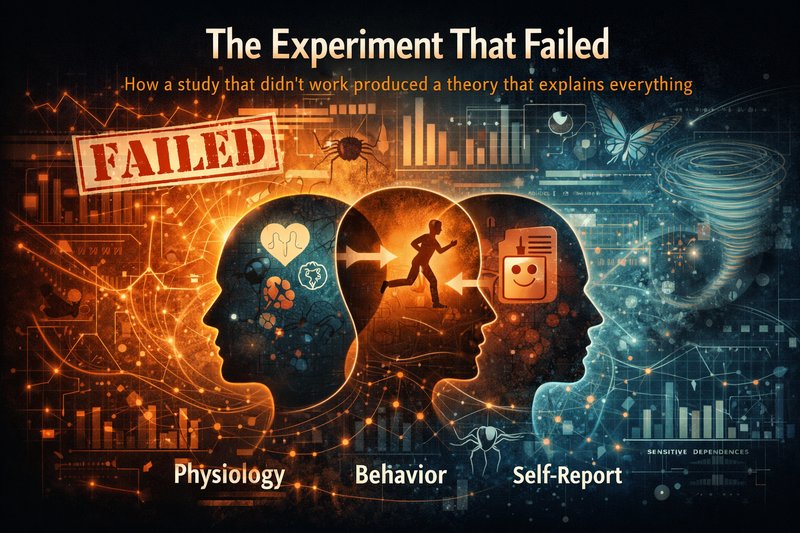
The assumption embedded in that original study — the assumption so obvious it was never stated — was that fear is a single thing. One internal state, expressed simultaneously and proportionally across all three channels: what you feel, what your body does, and what you do in the world. This is the model psychology inherited from physiology, which inherited it from common sense. You are afraid. Your heart races. You run. The three are one.
The data was showing something else. The three were not one. They were three distinct systems, each with its own dynamics, each capable of moving independently of the others. A person could be physiologically terrified and behaviorally calm. Another could report calm while their body screamed. Another could approach the feared object with their feet while every other system tried to stop them.
This state — the misalignment of the three fear systems — has a technical name: desynchrony. It was not a new observation. Researchers had noticed it in clinical populations for decades. But its implications had not been followed to their logical conclusion. If desynchrony is not an anomaly but a fundamental feature of how fear operates, then every study that measured only one channel, or assumed the three channels tracked together, had been measuring something incomplete. And the model of fear that underpinned decades of clinical practice — the model that said fear is a unified alarm that, when extinguished, goes out in all channels at once — was built on a foundation that the data had never actually confirmed.
The question was what kind of model would fit better.
Linear models could not do it. A linear model assumes proportionality: large causes produce large effects, and multiple systems responding to the same cause will respond proportionally. But the data was showing non-proportionality in every direction. A massive physiological response coinciding with a minimal behavioral response. A small subjective shift producing dramatic behavioral change. The relationship between cause and effect, and between the three output channels, was not proportional. It was not linear. Something else was going on.
Two bodies of mathematics, developed for completely different purposes, turned out to fit.
I. The Mathematics of the Unpredictable
Chaos theory was not invented to explain fear. It emerged from meteorology, when a scientist named Edward Lorenz discovered in 1961 that his weather simulation produced completely different outcomes depending on whether he rounded one starting variable to three decimal places or six. The difference between those starting values was less than one part in a thousand. The difference in outcomes was everything.
This violated the foundational assumption of classical science: that the universe is proportional. Small causes produce small effects. The future, given a full description of the present, is predictable. Lorenz's printout said otherwise. In certain kinds of systems — systems with feedback, with nonlinear interactions, with many variables coupling in ways that amplify rather than dampen — tiny differences in starting conditions cascade into outcomes so divergent that prediction becomes, in principle and not just in practice, impossible.
This came to be called sensitive dependence on initial conditions. The colloquial name is the butterfly effect: the notion that a butterfly flapping its wings in Brazil can, through an unbroken chain of amplifying consequences, set off a tornado in Texas. Lorenz was not speaking poetically. He was describing a mathematical property of certain dynamical systems. And fear, it turns out, is one of them.
To understand why, it helps to know what mathematicians mean by an attractor. In any system that evolves over time, there are states the system tends to fall toward. Leave a pendulum alone and it settles at the bottom — the bottom is its attractor. A more complex system might oscillate between two states rather than converging on one. More complex still, and the system traces patterns that never exactly repeat but are recognizably structured: what mathematicians call a strange attractor. The system is simultaneously ordered and unpredictable — not random, but incapable of producing the same state twice.
The human nervous system is a strange attractor.
Heart rate variability is the clearest demonstration. A healthy heart does not beat metronomically. It fluctuates continuously, varying in intervals that are complex, fractal, and structurally similar across different time scales. Cardiologists have discovered that more variability indicates better health. The rigid, overly regular heart — the one beating like a clock — is the diseased one. Health looks like structured unpredictability. The system that has lost its complexity, that has collapsed from a rich strange attractor into something simpler and more uniform, is the system in trouble.
The same signature appears in brain activity, in respiratory rhythm, in immune function. Healthy systems are complex. Chronically stressed or pathologically frightened systems are not. The neural activity of a person in the grip of a phobia, or caught in the loop of a PTSD episode, shows dramatically reduced complexity: the high-dimensional, richly variable activity of a free nervous system collapses into a narrow, repetitive pattern. The system has fallen into a deep attractor basin and cannot climb out.
In chaos mathematics, attractor basins have a size. A shallow basin requires only a small perturbation to escape. A deep basin requires enormous energy — or the right kind of perturbation at the right moment. This is why standard reassurance does not work on entrenched fear. It is not that the person chooses to remain afraid. Their nervous system has organized itself around a deep attractor, and the gentle push of verbal reassurance is nowhere near sufficient to shift it.
The butterfly effect operates here too. Two people with nearly identical histories can have dramatically different fear profiles, because some small difference early in development — a single incident, a single relationship, a single moment of protection or abandonment — set their systems on diverging trajectories that amplified over time into entirely different attractor landscapes. They are not simply "more or less anxious people." They are different dynamical systems.
And feedback loops — which chaos theory treats as central, where linear models treat them as complications — are the mechanism through which fear escalates. Noticing a racing heart triggers more fear. More fear accelerates the heart. The accelerated heart confirms the fear was warranted. The loop amplifies itself until the system reaches a new attractor state — panic — from which, again, escape requires more than reassurance.
This is why the three measures in that original study did not move together. Physiological arousal, behavioral approach-avoidance, and subjective report are three different components of the same nonlinear system, each coupled to the others through feedback loops with different time constants and different sensitivities. A treatment that intervenes at one node in the system — say, by reducing physiological arousal through pharmacology — does not automatically cascade through the other nodes. The system is not a single dial being turned down. It is a network of coupled oscillators, each following its own dynamics, each capable of being influenced without the others being affected.
Desynchrony is not a measurement problem. It is a mathematical property of nonlinear coupled systems.
II. The Mathematics of the Simultaneous
Chaos theory explains the dynamics of fear — how it moves, how it gets stuck, why the three systems diverge. It does not explain something else the data revealed: that fear, at any given moment, does not occupy a single state at all.
This is where quantum mechanics enters the picture. And this requires clarity about what quantum mechanics actually is, because it has been badly misappropriated in popular culture. Quantum mechanics is not mysticism. It is the most rigorously tested physical theory in the history of science. Its predictions have been confirmed to more decimal places than any other theory in physics. What makes it strange is not that it is vague or spiritual, but that it describes a universe that is genuinely, irreducibly different from the universe classical physics assumed.
The central discovery: at the subatomic scale, particles do not have definite properties before they are measured. An electron does not have a definite position. It exists in a superposition — a simultaneous occupation of multiple states that are mathematically real, not figurative. When a measurement is made, the superposition collapses into one definite outcome. But until that moment, the multiplicity is not merely our ignorance. It is physically real.
Einstein spent decades trying to disprove this. His objection — that God does not play dice — expressed his conviction that there had to be hidden variables beneath the quantum probabilities, that the universe was deterministic at a deeper level than quantum theory could see. He was wrong. Bell's theorem, developed in 1964, showed that any hidden-variable theory would have to predict results that disagree with quantum mechanics. Subsequent experiments confirmed quantum mechanics every time. The superposition is not ignorance. The universe is not deterministic. Reality at the quantum scale is irreducibly probabilistic.
Whether quantum mechanics applies at the scale of neurons and emotions is a separate and genuinely contested question. The claim being made here is not that neurons are quantum computers. The claim is narrower and more defensible: the mathematical framework developed for quantum systems — quantum probability theory — fits the empirical data of human cognition and emotion more accurately than classical probability theory does.
Classical probability theory assumes that events have definite values before they are measured. It assumes that the order in which you ask questions does not affect the answers. It assumes that probability distributions for different aspects of a situation can be combined multiplicatively. Every one of these assumptions fails for human emotional states.
The order in which questions are asked changes the answers in ways classical probability cannot predict but quantum probability can. Ask someone first how satisfied they are with their life, then how many dates they've been on this month, and you will get different answers than if the questions are reversed. This is not because people are irrational. It is because asking the first question forces a collapse — it takes an ambiguous emotional state that existed in multiple configurations simultaneously and crystallizes it into a specific answer. That crystallized state is now the context from which the next question is answered. Change the order, change the collapse, change the context, change the result. This is quantum probability's prediction for non-commuting operators: AB does not equal BA.
More fundamentally: a person who has not yet committed to a feeling is not confused or avoiding. Their emotional state is in genuine superposition. The simultaneous experience of fear and longing, of wanting and dreading, of drawing close and pulling back — this is not a contradiction to be resolved by clearer thinking. It is a mathematically coherent state in which multiple incompatible configurations coexist. The superposition collapses when context forces it: when a decision is required, when a question is asked, when a moment demands a response. Before that collapse, the multiplicity is real.
This reframes what introspection can and cannot do. A person who turns inward and tries to determine what they really feel is not finding a pre-existing truth. They are performing a measurement. The measurement itself creates the state they find. This is not relativism — the state that emerges is real, and it determines subsequent behavior. But it is not the same as retrieving a fact that was already there.
III. The Coupling That Cannot Be Undone
Superposition describes the structure of a single emotional state. Entanglement describes something else: what happens between states, between people, and between a person's past and present, once connection has formed.
In quantum mechanics, when two particles interact under the right conditions, they become entangled — linked in such a way that the state of one is instantly determined by any measurement performed on the other, regardless of the distance between them. Einstein called this spooky action at a distance and believed it would prove quantum mechanics wrong. The experiments proved him wrong instead. The correlation is not because information travels between the particles. It is because the two particles are not, in any meaningful sense, two separate systems anymore. They are one system described by a single quantum state. Any attempt to describe them separately loses something that is physically real.
Fear produces entanglement in the nervous system. Traumatic experience fuses memory to physiology in a coupling so tight that no amount of subsequent experience cleanly separates them. A memory of betrayal does not sit in the brain labeled "past event, neutralized." It is entangled with every sensory and emotional feature that surrounded it: a tone of voice, a time of day, the quality of light through a particular window, the feeling of hope just before it was destroyed. When any one of these features is encountered — a similar tone, a comparable moment of vulnerability — the entangled state activates. The terror arrives in full, before the conscious mind has had time to categorize what triggered it. This is not irrationality. It is quantum coupling.
And the entanglement runs between people, not just within them. Long-term partners develop physiological synchrony that cannot be explained by conscious communication or imitation. Heart rate variability correlates across a room. Cortisol rhythms track each other through the week. Telomere length — the cellular marker that tracks aging at the chromosomal level — is correlated between spouses who have lived together for decades. They do not merely share a life. They share a biology. The quantum description of this is that the two systems have become non-separable: a complete description of one person's state cannot be written down without reference to the state of the other.
This also explains emotional contagion in crowds — the way panic spreads through a large group far faster than any network of person-to-person communication could account for. Individuals whose emotional states have been primed toward fear, through shared context and mutual attention, develop something like social entanglement: each person's state becomes correlated with the states of others, not through explicit information transfer but through the coupling of entangled emotional fields. The quantum model of this was developed by scholars including Alexander Wendt, who argued that consciousness and emotion can operate as macroscopic quantum phenomena. The sudden, simultaneous onset of collective panic — in financial crises, in public emergencies — is not adequately explained by sequential person-to-person contagion. Something faster, more global, is happening.
The point is not that these phenomena are mysterious. The point is that they are entangled. Separating them analytically — treating each person's fear as an independent variable, each memory as an isolated file, each physiological response as a discrete event — destroys the information that is actually determining outcomes.
IV. Fear as a Quantum State
What emerges from the combination of these two frameworks — chaos theory and quantum mechanics — is a model of fear that is fundamentally different from anything that preceded it.
Fear is not a single internal state that either is or is not present. It is a dynamical quantum system: continuously evolving, sensitive to its own history in nonlinear ways, capable of occupying multiple incompatible configurations simultaneously, and coupled to other systems — physiological, behavioral, social — through entanglements that cannot be cleanly severed.
The three measures that refused to converge in that original study were not measuring the same thing poorly. They were measuring different components of a system that is designed — mathematically, constitutionally — to run asynchronously. The physiological channel has its own attractor landscape, its own time constants, its own sensitivity to triggers. The behavioral channel has different ones. Subjective report is itself a measurement — an act of observation that collapses a superposition into a momentary verbal state, which then affects subsequent states in ways classical models cannot track.
A treatment that moves only one channel is not a partial success. It is a targeted intervention in a coupled system, with predictable consequences for the other channels depending on the strength of the coupling and the direction of the feedback loops. The failure to understand this is why therapies that work in the physiological domain leave behavioral avoidance untouched. Why cognitive reframing changes self-report without touching the body. Why behavioral exposure sometimes produces physiological habituation without ever producing subjective calm.
The clinical implications are significant. But the theoretical implication is larger.
If fear is a quantum state, then the standard interpretive vocabulary for fear — "they are afraid," "the fear is gone," "the fear was triggered" — is approximately as accurate as describing an electron as being "in a location." It is a useful shorthand that captures something real while concealing the actual structure of what is happening. Fear is not a binary that is either on or off. It is not a value that a person either has or lacks. It is a state vector — a probability distribution over multiple simultaneous configurations — that evolves continuously, collapses under measurement, and becomes entangled with other state vectors through interaction and experience.
This is not a metaphor borrowed from physics to make psychology sound rigorous. The mathematical structures fit the empirical data in ways that classical models do not. The order effects, the context effects, the superposition of incompatible emotional states, the non-separability of coupled systems — these are exactly what quantum probability predicts and exactly what the data shows.
V. Love in the Same Framework
Fear and love are not opposites occupying different psychological territories. They are dynamical systems running the same mathematics, deeply coupled, often simultaneously active in ways that classical psychology has struggled to describe.
The butterfly effect operates in love exactly as in fear. Whether a couple's first disagreement happens on an ordinary Tuesday or on a day when one of them is already at the edge of their regulatory capacity — this is not a trivial difference. In a nonlinear system, initial conditions matter catastrophically. Two relationships that look identical at the start can, through the amplification of small divergences, arrive at completely different attractor landscapes a decade later. This is not fate or luck. It is mathematics.
Ambivalence in love — the simultaneous experience of deep attachment and profound terror — is a superposition state. The person who feels drawn to someone they also fear, who wants intimacy and withdraws from it, who reaches toward connection and then creates distance, is not confused or indecisive. They are occupying a genuine quantum configuration in which attraction and avoidance coexist as real simultaneous states. This is neurologically demonstrable: brain imaging shows that ambivalent attachment simultaneously activates the approach circuitry and the fear and avoidance systems, including the amygdala. These are not alternating states. They are concurrent.
And the entanglement between fear and love runs in a specific direction that matters. The neural architecture of deep attachment overlaps substantially with the neural architecture of threat response. Love activates vulnerability, and vulnerability activates the same systems that respond to danger. A person who has experienced the specific pain of loving someone and losing them — to death, to betrayal, to rejection — has developed an entanglement between love and fear that is not a cognitive distortion. It is an accurate record of their experience, encoded in the coupling of neural systems. The closer they come to love, the more strongly the entangled fear system activates. They are not being irrational. They are being a system that has learned.
Quantum tunneling provides a framework for what happens in breakthrough moments — when a couple that has been unable to move past a fear barrier suddenly does. Classical physics would say the barrier is too high: the system lacks the energy to climb over it. Quantum mechanics allows for tunneling — a probabilistic breakthrough through a barrier, not over it, that occurs when conditions create the right configuration of factors simultaneously. In human terms, this is the moment of sudden, unexpected openness. The conversation that breaks something loose. The experience of being seen that reorders the attractor landscape. It cannot be predicted in advance. It cannot be manufactured on demand. But it can be created by holding the conditions that make it possible.
VI. What This Means for the Person Who Is Terrified to Try Again
There is a diagnosis that circulates in the world of shidduchim like a verdict. Fear of commitment. It is delivered by shadchanim, by parents, by therapists, by the people who have watched someone date for years and still not reach the chuppah. The word "commitment" carries the implication that the problem is moral or dispositional — that the person is withholding something they could give if they chose to. That they are, in some meaningful sense, choosing their fear.
They are not.
What observers are watching, when they watch someone who seems to freeze every time the relationship approaches depth, is a quantum state system running exactly as it was built to run. The fear is not an obstacle sitting between the person and commitment, which better willpower or clearer thinking would allow them to step around. The fear is entangled with the love. The approach activates the avoidance. The longing and the terror are not sequential — not "I feel hopeful and then I feel afraid" — they are simultaneous superpositions, and the superposition collapses differently depending on what question is asked, what context is present, what prior experience has created the attractor landscape the person is standing in.
Telling this person they have fear of commitment is approximately as useful as telling an electron it should be in a definite position. The state they are in is not a choice. It is not a flaw. It is the quantum structure of a system that has been shaped by experience into a particular configuration, and that configuration is doing exactly what it is designed to do.
The shadchan who has worked with enough people to develop real intuition knows something about this even without the vocabulary. She does not push. She does not confront. She gives the system time to evolve. She keeps the question open rather than forcing a collapse. She understands — without being able to say why — that certain questions asked in a certain order produce different emotional states than the same questions asked differently. She has learned, through thousands of interactions, that the report at the end of a date is not the ground truth. That the person who is coldest in the middle of the relationship is sometimes the most deeply attached. That the one who walks away is sometimes the one who comes back.
She is doing quantum mechanics without the equations.
The attractor landscape can shift. This is the crucial point. Strange attractors are not permanent. The nervous system is plastic. Deep basins can be widened; rigid patterns can regain their complexity; entangled states can, through the sustained experience of new information, begin to decouple. But this happens at the pace of a dynamical system, not at the pace of a therapist's timetable or a family's impatience. The system requires repeated exposure to conditions that do not activate the entangled fear response. It requires enough stability that the attractor landscape can reorganize without the reorganization itself becoming a new threat. And it requires the people around the person to understand that what they are watching is not ambivalence.
It is physics.
The person who seems unable to commit is not withholding. The person who freezes at depth is not playing games. The person who reports feeling nothing at the end of a date that looked, from the outside, like it had every element of a successful encounter — that person's three systems are running asynchronously, as they are designed to, as the mathematics predicts, as the data from a study that was almost never examined closely enough has now confirmed.
Understanding this does not make the work easier. It makes it more honest. The problem is not the person. The problem is the model. The old model said fear was a unified alarm that, when extinguished, goes out all at once. The data said that never happened. The new model says fear is a quantum state — multidimensional, entangled, superposed, sensitive to its own history in ways that cannot be predicted from the outside by someone who cannot see the attractor landscape the person is navigating.
That landscape was built by experience.
It will be rebuilt by experience.
That is all.