
Seven Names for What Is Missing
The Gemara in Yevamot does not say that a man without a wife tends to be unhappy, or that he faces certain disadvantages in life. It says something more precise and more categorical. Rabbi Tanchum said in the name of Rabbi Chanilai: any man without a wife lives without joy, without blessing, without goodness. The Western Sages — those in Eretz Yisrael — added four more: without Torah, without a wall, without peace. Rav Ulla bar Ravin added a seventh: without life.[1]
Seven terms. The Maharal understands exactly how the Gemara uses categorical language. He does not let these seven terms rest as a rhetorical list or reduce them to synonyms for loneliness. He analyzes each one separately, because each names a different structural reality. Together they do not describe seven unfortunate tendencies. They describe what is ontologically absent from a man who has not yet entered the category the Torah defines as complete.[2]
Joy arises from wholeness. A fractured thing cannot truly rejoice — not because it is sad, but because the structural conditions for joy do not exist inside a fractured state. A man without a wife is not unhappy in the ordinary sense. He is incomplete in the Maharal's precise sense: half a form, missing the other half that was always designated as his. The half-form cannot generate what belongs only to the whole. Blessing requires a vessel to receive it. The Gemara in Bava Metzia states it plainly: there is no blessing in a man's home except for the sake of his wife. Rava told the people of Machoza: honor your wives so that you become wealthy. Not as a reward for virtue, but as a description of causality. The wife is the vessel into which divine overflow enters; when she is honored, the blessing has somewhere to land.[3]
Goodness — tovah — belongs to unity, and division is its structural opposite. The first six days of creation: each day the Torah records "and God saw that it was good" — except the second day, when the separation of the upper waters from the lower was introduced into the world. Division itself is the presence of not-good. The Torah used the word tov when it said "it is not good for man to be alone" — and the Maharal hears that word with full weight. The man alone is in a state of internal division, severed from the half designated as his from before the world began. He cannot inhabit the category of tovah because that category requires the wholeness he does not yet have.[4]
The four additions the Western Sages and Rav Ulla bring carry the analysis into dimensions that go beyond the man's own interior condition. Without Torah: Torah is called "a woman" in the tradition, from the verse "see life with the woman you love" (Kohelet 9:9). A man who has been completed by marriage is drawn toward Torah as his completion in a way an incomplete man cannot be. Marriage creates the structural conditions within which that gravitational pull toward completeness — in all its dimensions — can operate. Without a wall: the Maharal draws this from the word binyan in "God built the rib into a woman" (Bereishit 2:22). Every building implies enclosure and protection. The wife is the wall and the building within which a man's life is held. Without peace: peace is the product of wholeness, and a man without his completion has not achieved the state from which peace flows. Without life: Rav Ulla cites Kohelet 9:9 — "see life with the woman you love." R' Chiya bar Gamda draws the final conclusion: not even a complete man — because the name Adam was given to both together.[5][6][7]
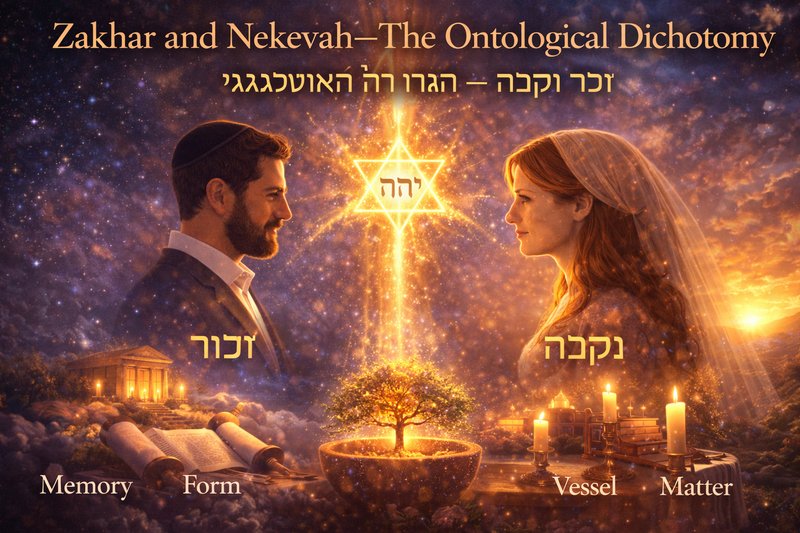
Zakhar and Nekevah — The Ontological Dichotomy
Before the question of what marriage provides, the tradition asks a prior question: what are the two things that marriage joins? The answer is embedded in the Hebrew language itself, and the Maharal develops it across multiple tractates with precision that no translation can fully convey. Zakhar and nekevah — male and female — are not merely biological designations. They name two fundamental orientations in the structure of creation.[8]
The word zakhar comes from zachor — memory, preservation, transmission. Hirsch: the zakhar is the one who bears and transmits the divine and human tradition, who guards the yah above him. The word nekevah comes from a root meaning designated, appointed — or, in another reading, from nikev, meaning vessel, channel. She is the appointed one who receives her purpose through her joining with the one who chooses his purpose. These are not etymological curiosities. They describe the fundamental orientation of each toward the other and toward the world.[9]
The Maharal's analysis goes deeper. He identifies zakhar with tzurah — form — the active principle that lends structure, that imprints and initiates. He identifies nekevah with chomer — matter — the receiving vessel that develops what is placed within it. This is not a social distinction and not a moral one. It is the fundamental ontological polarity that runs through all of creation. Heaven and earth, soul and body, form and matter, right and left — the created world is structured on opposing poles that need each other for completion. Zakhar and nekevah are the human expression of this universal structure.[10]
Every created thing partakes of this polarity. The Zohar states it explicitly: all spirits in the world go out as zakhar and nekevah combined. When they descend into the world they separate — each going its own way. The Holy One alone holds the key to pair them again, to join them as they ought to be — one soul from which they both come, returning to that unity after the separation of descent. The zakhar/nekevah distinction is not imposed on creation from outside; it is the structure within which creation exists.[11]
Because the zakhar is tzurah — the active, form-giving principle — blessing and divine overflow move through him first, and from him to the nekevah. The Zohar on Vayechi: "may the Lord bless him, may Israel bless" — the men first, then from their blessing the women receive. Not because the man is more important, but because this is the structure of how divine overflow moves: from the form-principle into the matter-principle, from the active into the receiving. The man who is form initiates; the woman who is matter develops and builds from what she receives.[12]
Because the nekevah is chomer — the receiving, developing principle — she requires the input of the tzurah to express what she contains. This is why the woman is called golem — the unformed vessel — until her husband makes her a vessel. The Gemara in Sanhedrin:: "a woman makes a covenant only with one who made her a vessel." The golem in Kabbalistic thought is matter awaiting the imprint of form. She is complete in herself as chomer; she becomes the fully realized vessel she is meant to be through the joining. This is not inferiority. It is the structure of how matter relates to form throughout all of creation — the same structure that makes the ground productive when properly seeded, the same structure that makes the world capable of building anything at all.[13]
Zakhar and nekevah — two separate qualities, two distinct orientations — He created them and called their name Adam. — Bereishit 5:2[14]
The implications run in every direction. The Maharal notes: because the man is form and form is singular — a single form is what makes something what it is, and form does not divide — one man may be in a proper relation with multiple women without the structural contradiction arising. But one woman may not be with multiple men simultaneously — because matter cannot receive two forms at once without losing its structural identity. This is not custom or convention. It is the logic of form and matter as the Maharal understands those principles throughout the created world.[15]
The Hebrew name ishshah encodes a further dimension of all of this. Aleph-shin-heh — the letter heh of the divine name, connected to the left side illumination, joined to aleph-shin, fire. She is "the fire of God" — the divine feminine flame, connected to the left side which is the receiving-developing side of the divine structure. When she merits it, she brings that divine fire into the household. When the divine Name is present between the letters of ish and ishah, her fire is the completing fire of the sacred union. When the divine Name is absent — when what remains is esh and esh, fire and fire — the two fires consume each other. The name does not simply describe her. It is a warning and a promise simultaneously.[16]
What It Is to Be a Man
The Torah records the creation of the man and then says: "vayehi ha'adam l'nefesh chayah" — the man became a living soul. The Targum translates this differently than any other place in Bereishit: "l'ruach m'malela" — a speaking spirit. The Maharal draws from this that the defining quality of the man, the thing that the word adam names, is the capacity for speech — not speech in the sense of audible words but speech in the sense of the rational faculty that articulates, transmits, and creates meaning. Dabber: the word, the articulated form. Man is the form-principle in the world. His defining capacity is to impose form.[17]
This is why the Torah values a man at fifty shekels and a woman at thirty. Not because men are more important — the Maharal is careful about this — but because the man's defining quality, the intellectual speech-form, is less embedded in the material. The ratio reflects the proportion of form to matter in each. The man is more form than matter. His soul participates more directly in the abstract, the rational, the detached. And this is precisely why the Torah says that "greater binah was given to the woman than to the man" (Tractate Niddah 45b) — because binah, the intuitive understanding that grasps wholes and builds from what it receives, belongs to the developing-matter side. Her greater binah is not a consolation prize for a lesser sekhel. It is the specific quality that belongs to the one who builds.[18]
The man looks downward. His face is oriented toward the earth, because he was created from adamah and faces toward his source. This is not humility in the ordinary sense; it is ontological direction. The earth is what he came from and to which he tends. His work is the transformation of raw material into meaning — which is why the Torah places on him the obligation of labor, of earning a living, of cultivating the ground. His obligation is to take the raw earth and make something of it. This is tzurah in practice: form imposing itself on matter to produce something new.[19]
The man seeks. The woman does not seek in the same way. This distinction appears throughout the tradition without apology. The Torah writes "a man takes a woman" rather than "a woman is taken by a man" — because it is the way of a man to seek his lost object. She was taken from him. He returns to seek what belongs to him. The Maharal: she does not need to seek what was never taken from her. This is not a statement about agency or dignity. It is a description of orientation. The form-principle seeks its completion in the matter that will develop it. The matter-principle awaits the form that will make it fully what it is.[20]
When the man merits his true zivug, when the proper pairing is achieved, the structural consequences are dramatic. Yirat shamayim rests on him — not as a disposition he cultivates but as a quality that the structure now houses. Anavah (humility) rests on him. Chesed rests on him. The Maharal is precise: these are not character traits he develops as a result of the domesticating influence of partnership. They are structural qualities that belong to the complete form of the thing called Adam. Until the structure is complete, these qualities cannot fully inhabit it. This is why "any man without a wife is not called Adam" — because the category Adam requires the completeness that only the joined form achieves.[21]
The man's obligation to his wife follows from all of this. If he is the form-principle, then his orientation toward her — his honoring her, his rejoicing her, his protecting her from all excess fear — is not charity. It is what form owes to the matter it completes. A form that does not honor the matter it inhabits has misunderstood what it is. The Rambam's ruling: a man is obligated to honor his wife more than his own body and to love her as his own body. These are not aspirational statements. They are descriptions of what the structure requires.[22]
What It Is to Be a Woman
The word binyan — building — is where the tradition locates the woman's defining function. "God built (va'yiven) the rib into a woman" (Bereishit 2:22). The Gemara in Niddah 45b derives from va'yiven that God gave her greater binah than the man — because the building of the household, the raising of children, the transformation of raw domestic life into something capable of housing the divine Presence is her work. Her greater binah is the specific cognitive capacity that the work of building requires: the intuitive grasp of wholes, the sense of what is needed, the ability to build from what is received rather than from abstract principles.[23]
She is the golem made vessel. She is the matter awaiting form. And she is the wall — the chomah — that surrounds and protects what is built within her. The verse in Yirmiyahu: "a woman surrounds a man" (31:22). The Maharal: when a wall is whole, the structure is secure. When the wall has even one stone missing, a chain of collapse begins. The woman's integrity — her wholeness — is the condition under which the man is protected. Without her he stands exposed to everything the world brings against his life. The wall does not receive gratitude or attention from the building it houses. It simply holds.[24]
She looks upward. The man looks toward the earth from which he was created; the woman looks toward the man from whom she was created. Her face is oriented toward him because he is her source in exactly the way the earth is his. This is not dependence. It is the direction of her fundamental orientation — she was built from him, she completes him, she builds what was taken from him back into the world. Her gaze is the gaze of the one who has been given something to build and knows where the foundation lies.[25]
The name ishshah — aleph-shin-heh — encodes the divine fire she carries. The letter heh of the divine Name is present in her name as it is not in the name of most things. She is "the fire of God" — the divine feminine flame connected to the left side of the divine structure. The Zohar: she is called "a'ishah" to praise her — because after the wisdom of her husband has been included in her, the divine illumination shines through her. She is the left side illumination, the side that receives and develops what the right side initiates. When the divine Name is present between the letters of ish and ishah, her fire is the completing half of the sacred. When it is absent, both become only fire — consuming rather than illuminating.[26]
She does not seek the man in the way he seeks her. She is the lost object from his perspective; from her perspective, she is awaiting what belongs within her. This is not passivity. Her chesed is the active orientation of the receiving principle toward what it is designed to receive. Her binah is the active capacity to build from what she receives. Her anavah — when she merits it — is the active cultivation of the interior space where the sacred can reside. And her tzniut is perhaps the most striking expression of all of this: the woman who maintains her interior dimension, who does not exhaust herself in the merely external, who preserves the enclosed space of the house even when the world presses against it — from her come kings and prophets.[27]
The Gemara in Sotah: any bride who is modest (tznu'ah) in her father-in-law's house — kings and prophets come from her. The Maharal explains: because kingship and prophecy require separation from the purely material, and the woman who embodies tzniut has already cultivated that separation in her own person, the children who emerge from her carry the capacity for that elevation. Tzniut is the woman's analog to the man's dabber — the quality that most precisely names what she is when she is most fully herself. As the man's speech-form imprints the world with meaning, the woman's inner silence — her preserved interior space — provides the vessel in which that meaning can develop.[28]
Her soul chambers in the world to come are reserved for women alone. The Zohar in Parashat Shelach describes six chambers in the Garden of Eden in which righteous women gather — no males enter. In each chamber are thousands upon thousands of women, each with her own place of light and delight. Three times each day a herald announces the approach of Moshe Rabbeinu's image; the women go to their section, bow, and say: "blessed is my portion that I raised this light." This is her unique delight above all others — the delight of the one who enabled the light.[29]
In the world to come, the Zohar says, the union of husband and wife is the cleaving of soul to soul, light to light — a pairing far more complete than the pairing of this world which is body in body. The children produced from that union are souls who enter the world as geirim — converts to holiness — drawn from the light generated by the spiritual union of two elevated souls. The woman who in this world inhabited her chomer dimension with kedushah generates in the next world a union so complete that its children are lights who join the world already turned toward their source.[30]
A Helper Against Him
R' Yosi met Eliyahu HaNavi and asked him: in what way is a woman a help to a man? Eliyahu answered with something simple: a man brings wheat — does he chew raw wheat? He brings flax — does he wear raw flax? She illuminates his eyes and sets him on his feet. The practical meaning is unmistakable. She takes the raw material of his life and makes it into something he can inhabit and use. Without her the raw material remains unprocessed. He has it. He brought it. But it sits there in the form he brought it in — unground, unwoven, unavailable.[31]
The Maharal refuses to leave the analysis at this practical level. The word ezer names what she is functionally; the word kenegdo names what makes the ezer genuine. A father's help to a son has a built-in directional asymmetry — the son is always below the father, the help flows downward. But the wife stands kenegdo: his precise counterpart, equal in spiritual weight, standing directly opposite. What makes something a genuine counterweight is its capacity to push back. Something that can only support and never oppose is not a counterweight; it is furniture. The wife is called kenegdo precisely because she can do both — support when he merits, and genuinely oppose when he does not.[32]
The Maharal's further point — and it is the most important point in the entire analysis — is that the "against" and the "help" are the same quality expressed in two directions. The capacity to oppose and the capacity to support come from the same source: sufficient spiritual weight to be a genuine counterpart. A man who has arranged his household so that nothing ever pushes back has dismantled the structure the Torah built when it said "it is not good for man to be alone." The loneliness of singlehood and the isolation of a marriage organized around one person's unchallenged authority are the same structural problem expressed at different stages of the arc.
R' Yehoshua ben Nechemia: if he merits, she will be like the wife of R' Chanina ben Chakhinai — the woman who enabled decades of Torah study, who ran the household so that Torah could happen. If not, like the wife of R' Yosi HaGalili — the woman who humiliated him publicly, whose behavior was a precise reflection of the level he had brought into the marriage. Both outcomes are structural, not accidental. The counterweight works in both directions with the same force.[33]
The Midrash in Bereishit Rabbah draws the widest conclusion. A chasid was married to a pious woman and they divorced. He married a wicked woman and she made him wicked. She married a wicked man and she made him righteous. Everything is from the woman — ha'kol min ha'ishah. The direction of the unit is set by her pull. Because she is genuinely kenegdo — his precise counterweight with sufficient weight to determine direction — the way she pulls is the way the unit goes. The Maharal's analysis of ezer kenegdo and the Midrash's conclusion about the wife's influence are not two different teachings. They are the same structural reality described from two angles.[34]
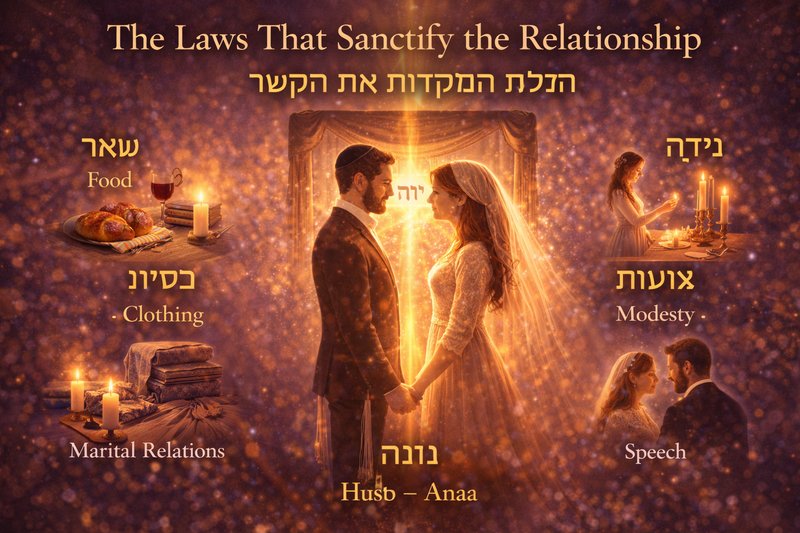
The Laws That Sanctify the Relationship
The Torah in Shemot 21:10 defines three obligations: she'ar, kesut, onah — food, clothing, and marital relations. Each has defined standards and each is actionable in beit din. The Mechilta defines each with precision. She'ar means food of quality appropriate to her needs — not what is minimally sufficient, but what her body requires. Kesut means clothing suited to the season and to her station. Onah is frequency defined by occupation: a man of leisure owes her daily; a laborer, twice per week; a donkey driver, weekly; a camel driver, monthly; a sailor, every six months. These are Torah law.[35]
The niddah laws carry a dimension the Gemara states with striking directness. The Maharal, drawing on the teaching in Tractate Niddah, explains why the Torah imposed seven days of separation: not as restriction, but as renewal. During all the days she was permitted to her husband, she became familiar — the desire dulled, the freshness faded. The Torah imposed the separation precisely so that when she returns, she would be as desirable to him as on the day of the chuppah. This is the Torah's mechanism for the ongoing renewal of marital desire — not as a restriction on intimacy but as the structural condition that keeps intimacy from becoming mere habit.[36]
The laws of tzniut operate on a different level but toward the same end. The Maharal, drawing on the Gemara in Sotah: any bride who is tznu'ah in her father-in-law's house merits that kings and prophets emerge from her. Modesty is not primarily a set of clothing standards. It is the woman's cultivation of her interior dimension — the preservation of the enclosed space within her that the external world cannot exhaust. When she protects that space, she enables what can emerge from her to be elevated. When she exhausts herself in the merely external, she depletes the source from which elevated souls could have come.[37]
The laws governing speech between husband and wife are subtler but equally precise. The Mishnah in Avot: do not multiply conversation with a woman — said about one's own wife. The Gemara clarifies: this refers to idle conversation that is not toward the purpose of the home and the union. The Maharal explains why: because the man is form and the woman is matter, and matter by its nature pulls toward the immediate, the practical, the earthly. Excessive conversation in certain directions can pull the form-principle toward what dissipates rather than focuses it. This is not a condemnation of conversation with one's wife. It is a recognition that the quality of the speech matters — that conversation directed toward Torah, toward the household's purpose, toward genuine connection is not the conversation being warned against.[38]
The Rambam in Hilchot Ishut articulates the relational law at its full dimension: a man is obligated to honor his wife more than his own body and to love her as his own body. He should speak gently, never imposing excessive fear. She is obligated to regard her husband as a king and to act in accordance with his wishes. These obligations are not symmetrical in their form, but they are symmetrical in their weight. Each addresses the specific vulnerability of the other. He is liable to the exercise of authority; she is liable to submission. The Torah addresses each where they can go wrong.[39]
A man should always be careful about his wife's pain — the Gemara in Bava Metzia states this as a governing principle. Her tears come quickly and her pain is near. The Maharal explains the mechanism: she is under his authority and therefore more exposed to his treatment than any other person. What would merely irritate her from a peer can devastate her from him, because she was created to be under his authority, and when that authority is wielded cruelly, it strikes at the root of the structure she was created to inhabit. The asymmetry of power creates an asymmetry of vulnerability. This is why the warning about her pain is issued with special force.[40]
One who imposes excessive fear on his wife ultimately brings upon himself transgression of immorality, bloodshed, and desecration of the Shabbat — the Gemara in Gittin, as analyzed by the Maharal. Fear without proportion disrupts the divine order that the home is meant to embody. The three transgressions represent body (immorality), soul (bloodshed), and intellect (Shabbat — which represents the completeness of creation). Excessive fear disrupts all three dimensions of what the home is meant to be. This is the Maharal's analysis: not a list of separate warnings but a single diagnosis of what excessive domestic fear does to the spiritual structure of the household.[41]
The Sanctity of the Union Itself
The Zohar in Parashat Mishpatim describes the union of husband and wife at the lips — the kiss — as the most complete form of the human unification. The Maharal elsewhere calls it the full expression of dachidut gemura — complete unity. The Zohar's analogy is precise: it is like the border between two adjacent fields, a line that belongs to neither and yet belongs to both, where both fields touch without either encroaching. The divine Name yah is present in this border because it belongs to the divine dimension — the dimension that is neither purely one nor purely the other but the meeting point between form and matter, between zakhar and nekevah, between what was separated before birth and what is being reunited now.[42]
The Maharal draws from Tractate Sotah and from the Zohar simultaneously: because zivug is an act of divine unity — the reunification of two halves of an originally undivided soul — and because Hashem alone is One and unification is His exclusive attribute, when husband and wife are properly joined the Shechinah enters the union. What they are doing in their union is participating structurally in the act that belongs to the divine. This is why the divine Name is spelled between the letters of ish and ishah. This is why the Gemara says that "husband and wife who merit it, the Shechinah rests between them." It is not metaphor. It is a precise description of what happens at the spiritual level of a properly consecrated marriage.[43]
The Ramban in Iggeret HaKodesh is the definitive text on what the union itself is and what it produces. He writes: the act has the capacity to bring the most elevated spiritual influence into the world, or to seal it off entirely — depending on the orientation of the couple at the moment of the union. When the man's thought is fixed only on the physical form of the woman, the children born from that union are banim zarim — spiritually foreign children, those in whom the divine Name does not rest. He cites Hoshea 5:7. This is not a moral judgment about desire. It is a description of spiritual mechanics. The union is a conduit; what flows through it depends on where the conduit is pointed.[44]
The Ramban demonstrates this from the chain of generations in Megillat Rut: Peretz, Chetzron, Ram — all the way to David HaMelech. Each generation produced by a father whose intention at the moment of union was directed toward the sacred purpose of what the union is for. The Ramban's specific claim about Avraham Avinu: before Yitzchak was conceived, "Avraham directed his mind toward the supernal." Yitzchak was the product of that orientation. The Ramban: "I guarantee that a son born from such intention is a tzaddik." He states this not as an aspiration but as a law of spiritual mechanics with the force of a guarantee.[45]
Three partners create a person — his father, his mother, and the Holy One. This is not a pious formula. The Gemara in Niddah 31b: the father provides the white (bone, sinew, brain, white of the eye); the mother provides the red (skin, flesh, hair, pupil); the Holy One provides soul, breath, features, sight, hearing, speech, movement. When the drop is from a male, the Holy One sends a male soul; from a female, a female soul. The Holy One's participation in the creation of each child is actual and specific — He determines the soul-type, He provides what neither parent can provide. The orientation of the parents at the moment of the union is the orientation that either opens or closes the conduit through which the Holy One sends what He intends to send.[46]
The golem/seal analogy from Tractate Niddah illuminates the mechanics. The woman is the golem — the vessel awaiting form. The man is the form that imprints itself in her. The child who emerges is not simply the biological product of two bodies; it is the result of chomer receiving and developing tzurah. When the form that imprints is elevated — when the man's intention at the moment of union is directed toward the sacred — the child that develops from that imprinting carries the elevation. When the form that imprints is purely material, what develops from it is the purely material. The Ramban's guarantee is the Maharal's ontology made explicit: the quality of the form determines the quality of what the matter produces from it.[47]
The Divine Name Between Them
The Maharal's fullest statement about the Shechinah in the household synthesizes everything the tradition has been building toward. Because zivug is an act of divine unity — the bringing of separated things into oneness — and because Hashem alone is One and unification is His exclusive attribute, every proper marriage participates structurally in what belongs to the divine act of creation. When two soul-halves are properly joined, the Shechinah enters the union because the union is an instance of the thing that is uniquely divine: the transformation of two into one.[48]
R' Akiva's exposition in Tractate Sotah made the structure visible through the letters themselves. Husband and wife who merit it, the Shechinah rests between them; those who do not merit it, fire consumes them. The divine Name is either present in the letters of ish and ishah, or it is not. When it is present, the two fires — the fire of the man's name and the fire of the woman's name — are oriented toward each other through the divine Name and the result is warmth and illumination. When the divine Name is absent, the two fires simply meet and consume. There is no neutral state. The household is either inhabited by the Presence or it is not.[49]
The Zohar in Parashat Vayikra (Acharei Mot) gives the most concrete picture of what this looks like in lived life. When a man enters his home with joy, the table is set, the candle burns, and both he and his wife are in a state of joy, the Shechinah arrives with the angels. It declares: "this one is mine — Israel, in whom I take pride." When that joy is absent — when he enters in distress or when the home is in disorder or when husband and wife face each other with coldness — the Shechinah departs. The evil inclination arrives in its place. Declares the same words: "this one is mine." The household has a resident. The question is which one.[50]
The wife is the foundation of the household — "ותשא אוה תיבה רקיע" — the wife is the essence of the house. The Shechinah does not depart from the house because of the wife's merit; it does not arrive because of the husband's merit alone. Yitzchak brought Rivka into his mother Sara's tent and the candle was relit and the Shechinah returned — because it had been present for Sara's sake and when Rivka arrived it returned for her sake. The Shechinah in the household is linked to the woman's presence and merit in a way that reflects the structural role of the nekevah as the receiving vessel: she is the one who can hold the Presence, who can maintain the conditions under which it stays.[51]
The Decree Before Birth
Forty days before the formation of a child, a Heavenly Voice goes out and announces: the daughter of so-and-so for so-and-so. The match is decreed before either person exists in any form that can act on it. The Gemara in Yevamot states this without qualification. The search that follows is not the making of something new. It is the arrival at something always written.[52]
Rav Chaim Kanievsky distinguishes two layers in the decree: who a person will marry is fixed before birth and is not altered by prayer or effort; when that person arrives is not fixed, and here prayer helps. It can bring the moment sooner. The Chazon Ish: one who prays and multiplies supplications accomplishes more than one who merely exerts effort. The H'ALSHA — the Shelah HaKadosh — provides two points of focus for prayer in this domain: first, that the right match should arrive at the proper time; second, that malicious people with bad intentions should not obstruct or destroy the match that heaven has designated.[53]
The Maharal explains why pairing is compared to the splitting of the Sea of Reeds. The sea was one unified thing that God split into two halves. Husband and wife are one split thing that must be reunified. The original unity of the two souls — present above before descent, separated at birth — must be reversed. The reunification runs in the opposite direction from the original separation and requires the same divine force that the splitting required. The first pairing is ordained from above and therefore, while difficult for humans to achieve, is not as difficult as the second — because the second requires the displacement of what was first designated, which involves a divine adjustment more complex than a simple pairing.[54]
The Torah writes "a man takes a woman" rather than "a woman is taken" — because it is the way of a man to seek his lost object. She was taken from him. He returns to seek what belongs to him. The Maharal: she does not need to seek what was never taken from her. The man's seeking is not merely social initiative. It is the structural expression of the form-principle returning to the matter that was designated as its completion before either existed in the world. He seeks because the loss was his. The decree names them together; the search is his side of the arrival.[55]
The shadchan, in this framework, is an instrument — not an author. The suggestion is not a creation of the match; it is the clearing of a path. The reference call does not determine whether two souls are designated for each other; it checks for obstructions. The process of shidduchim — the meetings, the investigating, the deliberating — is the human side of cooperating with a divine act that was set in motion forty days before either person was formed. When a suggestion fails it is not a failure of the process. When it succeeds, no one in the process created it. The decree is merely expressing itself through the instruments that were made available.
Marriage Across Lifetimes
The Arizal's Sha'ar HaGilgulim, Introduction 8, contains a passage unlike anything else in the literature of zivug. He writes to his student Shmuel: "In the matter of my wife, I tell you — there is not among all the sparks of the root of my soul any that is as close to me as R' Akiva's spark, which is closer to me than all the others. And what happened to him happened to me. My wife Chana is a gilgul of the wife of Kalba Savua — R' Akiva's wife." He is speaking of the daughter of Kalba Savua — Rachel — who enabled R' Akiva to learn Torah for twenty-four years, who sent him away for decades so that he could become who he was meant to be.[56]
The Arizal continues: because his wife Chana is a gilgul of a woman who was connected to a male gilgul (she was previously a man in a prior incarnation, one of the Arizal's teachers), it is impossible for him to have male children from her — only female children, unless a second female soul joins her at the moment of conception. He predicts specific events in her subsequent gilgulim, describes the souls that will be born from her and how they will continue the chain of tikkun. The precision is extraordinary. A man's marriage in this life is not a meeting of two isolated souls making choices in the present; it is the convergence of spiritual lineages that may span generations and lifetimes, each with its own history of obligation, capacity, and still-unfinished work.[57]
The Arizal further states: his true zivug — the one he will merit after his soul's tikkun is complete — is identified as R' Akiva's wife's soul. "My wife, who is truly my zivug, is called by my teacher: the mother of the Rashb'am." The true zivug is not necessarily the wife of this life. It is the soul-partner designated before descent, the one that completes his soul-root, the one whose soul history runs parallel to his own across the generations. Marriage in this life is a way-station toward the full union that awaits after the tikkun is achieved.[58]
The Zohar is explicit about the structure of this. All spirits in the world go out as zakhar and nekevah combined. When they are born into the world they separate. The Holy One alone holds the key to pair them again — to join them as they ought to be, as one soul from which they both come. The pairing is always divine; the timing is the result of the human spiritual state. If the person has not yet achieved the level at which the true zivug can be received, the pairing will come imperfectly — through the zivug of this life which may not be the final, complete zivug — and the tikkun of this life brings him closer to the pairing that awaits.[59]
This is why the second pairing is compared to the splitting of the sea in all its difficulty. Not because second marriages are spiritually lesser — the Gemara explicitly says that the second zivug is also "from the Lord" — but because achieving it requires that the first designated pairing be displaced, which is a divine intervention more complex than a simple announcement. When the Zohar says that a woman's first husband was displaced from heaven to give way to the true zivug, it is not describing a mistake in the original decree. It is describing a divine correction, carried out across lifetimes, through the actual circumstances of actual lives. The displacement itself was divine. The correction was divine. The second husband is the true zivug. The first was displaced so that the second could arrive.[60]
The Arizal states the operative Kabbalistic principle most clearly: a man finds his true zivug when he rectifies his deeds and becomes worthy. "L'tzaddek nafsho." This is the principle behind the difficulty of the pairing — it requires not just the meeting of souls but the spiritual readiness of the vessel to receive what heaven has designated. A man who has not achieved his tikkun is not yet the man his true zivug was designated to join. He may marry in the meantime. He may build something genuine in the meantime. But the full arrival of the designated partner awaits the completion of the work that makes him ready to receive it.[61]
The Zohar's teaching about the chambers of women in the Garden of Eden adds a further dimension: in the world to come, the union of husband and wife is the cleaving of soul to soul, light to light. The children produced from such unions are souls who enter the world already turned toward their source. They are called geirim — converts — because they come into the world already oriented toward the divine, the way a ger comes to Judaism already committed rather than merely born into it. The spiritual lineage established by a marriage aligned with its divine purpose is not merely genealogical. It is a chain of souls, each one prepared by the one before it, moving across generations toward the completion that was always written in the decree.
What Motive Produces
The Gemara in Kiddushin does not merely discourage marrying for money. It describes what that motive structurally produces. Anyone who marries for money will have children who are not fitting — "they bore foreign children" (Hoshea 5:7). The money itself flees: a new month enters, a new month exits, and the money is gone. A union built on the wrong motive produces what that motive produces. Something transactional lasts as long as the transaction and no longer.[62]
The Ramban addresses what the orientation at the moment of the union itself produces in the world. Not beauty as a criterion — the Pele Yoetz is explicit that if one finds beauty, yirat shamayim, and proper lineage together in the same person, one should certainly pursue the beautiful one. R' Yochanan sat at the gates of the mikveh so that daughters of Israel would see him, that their children would be beautiful and learned in Torah like him. Beauty is real and the tradition takes it seriously. What the Ramban prevents is stopping at beauty — making the window into a wall, treating the surface as the destination rather than the gateway.[63]
The Ramban's concern is the orientation of consciousness at the moment of the union. When thought is fixed only on the physical form, the children born are banim zarim — because the divine Name does not rest on that union, because the conduit was not pointed toward what was meant to flow through it. When thought is oriented toward the sacred purpose — toward bringing into the world a soul worthy of the chain of generations that produced both parents — the child born carries that orientation. "I guarantee that a son born from such intention is a tzaddik." The Ramban states this as law, not aspiration.
When the First Wife Dies
The Gemara in Yevamot makes a statement about the death of a first wife that the subsequent tradition has not softened. R' Yochanan: anyone whose first wife dies in his days — it is as if the Temple was destroyed in his days. The verse cited is from Yechezkel: God tells the prophet his wife will be taken from him and immediately the Beit HaMikdash falls. First wife, Temple. Both are the central dwelling of the divine Presence in the world. Both, when gone, leave behind a darkness that reshapes everything.[64]
R' Alexandri: the world goes dark for the man whose wife dies. R' Yosei bar Chanina: his steps shorten. Abba bar Yudan: his counsel falls. These are structural consequences, not general grief. Steps shorten because she is no longer setting him on his feet — R' Yosi had already said that she illuminates his eyes and sets him on his feet. Counsel falls because the one who illuminated his eyes is gone. The world goes dark because the lamp lit from his flame has been extinguished — and it was his light that lit her, so when she is gone that light disappears from the world.[65]
The Maharal's analysis of the lamp metaphor: his wife is the lamp lit from his flame. They were one light together. When she dies, the lamp goes dark — but it was his light that lit her. The world does not merely feel darker for him; something objectively illuminating has been removed from it. This is what the Gemara means when it says the world goes dark: not that he feels dark but that a source of light in the world has been extinguished.[66]
There is a replacement for everything except the wife of one's youth — Mishlei 5:18. R' Yehuda bar Yitzchak: a man finds nachat ruach only from his first wife. The Maharal: because their pairing was decreed forty days before either was formed, and because they have been building the specific form of their completion across years of shared life, the form of that completion cannot be replicated. The second marriage may be valid, joyful, and obligatory. It is structurally something different from what is gone.[67]
What the Altar Knows About First Marriages
The Gemara in Gittin 90b makes a statement about divorce that operates on a completely different register from the halachic discussion surrounding it. Anyone who divorces his first wife — even the altar weeps for him. The verse from Malachi: "You cover the altar of the Lord with tears, with weeping and sighing... because the Lord has been witness between you and the wife of your youth, against whom you have dealt treacherously — she is your companion and the wife of your covenant." The altar's tears and the betrayal of the first wife are the same verse.[68]
The Maharal: a first wife is the original pairing. The union built with her is the union in which the divine Name was engraved between the letters of ish and ishah. When that union is dissolved — even for legally permitted reasons — something of the original order passes out of the world. The altar registers it. Not because the divorce is prohibited in this case. But because the original form of the thing — the form the decree designated before either person was born — has been undone. The halachic permission and the spiritual weight are separate categories. The tradition holds both simultaneously without requiring them to be harmonized.[69]
The Zohar in Parashat Mishpatim gives the spiritual mechanics of what happens when a widow remarries. A woman does not settle properly with a second husband because the spirit of the first beats within her like a serpent, contending with the spirit of the second. Two soul-presences in the same interior space. Neither fully settled. In some cases — and this is the most striking statement in the passage — the second husband is the true zivug, and the first was displaced from heaven to give way to the real match. The displacement was divine. The correction was divine. What looks from the outside like ordinary remarriage is a divine adjustment still working itself out.[70]
Good Wife, Bad Wife
The Gemara in Yevamot 63b addresses both ends of the spectrum with full evenhandedness. Rava: a good wife — how good is she! The verse from Mishlei 18:22 celebrates her in Agadah; in Torah, Torah itself is compared to her. Then without transition: a bad wife is like a dripping on a rainy day, from Mishlei 27:15. Constant, unceasing, without pause or resolution. Her ketubbah is large, making divorce expensive and her a permanent fixture. The Gemara adds: it is a mitzvah to divorce a bad wife. The same tradition that says the altar weeps for divorce also says divorce is a mitzvah when she is genuinely destructive.[71][72]
One who follows his wife's counsel in spiritual matters falls into Gehinnom — the Gemara in Bava Metzia, citing the case of Achav who followed Izevel. Rav Pappa resolves: in household matters, following her lead is proper; in matters of Torah and divine service, a man who subordinates his judgment entirely to hers has surrendered the vertical dimension of the marriage. The man is the form-principle in the union; when he allows that function to be absorbed entirely into the woman's orientation, the structural axis of the marriage has been inverted.[73]
The Midrash in Bereishit Rabbah is the sharpest statement in the entire tradition. A chasid married to a pious woman and a rasha married to a wicked woman — each ordinary in isolation. They divorced. The chasid married a wicked woman and became wicked. The rasha married a righteous woman and became righteous. Everything is from the woman — ha'kol min ha'ishah. The chasid did not become slightly less pious. He became a rasha. The rasha did not improve marginally. He became righteous. The counterweight works in both directions with full force.[74]
A New Category of Being
R' Chisda: one who marries a woman, his sins become scattered, as it says "he who finds a wife finds goodness and draws forth favor from the Lord." The Maharal's explanation of why this is true is among the most structurally significant teachings about marriage in the entire tradition. Before marriage a man was not yet a complete Adam. When he marries and enters the full category of Adam, he is — in the category of being — a different entity from the one who accumulated those sins. The sins are forgiven not in the way a judge grants amnesty to the same person who committed the crimes. They are forgiven because the person carrying them no longer fully exists in the same structural sense.[75]
The debts of the incomplete entity are released when the complete entity comes into existence. The man who was not Adam — who lacked yirat shamayim, anavah, and chesed in their structural form — becomes one who is so called. The person who incurred those debts no longer fully exists in the same sense. This is not a legal fiction. It is the Maharal's ontology: entering a new category of being is being a new kind of being. The slate is not wiped clean; the entity who carried those debts no longer exists in its prior form.
R’ Yochanan: anyone who marries a woman for the sake of Heaven, Scripture considers it as if he fathered her — כאילו ילדה. The Gemara in Sotah discusses this through Kalev, who married Miriam l’shem shamayim and transformed her through his merit. The Maharal explains why: before marriage a man was not yet a complete Adam. When he marries and enters the full category of Adam, the prior incomplete entity has been replaced. The man who walks out of the chuppah is not the man who walked in — not because the ceremony changed his feelings but because the category of being he occupies has been structurally transformed.[76]

The World Cannot Be Built Without It
The Maharal's final synthesis draws on the root that appears in the creation narrative itself: "Olam chesed yibaneh" — the world shall be built through chesed (Tehillim 89:3). Binyan — the building — is the root of va'yiven, what God did when He built the rib into a woman. The same act that created the woman is the act the world requires for its ongoing existence. The world is built through the structure of the properly established household. Male and female together, form and matter properly joined, the divine Name present between the letters — this is what the world's building requires.[77]
The Midrash Rabbah in Bereishit 17 assembles the full list one final time: R' Yaakov — anyone without a wife lives without goodness, without helper, without joy, without blessing, without atonement, without peace. R' Shimon ben Nechemia adds: without life. R' Chiya bar Gamda: not even a complete man. Not seven unfortunate tendencies. Seven names for the same underlying condition: the half-form that has not yet been completed. The joy is absent because the wholeness that makes joy possible is absent. The blessing is absent because the vessel that holds it is absent. The Torah is absent because the structural completion that enables the pull toward Torah is absent. The wall, the peace, the life — all absent for the same reason: the form has not yet found its matter, the matter has not yet received its form, the divine Name has not yet settled between the letters.[78]
It is forbidden for a man to remain without a wife even when he already has children — because "it is not good for man to be alone" applies at every stage of a man's life, not only to the young man before he has built a family. Rav Yehoshua: a man should take a wife in his youth and also take a wife in his old age. The completion she provides is not a one-time acquisition. It is the structure within which the entirety of a man's adult life is meant to be lived. When she is gone, the structure is no longer whole — and the tradition requires that the man rebuild it.[79]
The Zohar in Parashat Vayechi: blessed is He who provides, from His treasure, for each person — blessing for himself and blessing for his wife. The divine overflow flows from the supernal source through the properly established household and into the world. It requires the properly established household: the matched pair, the union made for the sake of Heaven, with proper intention, honoring the obligations the Torah defines, maintaining the joy the Zohar says draws the Shechinah through the door. The household is not merely where Jewish life happens to occur. It is the primary vessel through which the divine Presence inhabits the world.[80]
Any man without a wife is not called Adam. — Tractate Yevamot 63a[81]
The Arizal teaches that a man finds his true zivug when he rectifies his deeds and becomes worthy. The decree is written forty days before formation. The match is designated before either soul arrives in the world. The search is not the making of something new; it is the clearing of the path so that what was always written can express itself in real life. Seven names for what is missing when the path has not yet been cleared. Seven names for what is present when it has. The altar knows when the original union is dissolved. The Shechinah enters the home where the union has been made holy. The world is built from this — from nothing else and from no substitute for it.[82]
The Shadchan and the Decree
If the analysis above is correct — that a zivug is not an arrangement but a restoration, that the soul-pair was designated before birth and the separation is the condition of the search — then the shadchan is not doing what most people think she is doing. She is not solving a social problem. She is not sorting through profiles with an eye for compatibility. She is working inside a decree that was already issued, trying to bring two halves of something back together.
The Gemara in Yevamot states this with the kind of precision that stops you cold: forty days before the formation of the fetus, a heavenly voice goes out — the daughter of so-and-so for so-and-so. The match exists before the people do. Before the name is chosen, before the family knows what they have, before a single year of school or a single choice of community, the pairing has been called. The shadchan enters a world where the answer already exists. Her work is not to create the match. It is to find it.
The pairing was called before the people existed. The shadchan enters a world where the answer is already there.
This is why the Talmud compares arranging marriages to splitting the sea. The comparison is not flattery. Splitting the sea was not a creative act — it was a revelatory one. The waters did not become something new; they parted to reveal the dry land that was always beneath them. A shidduch works the same way. Something hidden becomes visible. The shadchan who brings two people together has not manufactured a connection. She has surfaced one.
The Zohar goes further. Souls leave the divine treasury going forth as pairs — male and female together — and only separate as they descend into the world. The search for one's zivug is, in the Zohar's framing, the soul's effort to recover what it lost at the moment it arrived. This is not a metaphor for romantic longing. It is a description of what the soul is actually oriented toward, below the level of conscious decision-making, beneath the checklist and the photograph and the reference call. The pull is older than any of that. It precedes the person.
The Ari, as recorded in Sha'ar HaGilgulim, understood this to apply across lifetimes. A soul that did not complete its zivug in one life returns to find it. The work of the shadchan is thus not confined to a single generation — she is participating in a process that may have been set in motion long before the two families she is calling ever came to America, or to Israel, or to wherever the next meeting will take place. She does not need to know any of this to do her work well. But the ones who do this work with genuine seriousness — who feel the weight of it, who lose sleep over a suggestion and pray before they make a call — they know something about the stakes that cannot be taught from a training manual.
The pull is older than the checklist. It precedes the person.
None of this makes the work easier. It makes it harder, in the right way. If the match already exists — if the decree was issued and the soul-pair is somewhere in the world — then failing to bring them together is not a neutral outcome. The Talmud is unsparing on this point: it is the shadchan who produces zivugim that is described as doing the work Hashem occupies Himself with since creation. That is not a compliment bestowed on someone filling out a spreadsheet. It is a statement about what the work actually is when it is done with full awareness of what is at stake.
The shidduch system, when it functions as it should, is the community's infrastructure for this work. It is the set of relationships, norms, and practices that make it possible for the shadchan to do what she does at scale — to hold many names in mind, to think across families, to remember a young man she met three years ago when a young woman walks through the door today. When the infrastructure fails, the consequences are not merely social inconvenience. They are measured in the people who did not find each other, in the worlds that were not built, in the generations that were not called into being.
This is what the crisis is. Not a marketing problem. Not a technology gap, though technology can help. A failure of infrastructure around work that is, at its root, sacred — and that the community has not yet equipped itself to do at the scale the moment requires.
The decree was issued. The dry land is beneath the water. Someone has to initiate parting the sea.
Primary Sources
All material drawn from Sefer Derech Eretz by Rafi Newman (Passaic, NJ), Chapter 8 (Ish v'Ishah) and related chapters, pages 98–371. Primary sources cited therein: Tractate Yevamot, Tractate Bava Metzia, Tractate Gittin, Tractate Kiddushin, Tractate Sotah, Tractate Niddah, Tractate Sanhedrin, Tractate Ketubot, Bereshit Rabbah, Midrash Tanchuma, Zohar (Vayetze, Mishpatim, Vayikra, Vayechi, Lech Lecha, Bereishit, Shelach), Maharal Chidushei Aggadot, Ramban Iggeret HaKodesh, Rambam Hilchot Ishut, Mechilta, Pirkei d'Rabbi Eliezer, Sha'ar HaGilgulim (Arizal, Introduction 8), Shevet Mussar, Pele Yoetz, R' Samson Raphael Hirsch on Bereishit.

Buy the E-Book
Footnotes
Seven Deprivations
1 Tractate Yevamot 62b: R' Tanchum said in the name of R' Chanilai — any man without a wife lives without joy, without blessing, without goodness. The Western Sages add: without Torah, without wall, without peace. R' Ulla bar Ravin adds: without life. Sefer Derech Eretz, p. 105, Chapter 8 (Ish v'Ishah).
2 Maharal, Chidushei Aggadot on Yevamot 62b: simcha arises from shleimut. A man without a wife is not unhappy; he is structurally incomplete — half a form. The half-form cannot generate what belongs only to the whole. Sefer Derech Eretz, p. 105, Chapter 8.
3 Tractate Bava Metzia 59a: "There is no blessing found in a man's home except for the sake of his wife." Rava to the people of Machoza: honor your wives so that you become wealthy. Sefer Derech Eretz, p. 109, Chapter 8.
4 Maharal: goodness belongs to unity; division is its structural opposite. The second day of creation introduced separation into the world and is the only day the Torah does not say "it was good." The word tov in "it is not good for man to be alone" carries full weight: the divided state is the categorical absence of tov. Sefer Derech Eretz, p. 105, Chapter 8.
5 Maharal: Torah is called "a woman" from Kohelet 9:9 — "see life with the woman you love." Marriage creates the structural conditions for the gravitational pull toward Torah to operate. Sefer Derech Eretz, p. 105, Chapter 8.
6 Maharal on wall: the word binyan in "God built the rib into a woman" (Bereishit 2:22) means she is the fortification and protection within which a man's life is held. "A woman surrounds a man" (Yirmiyahu 31:22). Sefer Derech Eretz, pp. 141–142, Chapter 8.
7 Midrash Rabbah Bereishit 17; R' Chiya bar Gamda: not even a complete man, citing "He blessed them and called their name Adam" (Bereishit 5:2) — the name was given to both together. Sefer Derech Eretz, p. 112, Chapter 8.
Not Called Adam
8 Tractate Yevamot 63a: "Any man without a wife is not called Adam, as it says: male and female He created them and called their name Adam" (Bereishit 5:2). R' Elazar: one who marries a woman — it is as if he were born anew. Sefer Derech Eretz, p. 106, Chapter 8.
9 R' Yehuda: when male and female are joined together in marriage and they merit it, yirat shamayim rests in him, anavah rests in him, chesed rests in him. These are not character traits he develops; they are structural qualities that belong to the complete form. Tractate Yevamot 63a. Sefer Derech Eretz, p. 103, Chapter 8.
10 Maharal, Chidushei Aggadot on Sotah 17a: the yud of ish and the heh of ishah spell yah — one of the divine names — because zivug is an act of divine unity, and unity is the exclusive attribute of the Blessed One. When they do not merit it, aleph-shin and aleph-shin remain — esh and esh, two fires that consume each other. Sefer Derech Eretz, pp. 102, 108, 144, Chapter 8.
11 Zohar, Parashat Vayetze: until Yaakov married and had children, the divine name "Elokei Yaakov" was not said openly about him. Before marriage he could be a vehicle for Chesed or Gevurah but not both simultaneously; after marriage he became a complete spiritual vessel. The Zohar generalizes this to all men. Sefer Derech Eretz, p. 98, Chapter 8.
12 Tractate Sotah 17a: R' Akiva — husband and wife who merit it, the Shechinah rests between them; those who do not merit it, fire consumes them. Sefer Derech Eretz, p. 108, Chapter 8.
13 Zohar, Chapter Vayikra (Arachei Mot), Chadash: when a man enters his home with joy, the table is set, the candle is lit — the Shechinah arrives with the angels: "this is mine — Israel, in whom I take pride." When joy is absent, the Shechinah departs and the evil inclination arrives. Sefer Derech Eretz, p. 104, Chapter 8.
Zakhar / Nekevah
14 R' Samson Raphael Hirsch on Bereishit 1:27 and 5:2: zakhar — the one who bears and transmits the divine and human tradition, from zachor (memory, preservation); nekevah — the designated one, who receives her purpose through her joining with the zakhar. The Zohar: all souls go out as zakhar and nekevah combined, and when they descend into the world they go out separately; each is paired with its counterpart by the Holy One. Sefer Derech Eretz, pp. 150, 350, Chapter 8.
15 Maharal, Chidushei Aggadot on Yevamot 63a (Sefer Derech Eretz pp. 228–229): zakhar corresponds to tzurah (form, the active principle); nekevah corresponds to chomer (matter, the receiving vessel). This is not a social distinction or a moral one. It is the fundamental ontological polarity built into the structure of creation itself.
16 Maharal, Chidushei Aggadot (Sefer Derech Eretz pp. 228–229): the receiving principle (chomer) cannot generate blessing on its own — it requires the active principle (tzurah) to initiate. The Zohar on Vayechi: the men receive first, then from their blessing the women receive. Not because the man is more important, but because this is the structure of how divine overflow moves: from form into matter.
17 Maharal on Bereishit 2:18 (Sefer Derech Eretz pp. 148–149): "It is not good for man to be alone" — not because he is lonely but because he alone cannot fulfill the divine purpose. For animals, pairing serves procreation only. For human beings, the woman is needed for building the household, raising children, and the companionship that makes a man capable of his full function. The union serves purposes that last a lifetime.
18Maharal, Chidushei Aggadot (Sefer Derech Eretz pp. 228–232): the woman is called golem until her husband makes her a vessel — from Tractate from Tractate Sanhedrin 22b: ‘A woman makes a covenant only with one who made her a vessel.’ (אשה גולם היא ואינה כורתת ברית אלא למי שעשאה כלי). She is complete in herself as chomer; she becomes the fully realized vessel she is meant to be through the joining. This is not inferiority — it is the structure of how matter relates to form throughout all of creation.
19Tractate Niddah 31b: three partners create a person — his father, his mother, and the Holy One. His father provides the white (bone, sinew, nails, brain, white of the eye); his mother provides the red (skin, flesh, hair, pupil); the Holy One gives soul, breath of life, features of the face, sight, hearing, speech, and movement. Sefer Derech Eretz, pp. 354–355.
20Maharal on Tractate Niddah 45b: "Greater binah was given to the woman than to the man." The man possesses sekhel nifdal — the detached intellect capable of abstract cognition; the woman possesses binah yoter — the intuitive understanding that grasps wholes and relationships. Her binah is the capacity to build the house, to perceive what the household requires, to know what words will heal a man's heart and what will wound it. Sefer Derech Eretz, p. 254, Chapter 8.
21Maharal, Chidushei Aggadot on Tractate Niddah (Sefer Derech Eretz pp. 252–255): the man looks downward, the woman looks upward — because each faces the source from which they were created. Man was made from the earth and faces toward it; woman was made from man and faces toward him. The Gemara in Niddah: why does a man ask for a woman but a woman does not ask for a man? Because a man seeks what was lost from him.
22Maharal on zakhar/nekevah in Tractate Sanhedrin and Niddah (Sefer Derech Eretz pp. 246, 253): one man may marry multiple women because he is tzurah — form is singular and gives itself to multiple instances of matter without division. But one woman may not marry multiple men — because matter cannot receive two forms simultaneously without structural contradiction. This is not custom or convention; it is the logic of how form and matter operate throughout all of creation.
23Maharal on "ishshah" (Sefer Derech Eretz pp. 355–356): aleph-shin-heh contains the letter heh of the divine name, connected to the left side illumination. When they merit it, yud-heh is spelled between ish and ishah. The Zohar: when the divine Name departs, what remains is fire meeting fire. The word ishshah encodes the structure of what she is: the fire of God, connected to the divine left side, which she makes present in the household when the union merits it.
What It Is to Be a Man
24Maharal, Chidushei Aggadot on Tractate Niddah (Sefer Derech Eretz p. 251): "vayehi ha'adam l'nefesh chayah." The Targum: "l'ruach m'malela" — a speaking spirit. The Maharal: the dabber (speech, the rational faculty) is the defining quality of the man. Woman is called chayah (living) in the verse naming her, pointing to the life-giving capacity that belongs to the matter principle.
25Torah's valuation: the Maharal analyzes why the Torah values a man at fifty shekels and a woman at thirty (Vayikra 27). Not because men are more important, but because the man's defining quality (dabber) is less embedded in the material. The ratio reflects the proportion of form to matter in each. Greater binah belongs to the woman because binah belongs to the receiving, developing side of understanding. Sefer Derech Eretz, pp. 251–252.
26Maharal (Sefer Derech Eretz p. 253): men receive blessing first because they are the form principle, and form precedes matter in the order of transmission. The Zohar on Vayechi: the Holy One gives two portions to the married man — his portion and hers. The receptive capacity of the woman is what allows blessing to settle and remain in the house. Without the vessel, the blessing has nowhere to land.
27Maharal, Chidushei Aggadot (Sefer Derech Eretz pp. 228–232): because the man is form and form is unique, his orientation is toward his singular designated partner. The pairing is carved into the nature of the man. The Gemara in Kiddushin: a man seeks his lost object. He seeks because the loss was his.
What It Is to Be a Woman
28Maharal on Bereishit 2:22 (Sefer Derech Eretz pp. 254–255): God built (va'yiven) the rib into a woman. Va'yiven from binyan — building. The Gemara in Niddah 45b: God gave her greater binah because it is through her that the building is done. The word binah and the word binyan share the same root. She is the building and the understanding simultaneously.
29Zohar, Parashat Shelach (Sefer Derech Eretz pp. 355–357): the souls of women have their own chambers in the Garden of Eden — six chambers with tents spread out. Three times each day a herald announces: "The form of the faithful prophet Moshe is coming." The women go out, bow to his image, and say "blessed is my portion that I raised this light."
30Zohar on the woman's soul (Sefer Derech Eretz p. 358): women in the world above engage in Torah commandments in garments of light. The Zohar: the union in that world is the cleaving of soul to soul, light to light — a pairing far more complete than the pairing of this world which is body in body.
31Maharal on the woman as chomah (wall): "a woman surrounds a man" (Yirmiyahu 31:22). She is the wall of his life — the protection, the enclosure, the completion. When a wall is whole, any stone removed from it begins a chain of collapse. Sefer Derech Eretz, pp. 229–230, Chapter 8.
32Maharal, Chidushei Aggadot on Tractate Niddah (Sefer Derech Eretz p. 253): the woman does not seek the man because she has not lost anything that belongs to her. What she seeks is completion — the fulfillment of her chomer nature through its joining with tzurah. Her chesed, binah, and tzniut all flow from this orientation.
33Tractate Sotah 2a and Maharal (Sefer Derech Eretz pp. 237–238): a bride who is modest in her father-in-law's house — kings and prophets come from her. The Maharal explains: tzniut is the separation from the purely physical, which is the gateway to the divine dimension. Tzniut is not restriction; it is the cultivation of interior space where the sacred can reside.
Ezer Kenegdo
34Tractate Yevamot 63a: R' Yosi met Eliyahu and asked: in what way is a woman a help to a man? Eliyahu answered: a man brings wheat — does he chew raw wheat? He brings flax — does he wear raw flax? She illuminates his eyes and sets him on his feet. Sefer Derech Eretz, p. 106, Chapter 8.
35Maharal, Chidushei Aggadot (Sefer Derech Eretz pp. 106, 136, 143): the wife is kenegdo — his precise counterpart, equal in weight, standing directly opposite. If he merits, she helps; if not, she opposes. The "against" and the "help" are the same quality expressed in two directions. What makes something a genuine counterweight is its capacity to push back.
36Midrash Bereishit Rabbah 17: a rasha who had a righteous wife was made a chasid; a chasid who had a wicked wife was made a rasha. "Everything follows after the wife, wherever she leads him" — ha'kol min ha'ishah. Not most things. Everything. Sefer Derech Eretz, p. 112, Chapter 8.
37R' Yehoshua ben Nechemia: if he merits, she will be like the wife of R' Chanina ben Chakhinai; if not, like the wife of R' Yosi HaGalili. Both outcomes are structural, not accidental. Bereshit Rabbah; Sefer Derech Eretz, p. 112, Chapter 8.
Interpersonal Laws
38Mechilta, Parashat Mishpatim on Shemot 21:10: she'ar (food), kesut (clothing), and onah (marital relations) are the three biblical obligations. Onah frequency defined by occupation: man of leisure (daily), laborer (twice a week), donkey driver (weekly), camel driver (monthly), sailor (every six months). These frequencies are Torah law. Sefer Derech Eretz, p. 104, Chapter 8.
39Maharal on why the Torah imposed seven days of niddah (Sefer Derech Eretz p. 153): the entire period she was permitted to him, she was familiar. The Torah imposed seven days of separation so that when she returns, she is as desirable to him as on the day of her entry into the chuppah. The Torah's design for the ongoing renewal of desire within marriage.
40Maharal on tzniut (Sefer Derech Eretz pp. 237–238): tzniut is the woman's cultivation of the interior dimension. The Gemara in Sotah 2b: R' Shmuel bar Nachmani — any bride who is modest in her father-in-law's house merits that kings and prophets come from her. Tzniut generates the sacred interior from which elevated souls emerge.
41Tractate Ketubot 71b on speech; Tractate Avot 1:5: do not multiply conversation with a woman — said about one's own wife. Tractate Yevamot 63b clarifies: this refers to idle conversation not toward the purpose of the home and the union. Sefer Derech Eretz, p. 250.
42Rambam, Hilchot Ishut 15:19–20: a man is obligated to honor his wife more than his own body and to love her as his own body. He should speak gently with her, never be harsh or frightening, never impose excessive fear. The woman is obligated to honor her husband extremely and to act in accordance with everything he wishes. Sefer Derech Eretz, pp. 123–124, Chapter 8.
43Tractate Bava Metzia 59a: "A man should always be careful about his wife's honor, because blessing is found in a man's home only for the sake of his wife." Also: "A man should always be careful about his wife's pain, because her tears come quickly and her pain is near." Sefer Derech Eretz, pp. 109, 249, Chapter 8.
44Tractate Gittin 6b and Maharal (Sefer Derech Eretz p. 240): one who imposes excessive fear on his wife ultimately brings upon himself the three transgressions of immorality, bloodshed, and desecration of the Sabbath. The three transgressions are body, soul, and intellect — excessive fear disrupts all three.
45Maharal on ona'at ishto (Sefer Derech Eretz p. 249): she is under the authority of the husband, and what would merely irritate her from a peer can devastate her from him — because she was created to be under his authority, and when that authority is wielded cruelly rather than lovingly, it strikes at the root of the structure she was created to inhabit.
Sanctity of the Union
46Zohar, Parashat Mishpatim (Saba d'Mishpatim), Sefer Derech Eretz pp. 235–236: the union of husband and wife at the lips is the most complete form of the unification, analogous to the border between two adjacent fields — a line that belongs to neither and yet belongs to both. The Zohar calls this dachidut gemura — the complete unification. The divine Name yah is present in this border because it belongs to the divine dimension.
47Maharal, Chidushei Aggadot on Sotah 17a (Sefer Derech Eretz p. 238): because zivug is an act of divine unity — the reunification of two halves of an originally undivided soul — and because Hashem alone is One and unification is His exclusive attribute, when husband and wife are properly joined the Shechinah enters the union.
48Ramban, Iggeret HaKodesh (Sefer Derech Eretz pp. 122–124): when the man's thought is fixed only on the physical form of the woman, the children born are banim zarim — spiritually foreign children, citing Hoshea 5:7. Ramban demonstrates this from the chain of generations in Megillat Rut leading to David. "I guarantee that a son born from such intention is a tzaddik."
49Ramban, Iggeret HaKodesh: "Avraham directed his mind toward the supernal" before Yitzchak was conceived. The kavvanah at the moment of the union determines what descends into the world through that channel. The union is a conduit; what flows through it depends on where the conduit is pointed. Sefer Derech Eretz, pp. 122–124, Chapter 8.
50 Tractate Sotah 12a: R’ Yochanan — כל הנושא אשה לשם שמים מעלה עליו הכתוב כאילו ילדה — as if he fathered her. The Gemara illustrates through Kalev who married Miriam.
51Maharal, Chidushei Aggadot on Yevamot 63b (Sefer Derech Eretz pp. 137–138, 143–145): before marriage a man was not yet a complete Adam. When he marries and enters the full category of Adam, he is a different entity from the one who accumulated the prior sins. R' Chisda: one who marries a woman, his sins become scattered, as it says "he who finds a wife finds goodness and draws forth favor from the Lord."
Divine Name / Shechinah
52Zohar, Sefer Derech Eretz pp. 102, 144: whoever unifies yud-heh in ish and ishah, through holiness, purity, blessing, anavah — is called praiseworthy. The Mishnah Niddah: if they merit — the Shechinah is between them; if they do not merit — fire consumes them. The letters of ish and ishah either contain the divine Name or they contain fire. There is no third option.
53Maharal on the Shechinah in the household (Sefer Derech Eretz pp. 104, 356): the wife is the essence of the house. The Shechinah does not depart from the house because of the wife's merit. Yitzchak brought Rivka into his mother Sara's tent and the candle was relit and the Shechinah returned — because it had been present for Sara's sake, and when Rivka arrived it returned for her sake.
54Zohar, Vayikra (Sefer Derech Eretz p. 104): when a man enters his home with joy and the table is set and the candle burns — the Shechinah arrives with the angels and declares: "this is mine — Israel, in whom I take pride." When that joy is absent, the Shechinah departs. The evil inclination arrives in its place. The household has a resident. The question is which one.
Decree Before Birth
55Tractate Sotah 2a (cf. Moed Katan 18b): forty days before the formation of a child, a Heavenly Voice goes out and announces: the daughter of so-and-so for so-and-so. The match is decreed before either person exists in any form that can act on it. Sefer Derech Eretz, p. 110, Chapter 8.
56Rav Chaim Kanievsky (Sefer Derech Eretz p. 110, from Derech Sicha): even though it has been decreed with whom a person will marry, the timing has not been decreed — and prayer helps, that it should come sooner. The Chazon Ish: through our actions we merely awaken the gates of mercy; one who prays and multiplies supplications accomplishes more than one who merely exerts effort.
57Maharal on why pairing is as difficult as the splitting of the sea (Sefer Derech Eretz pp. 237–238): the sea was one unified thing that God split into two; husband and wife are one split thing that must be reunified. The original androgynous unity was separated before souls descended; the reunification reverses the original separation and requires the same divine force.
58Tractate Kiddushin 2b: the Torah writes "a man takes a woman" rather than "a woman is taken" — because it is the way of a man to seek his lost object. She was taken from him. He returns to seek what belongs to him. Sefer Derech Eretz, p. 108, Chapter 8.
What Motive Produces
59Tractate Kiddushin 70a: anyone who marries for money will have children who are not fitting — "they bore foreign children" (Hoshea 5:7). The money flees: a new month enters and a new month exits and it is gone. Eliyahu writes and the Holy One signs the record of one who marries a woman not suitable for him. Sefer Derech Eretz, p. 108, Chapter 8.
60Ramban, Iggeret HaKodesh (Sefer Derech Eretz pp. 122–123): when the man's thought is directed only toward the physical, the children born are banim zarim — because the divine Name does not rest on that union. The union is a conduit; what flows through it depends on orientation.
When the First Wife Dies
61Tractate Yevamot 62b: R' Yochanan — anyone whose first wife dies in his days, it is as if the Temple was destroyed in his days. Citing Yechezkel 24 — "I am taking from you the desire of your eyes with a plague" followed immediately by the verse about the Beit HaMikdash. Both are the central dwelling of the divine Presence. Sefer Derech Eretz, p. 109, Chapter 8.
62R' Alexandri: the world goes dark for the man whose wife dies. R' Yosei bar Chanina: his steps shorten. Abba bar Yudan: his counsel falls. Tractate Yevamot 62b. These are not observations about grief; they are structural consequences. Steps shorten because she is no longer setting him on his feet; counsel falls because she is no longer illuminating his eyes. Sefer Derech Eretz, p. 110.
63Maharal, Chidushei Aggadot on Yevamot 62b (Sefer Derech Eretz p. 103): his wife is the lamp lit from his flame; they were one light together. When she dies, the lamp goes dark — but it was his light that lit her. When she is gone, that light disappears from the world.
64Tractate Yevamot 62b: there is a replacement for everything except the wife of one's youth, citing Mishlei 5:18. R' Yehuda bar Yitzchak: a man finds nachat ruach only from his first wife. The Maharal: because their pairing was decreed forty days before either was formed, and because they have been building the specific form of their completion across years of shared life, the form of that completion cannot be replicated. Sefer Derech Eretz, p. 110.
The Altar Weeps
65Tractate Gittin 90b: anyone who divorces his first wife — even the altar weeps for him. Malachi 2:13–14: "You cover the altar of the Lord with tears... because the Lord has been witness between you and the wife of your youth, against whom you have dealt treacherously — she is your companion and the wife of your covenant." Sefer Derech Eretz, pp. 109, 146, Chapter 8.
66Maharal on the altar's tears (Sefer Derech Eretz p. 146): the first wife is the original pairing — the union in which the divine Name was engraved between ish and ishah. When that union is dissolved, even for legally permitted reasons, something of the original order passes out of the world. The halachic permission and the spiritual weight are separate categories. Both are true simultaneously.
67Zohar, Parashat Mishpatim (Sefer Derech Eretz pp. 99–100): a woman does not settle properly with a second husband because the spirit of the first beats within her like a serpent contending with the spirit of the second. In some cases the second husband is the true zivug — "the first was displaced from heaven to give way to the real match." The word the Zohar uses: from heaven. The displacement itself was divine.
Good Wife / Bad Wife
68Tractate Yevamot 63b: Rava — a good wife, how good is she! "He who finds a wife finds goodness and draws favor from the Lord" (Mishlei 18:22). If you look in Agadah, the verse celebrates her; if in Torah, Torah itself is compared to her. Sefer Derech Eretz, p. 107, Chapter 8.
69Rava: a bad wife is like a dripping on a rainy day, citing Mishlei 27:15. Constant, unceasing, without pause. Her ketubbah is large — divorce is expensive — so she cannot be easily removed. It is a mitzvah to divorce a bad wife. Tractate Yevamot 63b. Sefer Derech Eretz, p. 107, Chapter 8.
70Tractate Bava Metzia 59a: "One who follows his wife's counsel in spiritual matters falls into Gehinnom." Rav Pappa resolves: in household matters, following her is proper; in matters of Torah and spiritual life, a man who subordinates his judgment entirely to hers has surrendered the vertical dimension of the marriage. Sefer Derech Eretz, pp. 108–109, Chapter 8.
Marriage Across Lifetimes — Gilgulim
71Sha'ar HaGilgulim, Introduction 8 (Sefer Derech Eretz pp. 370–371): the Arizal writes to his student Shmuel: "In the matter of my wife — there is not among all the sparks of the root of my soul any that is as close to me as R' Akiva's spark. My wife Chana is a gilgul of the wife of Kalba Savua — R' Akiva's wife." She is the gilgul of a woman who enabled R' Akiva to learn Torah for twenty-four years. "I cannot attain it until I complete my soul."
72Arizal, Sha'ar HaGilgulim (Sefer Derech Eretz pp. 370–371): because the Arizal's wife Chana has within her the soul of a woman connected to a male gilgul, it is impossible for him to have male children from her — only female, unless a second female soul joins the union. He predicts specific events in her subsequent gilgulim. A marriage is not a meeting of two isolated souls but the convergence of spiritual lineages spanning many generations and many lifetimes.
73Zohar, Parashat Lech Lecha (Sefer Derech Eretz p. 350): all spirits in the world go out as zakhar and nekevah combined. When they are born into the world they separate. If a person merits, he is paired with his counterpart and they join as one in all ways, in body and in soul. Zohar, Parashat Bereishit: every spirit that comes out is zakhar and nekevah together; the Holy One alone holds the key to pair them as they ought to be.
74Maharal on the second zivug being as difficult as the splitting of the sea (Sefer Derech Eretz pp. 237–238): the second pairing requires the displacement of what was first designated as one's pair — a divine adjustment more complex than a simple pairing. This is what the Zohar describes when it says the first husband was displaced from heaven to give way to the true zivug.
75Arizal (Sefer Derech Eretz p. 370): a man finds his true zivug when he rectifies his deeds and becomes worthy. The Arizal states explicitly that he cannot attain his true zivug until he completes his soul's tikkun. Marriage in this life is not merely the joining of two people; it is a station on the soul's return to its root.
The World Cannot Be Built Without It
76Maharal on Tehillim 89:3 — "Olam chesed yibaneh" — the world shall be built through chesed. The word binyan (building) that describes what God did when He built the rib into a woman is the same word that describes what the world requires for its ongoing existence. Sefer Derech Eretz, pp. 103, 112, Chapter 8.
77Midrash Rabbah, Bereishit 17: R' Yaakov — anyone without a wife lives without goodness, without helper, without joy, without blessing, without atonement, without peace. R' Shimon ben Nechemia adds: without life. R' Chiya bar Gamda: not even a complete man. Sefer Derech Eretz, p. 112, Chapter 8.
78Tractate Yevamot 62b: it is forbidden for a man to remain without a wife even when he already has children — because "it is not good for man to be alone" applies at every stage of a man's life. Rav Yehoshua: a man should take a wife in his youth and also in his old age. Sefer Derech Eretz, p. 105, Chapter 8.
79Zohar, Parashat Vayechi (Sefer Derech Eretz p. 99): blessed is He who provides, from His treasure, for each person — blessing for himself and blessing for his wife. The divine overflow flows from the supernal source through the properly established household and into the world. The man receives for himself and for his wife; she is the vessel that holds and transmits what he receives.